Quick Answer
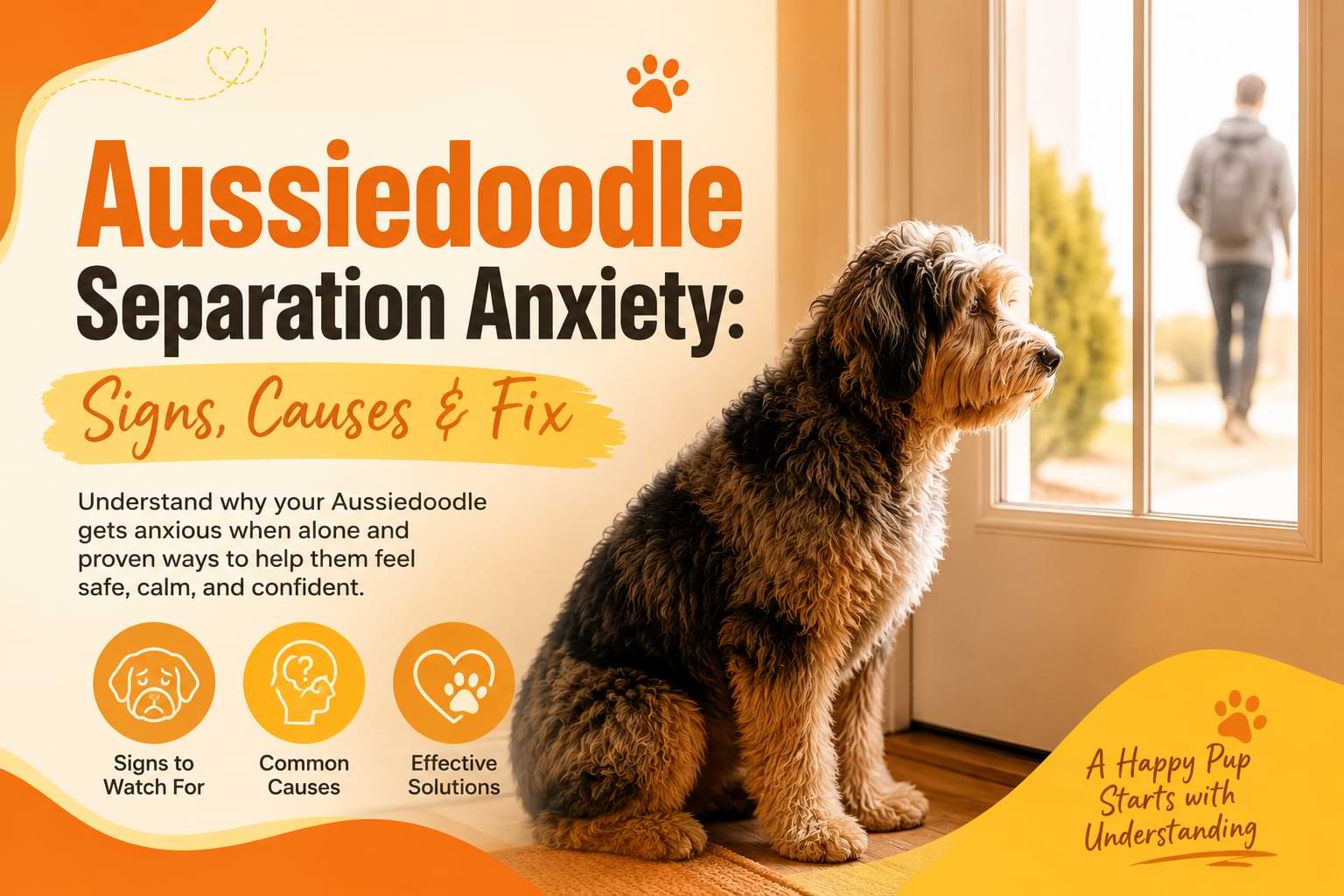
Aussiedoodles are more prone to separation anxiety than average because they’re bred from two people-focused, high-intelligence breeds — the Australian Shepherd and the Poodle. Watch for pacing, howling, destructive chewing, or house-soiling that only happens when your dog is alone. Most cases improve with departure desensitization, crate comfort training, and a gradual alone-time ladder; severe cases need a veterinary behaviorist and possibly short-term medication.
Quick Summary
- Aussiedoodles inherit high attachment drive from both parent breeds, making separation-related issues more common than in low-attachment breeds.
- Symptoms cluster into three tiers: mild (whining, pacing), moderate (destructive chewing, barking), severe (self-injury, escape attempts, panic).
- Fix starts with low-key departures/arrivals, crate comfort, and short absences built up in small increments — not a sudden 8-hour workday.
- Severe cases (self-injury, non-stop panic within seconds of your leaving) need a vet visit to rule out medical causes and discuss medication alongside training.
- Behavioral therapy and specialist trainers typically run $80–$300 per session; anti-anxiety medication runs roughly $20–$100/month.
Shortest Key Takeaway
Aussiedoodle separation anxiety is a training-and-attachment issue, not a discipline issue — punishment makes it worse, structured alone-time practice makes it better.
Why Aussiedoodles Get Separation Anxiety More Than Many Breeds?
Both parent breeds of the Aussiedoodle were bred to work with a person, not independently. The Australian Shepherd was bred to stay tuned into a handler’s movement all day on a ranch. The Poodle was bred as a retrieving companion dog, prized for reading and bonding closely with people.
Cross those two, and you get a dog engineered for constant human contact — sometimes nicknamed a “velcro dog” for how closely it shadows its owner around the house.
That attachment is also exactly what makes Aussiedoodles so trainable and emotionally in tune with their families. It’s not a flaw in the breed — it’s the flip side of the same trait that makes them such responsive companions. The problem shows up when that attachment isn’t given any practice tolerating distance, especially in the first few months at home.
Signs and Symptoms, by Severity
| Severity | What you’ll see | When it typically shows up |
|---|---|---|
| Mild | Whining, pacing, following you room to room before you leave, brief fussing right after departure that settles within 10–15 minutes | New puppies, first weeks in a new home |
| Moderate | Persistent barking or howling, destructive chewing at doors/furniture, house-soiling only when alone (not when you’re present), excessive drooling | Dogs with no alone-time practice, sudden schedule changes |
| Severe | Self-injury (broken nails, cut paws, damaged teeth from escape attempts), panic within seconds of departure, destroying door frames or window sills, refusal to eat when alone | Underlying anxiety left untreated, major life changes (move, new baby, loss of a companion) |
If your Aussiedoodle only shows these behaviors when left alone — not when you’re in another room with the door shut, and not when any human is present — that’s the clearest sign it’s genuinely separation-related rather than boredom or a house-training gap.
Separation Anxiety vs. Isolation Distress vs. Boredom
| Separation anxiety | Isolation distress | Boredom | |
|---|---|---|---|
| Trigger | Absence of one specific person | Being alone at all | Lack of mental/physical stimulation |
| Fixed by another person staying home? | Yes | No | N/A |
| Timing of symptoms | Within minutes of departure | Within minutes of being alone | Can happen any time, escalates over hours |
| Typical fix | Departure desensitization tied to that person | General alone-training, doggy daycare | More exercise, puzzle feeders, structured play |
Mixing these up is the most common mistake owners make — treating boredom-driven chewing with anti-anxiety protocols wastes months, and treating true separation anxiety with “just give him more toys” rarely moves the needle.
Puppies vs. Adult Aussiedoodles: Different Baselines?
A puppy fussing for the first few nights alone in a crate is developmentally normal — it’s not yet separation anxiety, it’s a young animal adjusting to a new environment without its littermates. What turns normal puppy adjustment into a lasting anxiety pattern is usually one of two things: never practicing short, calm absences before a full workday is expected, or reinforcing the panic by rushing back in the moment the puppy starts to cry.
Adult-onset separation anxiety looks different. It tends to follow a specific trigger — a move, a change in work schedule, the loss of another pet in the household, or a period of unusually constant togetherness (extended time off work) followed by an abrupt return to normal hours. Dogs adopted from a shelter or rehomed as adults are also more likely to show it, independent of breed.
How to Treat Separation Anxiety in an Aussiedoodle: Step-by-Step?
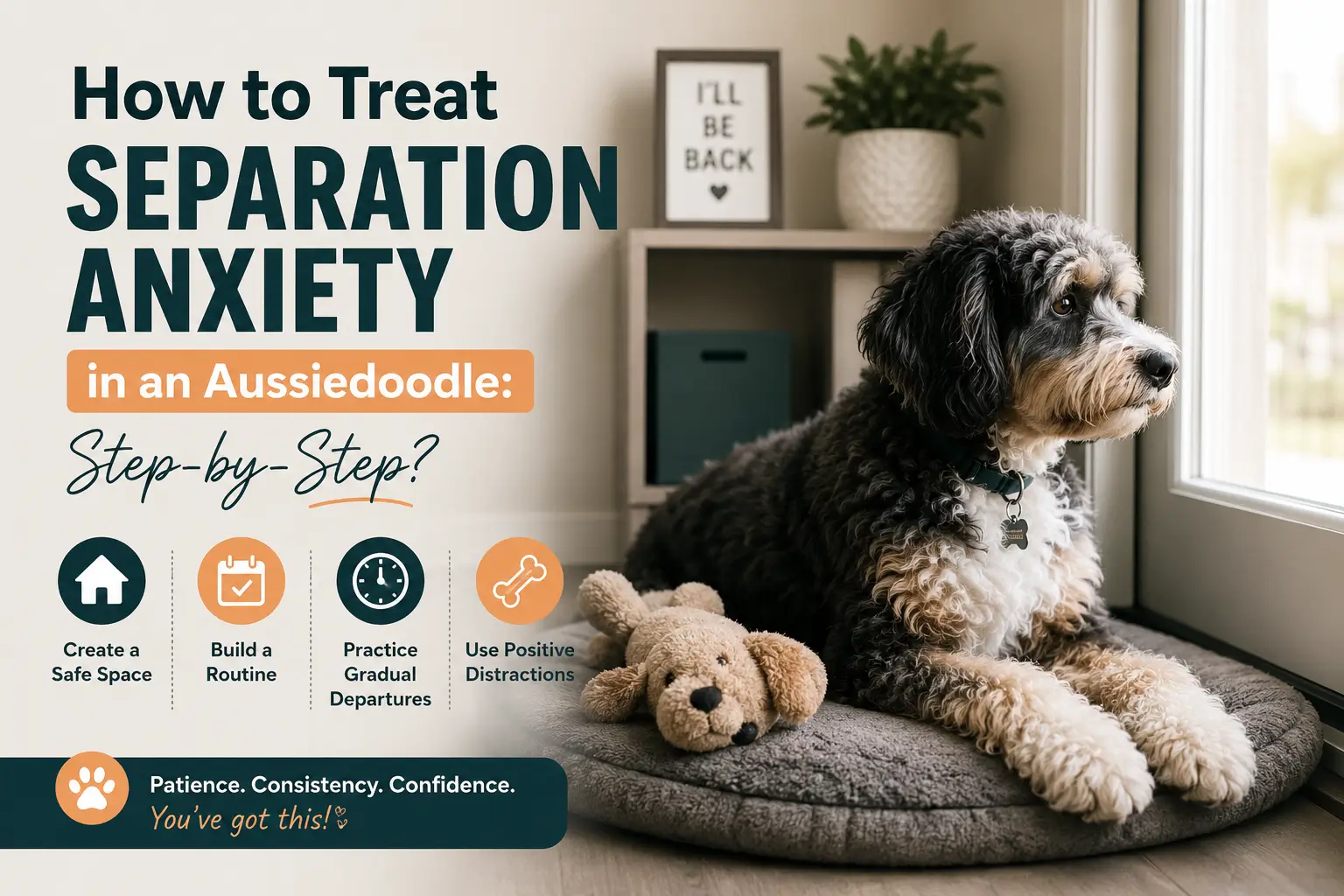
1. Make departures and arrivals boring. Skip the long goodbyes and excited hellos. Calm departures and calm greetings teach your dog that you leaving and returning isn’t a big event worth panicking over.
2. Desensitize the departure cues. Dogs learn to dread the specific sounds that predict you leaving — keys, shoes, the garage door. Practice those cues without actually leaving: pick up your keys, put on your shoes, then sit back down. Repeat several times a day until the cues stop triggering a reaction.
3. Build a positive crate or safe-space association. A crate (or a gated, dog-proofed room) should feel like a den, not a cage. Feed meals in it, add a worn piece of your clothing, and never use it as punishment.
4. Practice absences in small increments. Start with departures of 30–60 seconds, and only extend the time once your dog stays calm at the current length. This is slower than most owners expect — jumping straight to a full workday is the single most common reason training stalls.
5. Add mental and physical enrichment before you leave. A dog that’s had a real walk and a food puzzle to work on is far more likely to settle than one that’s wound up with nowhere to put that energy.
6. Track progress, don’t guess. A phone camera or pet monitor tells you what’s actually happening in the first 10 minutes after you leave — the window where most separation anxiety behavior peaks.
When to Call In a Vet or Certified Behaviorist?
Home training resolves most mild-to-moderate cases. Bring in a professional when you see:
- Self-injury (bleeding paws, broken teeth, or nails from trying to escape)
- Panic that starts within seconds, not minutes, of your leaving
- Destruction severe enough to damage door frames, drywall, or window sills
- No improvement after several weeks of consistent, correctly-paced training
- Refusal to eat or drink while alone
A veterinarian should first rule out medical causes — some house-soiling or restlessness that looks like anxiety is actually a UTI, GI issue, or age-related cognitive decline, especially in senior dogs. From there, a board-certified veterinary behaviorist or a certified separation anxiety trainer can build a structured plan, and may discuss short-acting medications (commonly trazodone or gabapentin, taken before a departure) alongside longer-term options like fluoxetine for dogs with chronic, severe cases.
Medication decisions should always go through a vet — it’s a support for training, not a replacement for it.
What This Actually Costs
- Behavioral therapy sessions: roughly $80–$300 per session, depending on whether you’re working with a general trainer or a certified separation anxiety specialist.
- Anti-anxiety medication: roughly $20–$100 per month for common prescriptions.
- Initial vet workup: typically bundled into a standard exam visit unless bloodwork is needed to rule out medical causes.
Some pet insurance plans cover behavioral treatment if it’s not a pre-existing condition at enrollment, which is worth checking before symptoms start if you’re getting a puppy already known for high attachment.
Common Mistakes That Make It Worse
- Punishing the mess or the noise. Anxiety-driven destruction isn’t defiance — punishment adds fear on top of the anxiety that caused it in the first place.
- Making a big deal out of goodbyes. This teaches your dog that departures are significant events worth reacting to.
- Jumping straight to long absences. Going from “never alone” to “gone all day” skips the exact step that builds tolerance.
- Getting a second dog to “fix” it. This helps with isolation distress but does nothing for true separation anxiety, which is tied to a specific person, not the presence of any living creature.
- Giving up after one bad week. Separation anxiety training is genuinely slow — weeks to months, not days — and a single setback doesn’t mean the plan isn’t working.
Expert Tips
- Practice absences at random times of day, not just before your usual work schedule — dogs pattern-match fast, and a routine-only practice schedule doesn’t generalize.
- If you work from home and are planning a return to office, start the alone-time ladder weeks before the schedule actually changes, not the week of.
- A worn (unwashed) t-shirt in the crate carries your scent longer than most people expect, and costs nothing.
FAQs
How do you treat separation anxiety in dogs?
Treatment combines low-key departures and arrivals, desensitizing the cues that predict you leaving (keys, shoes, the door), and building up alone time in small increments rather than jumping straight to a full day.
What breed has the worst separation anxiety?
There’s no single official “worst” breed, but velcro-type breeds bred for close human partnership — Vizslas, Labrador Retrievers, German Shepherds, and doodle mixes like Aussiedoodles and Bernedoodles — are consistently reported by trainers and vets as showing separation anxiety more often than independent, low-attachment breeds like Basenjis or Afghan Hounds.
Is it normal for puppies to have separation anxiety?
Brief fussing in the first few nights in a new home is normal puppy adjustment, not clinical separation anxiety — it’s a young animal adapting to life without its littermates.
It becomes a real concern if the distress doesn’t fade with age and practice, or if it escalates into destructive behavior, self-injury, or panic that starts the moment you’re out of sight. Early, gentle alone-time practice in puppyhood is the best prevention.
How to train a dog with separation anxiety to be alone?
Start with absences of 30–60 seconds and only extend the length once your dog stays calm at the current duration — this “alone-time ladder” is slower than most owners expect, but skipping steps is the most common reason training fails.
Pair it with a positive crate or safe-space association, calm departures and arrivals, and mental/physical enrichment beforehand so your dog is settled, not wound up, when you leave.
Is Aussiedoodle separation anxiety something to actually worry about, or do they grow out of it?
Some mild puppy fussing does fade on its own with age and normal exposure to being briefly alone. But without any alone-time practice, Aussiedoodles are more likely than average to develop lasting separation anxiety rather than outgrow it, precisely because both parent breeds were bred for constant human contact.
Treating it as a training priority in the first few months — rather than assuming it’ll resolve itself — is the difference most owners see.
How much does it cost to treat severe separation anxiety in a dog?
Behavioral therapy with a trainer or certified separation anxiety specialist typically runs $80–$300 per session, and anti-anxiety medication generally costs $20–$100 per month. Severe cases that need a veterinary behaviorist referral cost more upfront but usually resolve faster than untreated cases left to escalate, and some pet insurance plans cover behavioral treatment if it wasn’t pre-existing at enrollment.
Key Takeaways
- Aussiedoodles are prone to separation anxiety because both parent breeds were bred for close human attachment — this is a byproduct of the trait that makes them so trainable, not a flaw.
- Symptoms only happening when your dog is truly alone (not with any person present) is the clearest sign it’s separation-related.
- Treatment is a slow, incremental alone-time ladder paired with calm departures — not punishment, and not a sudden jump to full-day absences.
- Self-injury, panic within seconds, or no improvement after weeks of correctly-paced training are the signals to bring in a vet or certified behaviorist.
- Puppy fussing is often normal adjustment; the risk is letting it go unaddressed long enough to become a lasting pattern.