Quick Answer:
A Munchkin Bernedoodle is a small Bernedoodle with no official standard. Most breeders add Cavalier King Charles Spaniel (10–25 lb advertised); a few mean short legs. Confirm which before buying.
By Muhammad Rehan Iqbal, founder and editor of Aussiedoodle.net and a hands-on Aussiedoodle owner across multiple puppy-to-senior life cycles.
A Munchkin Bernedoodle is a smaller Bernedoodle (Bernese Mountain Dog × Poodle), but the name has no official standard. Most breeders add Cavalier King Charles Spaniel genetics to reach roughly 10–25 pounds; a minority use the name for short-legged dogs. Aussiedoodle.net recommends confirming the exact cross, the parents’ health tests, and the parents’ adult weights before paying a deposit.
Who this is for:
A prospective buyer comparing small doodle types before choosing a breeder, including Aussiedoodle.net readers weighing this cross against a Miniature Aussiedoodle. It covers puppy purchase through adult life and treats every type, because breeders define the name differently.
Important Notice: Please Read This First!
“Explore our ongoing project, Oval Face Shape, featuring face shape checkers, AI-powered analyzers, and practical guides on hairstyles, fashion, beauty, and personal style. Visit OvalFaceShape.com to explore the tools and guides.”
When to call a vet or emergency clinic:
Sudden back or neck pain, crying out when lifted, weak or dragging hind legs, collapse, fainting, labored breathing, or a new persistent cough. These need same-day veterinary care. Do not wait to see if they pass.
What Is a Munchkin Bernedoodle?
The name describes two different dogs, and breeders do not agree on which one the name means. The first is a downsized, proportionally built Bernedoodle created by adding Cavalier King Charles Spaniel (or Cavapoo) lines. The second is a Bernedoodle carrying a short-leg trait, a meaning that echoes the short-legged Munchkin cat.
| Cavalier-infused type | Short-legged type | |
|---|---|---|
| Typical makeup | Bernese Mountain Dog + Poodle + Cavalier King Charles Spaniel | Bernedoodle carrying a short-leg trait |
| Build | Proportional, compact | Long body, short legs |
| Breeder-advertised adult weight | About 10–25 lb | One breeder lists 20–45 lb |
| Main health question | Cavalier-line heart and spinal conditions | Disc disease linked to the short-leg gene |
No major kennel club recognizes it, so every size and health claim comes from individual breeders.
Munchkin Bernedoodle Size: How Big Do They Get Full Grown?
A full-grown Cavalier-infused Munchkin Bernedoodle is advertised at about 10–25 pounds, with most breeders targeting 15–25. The short-legged type is advertised heavier, up to 45 pounds, at roughly 9–13 inches at the shoulder. These are breeder claims; no registry or study verifies them.
Adult size depends on the Poodle size in the pedigree (Toy or Miniature), the Bernese Mountain Dog share, and the generation. Two puppies from one litter can mature several pounds apart.
Illustrative scenario (not a real dog):
A breeder lists parents at 17 and 22 pounds, and earlier puppies matured between 15 and 24 pounds. A 20-pound adult would be unsurprising; a 30-pound adult would fall outside that breeder’s own record. Ask for that history instead of a single number.
Munchkin Bernedoodle vs Mini Bernedoodle vs Mini Aussiedoodle
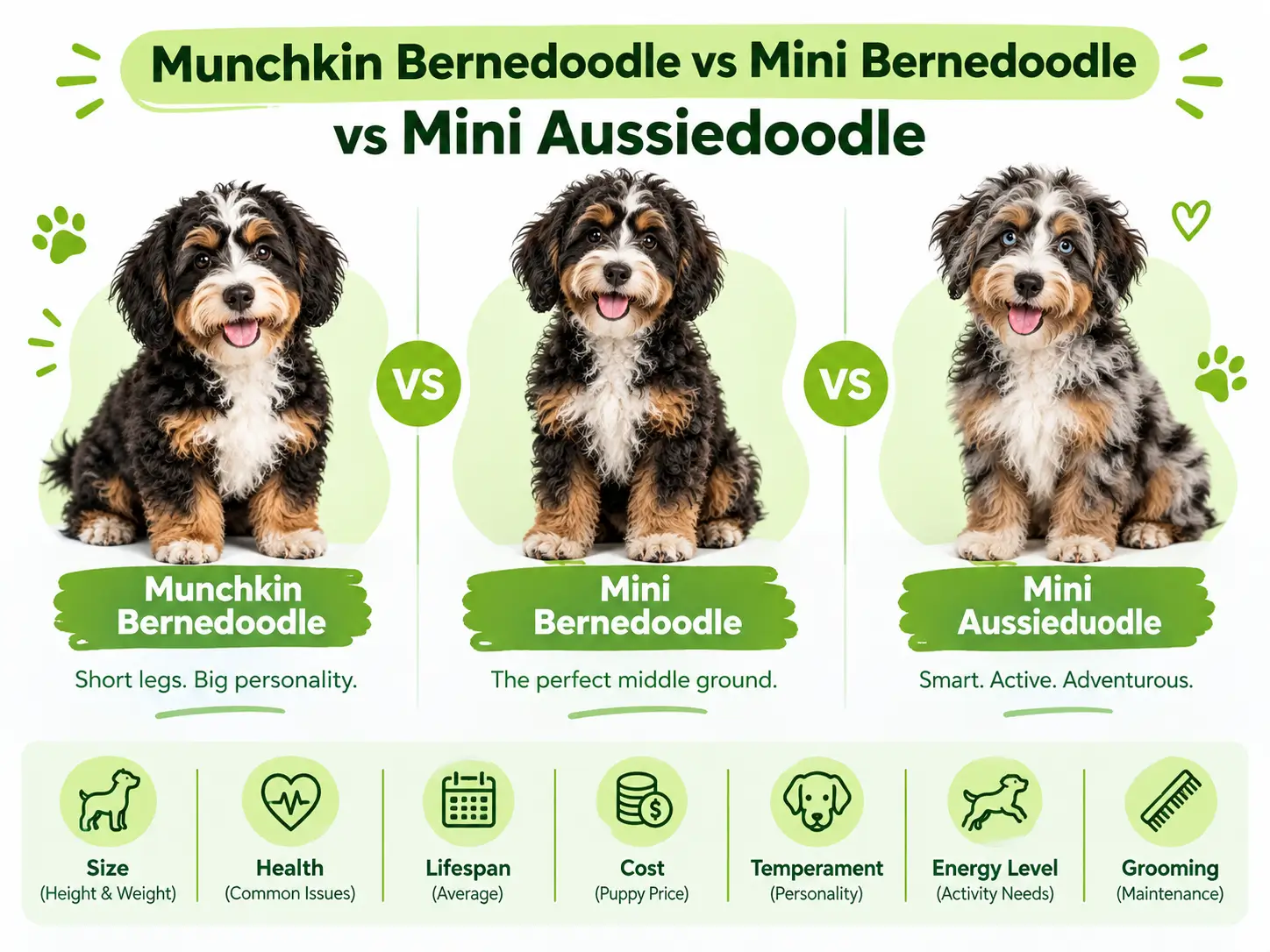
A Munchkin Bernedoodle is not simply a Mini Bernedoodle with a new label. A Mini Bernedoodle is a Bernese Mountain Dog × Miniature Poodle cross, while the Munchkin typically adds Cavalier genetics to reduce size further. In the breeder listings reviewed, Mini Bernedoodle litters were advertised heavier than Munchkin litters.
A Miniature Aussiedoodle (Australian Shepherd × Miniature Poodle) is a different cross with different health priorities. Australian Shepherd lines can carry MDR1 (ABCB1) drug sensitivity, which Aussiedoodle.net covers in its Miniature Aussiedoodle guide.
To compare expected adult size across crosses, use the Puppy Growth & Adult Size Calculator.
| Munchkin Bernedoodle (Cavalier type) | Mini Bernedoodle | Miniature Aussiedoodle | |
|---|---|---|---|
| Parent breeds | Bernese Mountain Dog, Poodle, Cavalier King Charles Spaniel | Bernese Mountain Dog, Miniature Poodle | Australian Shepherd, Miniature Poodle |
| Parent-breed health flags | Cancer (Bernese); heart and spinal (Cavalier) | Cancer (Bernese) | MDR1 sensitivity, eye conditions (Australian Shepherd) |
| Official breed standard | None | None | None |
Munchkin Bernedoodle Health Issues
No published study has measured health outcomes in these dogs. Everything below comes from the parent breeds and is labeled that way. Crossbreeding does not automatically remove inherited risk, and the effect of a smaller share of Cavalier genes has not been measured in these dogs.
For wider context, see Aussiedoodle.net’s doodle health hub.
Cancer risk from the Bernese Mountain Dog line
A Dutch population study found tumors were associated with at least 55.1% of Bernese Mountain Dog deaths, and histiocytic sarcoma, an aggressive cancer, accounted for over one in seven deaths (Veterinary Journal study on PubMed). Those figures describe purebred Bernese Mountain Dogs. How much a Bernedoodle inherits is unknown.
Heart and spinal disease from the Cavalier line
Myxomatous mitral valve disease (MMVD), a degenerative heart-valve condition, is unusually common in Cavalier King Charles Spaniels. A Swedish breeding-program study reported heart-murmur prevalence of roughly 50% at ages 6–7 (Swedish evaluation, PMC).
Syringomyelia, a fluid-filled cavity in the spinal cord, was reported at 39–46% in screened Cavalier populations, and MRI is the only reliable screening tool (Dutch and Danish MRI study, PMC). These figures describe purebred Cavaliers, not Munchkin Bernedoodles.
Back problems in the short-legged type
A short-legged type may carry the FGF4 retrogene on chromosome 12, which causes chondrodystrophy and predisposes dogs to Hansen’s type I intervertebral disc disease (IVDD). The variant acts dominantly, so one copy raises risk (PNAS, Brown et al. 2017).
A separate chromosome-18 variant shortens legs with a smaller effect on discs in single-copy dogs. Genetic testing, such as the UC Davis Veterinary Genetics Laboratory CDDY/CDPA test, shows which variants a given dog carries.
Joints and eyes
Hip and elbow screening through the Orthopedic Foundation for Animals (OFA) is standard practice for Bernese Mountain Dog lines. Ask for OFA results for both parents and a current eye examination.
Health & Safety Note:
This article is educational and is not veterinary advice. It does not diagnose or treat any dog. Consult a licensed veterinarian about any individual dog, and ask a vet to review the parents’ test results before you buy a puppy.
Munchkin Bernedoodle Life Expectancy
No published lifespan study exists for the Munchkin Bernedoodle, so any single figure is an estimate. The firmest anchor is a parent breed: the Dutch study above found a median age at death of 8.0 years in Bernese Mountain Dogs, about 3.2 years earlier than the average British dog. Cavalier-line heart disease is a further unknown.
Treat a breeder-quoted lifespan as unverified unless it names a study. For how crossbreed lifespan data is gathered and where it falls short.
See Aussiedoodle.net’s lifespan guide to get more details in deep.
Price: What the Cost Should Include
Breeders in the listings reviewed advertise Munchkin puppies at about $4,500–$10,000 or more, depending on the breeder, region, and size. That range comes from breeder advertising, not independent sales data.
Price is not evidence of health testing. A puppy at the top of that range should come with the parents’ test results, a written health guarantee, and a contract stating the return policy. If a breeder cannot show them, the price is paying for the name.
Buying Checklist: What to Ask a Breeder
Searches for “munchkin bernedoodle for sale” and “munchkin bernedoodle breeders” show buying intent. This guide does not rank breeders, because Aussiedoodle.net has not verified any breeder’s records. Use this checklist instead:
- Cross in writing: parent breeds, generation, and which meaning of “Munchkin” applies.
- Heart: a current cardiology exam for any Cavalier or Cavapoo parent.
- Spine: MRI-based syringomyelia results for Cavalier parents, where offered.
- Hips, elbows, eyes: OFA results for Bernese-line parents, checked in OFA’s public database.
- Short-legged type: CDDY/CDPA genetic results for both parents.
- Weights: adult weights of both parents and previous litters.
- Guarantee: a written health guarantee and return policy.
- Red flags: pressure to pay a deposit before showing records, “hypoallergenic” or “guaranteed non-shedding” promises, no parent paperwork, vague answers about Cavalier ancestry.
Coat, Shedding and Grooming
Bernedoodle coats in Munchkin litters vary by generation and individual, from straight to wavy to curly, and shedding cannot be promised from the cross alone.
Ask to see coat photos of both parents and of earlier puppies as adults. Wavy and curly coats need regular brushing to prevent matting; the schedule depends on the individual coat.
Is This Dog Right for You?
Munchkin breeders consistently describe affectionate, people-oriented dogs, but no temperament study exists for the cross. Exercise needs are usually described as moderate; one breeder lists 30–40 minutes a day, and individual dogs vary.
This dog may suit you if you:
- want a compact doodle and will pay for verified health testing;
- can accept uncertain lifespan and adult weight;
- will brush a wavy or curly coat regularly.
It may not suit you if you:
- need a predictable adult weight or the lowest long-term medical risk;
- are buying on price alone or without seeing parent test records.
Key Takeaways
- The name has no official standard; breeders mean either a Cavalier-infused small Bernedoodle or a short-legged one.
- Advertised adult weight for the Cavalier type is about 10–25 lb; no registry verifies it.
- No health or lifespan study exists for the cross; risks are inferred from Bernese Mountain Dog, Cavalier, and (for short legs) FGF4 research.
- Price, about $4,500–$10,000 or more, does not prove health testing.
- Get heart, spine, hip, elbow, eye, and (if short-legged) CDDY/CDPA results in writing.
Still choosing between breeds? Compare the two crosses side by side in Aussiedoodle vs Bernedoodle.
FAQs
Are munchkin bernedoodles hypoallergenic?
No dog breed or cross can be called hypoallergenic, and that includes this cross. A 2012 study of dog allergen levels in hair and homes (Vredegoor et al., Journal of Allergy and Clinical Immunology) found no evidence to describe any breed as hypoallergenic. Allergen output varies by individual dog, so spend time with the specific puppy’s parents before committing.
Aussiedoodle.net explains the evidence in its hypoallergenic guide.
Are Munchkin Bernedoodles short-legged?
Not necessarily. Some breeders use the name for a short-legged Bernedoodle, while others use it for a proportionally built small dog created with Cavalier King Charles Spaniel lines. Ask the breeder in writing which type the puppy is, because the health questions differ.
What is the difference between a Munchkin and a Mini Bernedoodle?
A Mini Bernedoodle is a Bernese Mountain Dog and Miniature Poodle cross. The Munchkin version usually adds Cavalier King Charles Spaniel genetics to go smaller, and in listings reviewed it was advertised lighter than Mini litters. Neither has an official breed standard.
Is a Munchkin Bernedoodle worth the price?
It depends on what the price includes. Breeder prices of about $4,500–$10,000 or more are worth paying only when backed by parent health-test records, a written guarantee, and adult-weight history. Without those, the price does not reduce the risks described above.
Are Munchkin Bernedoodles good for apartments and first-time owners?
Their advertised small size can suit apartments, and breeders describe friendly temperaments. No behavior study exists for the cross, so judge by the individual parents and the breeder’s records. First-time owners should budget for coat care and possible veterinary screening.
How can I tell if a breeder’s “health tested” claim is real?
Ask for the actual result documents, with registration numbers, for each parent. OFA results are searchable in OFA’s public database, and a breeder who deflects or offers only a general statement has not answered the question. Having your own veterinarian review the paperwork is the safest check.