Quick Answer:
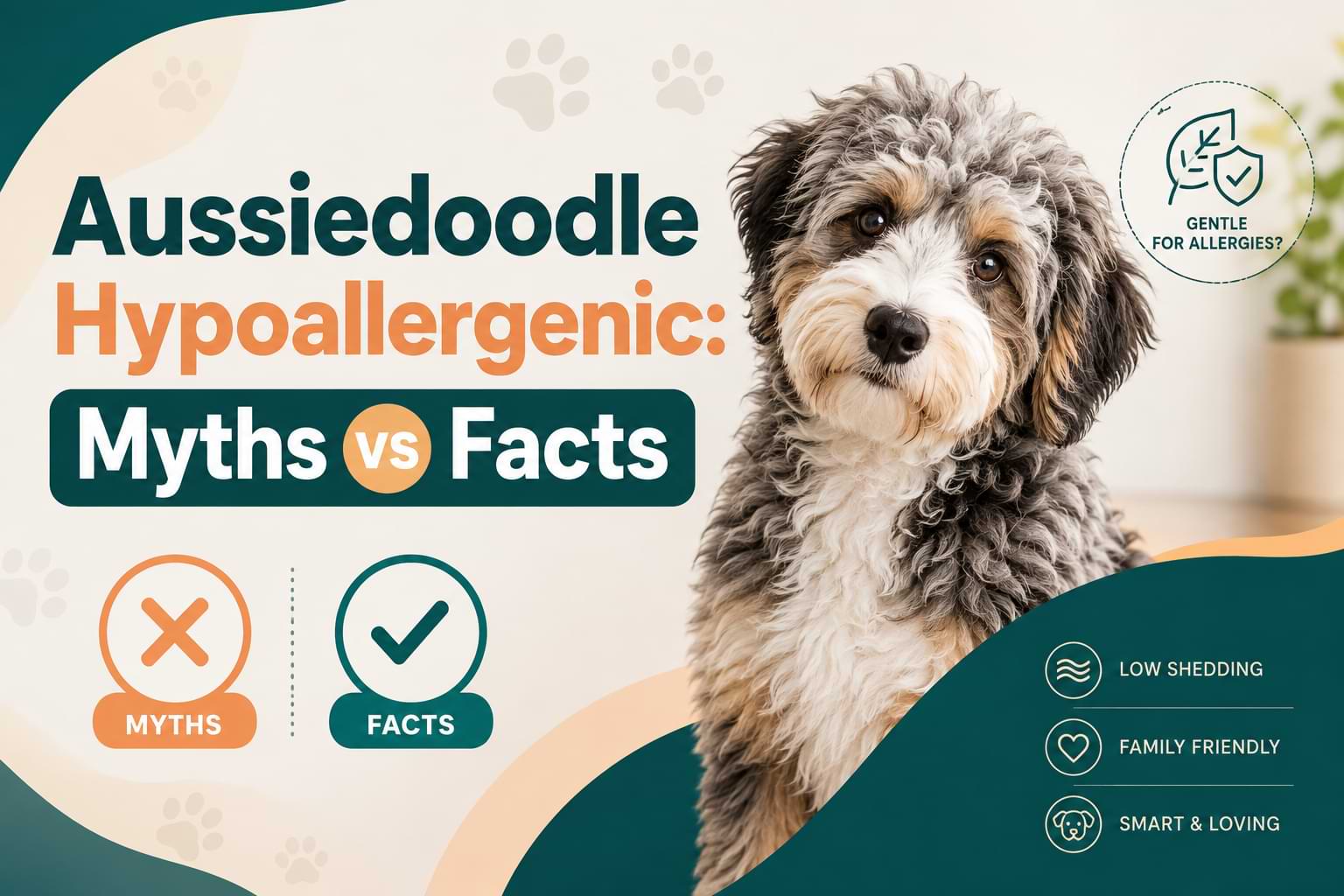
No dog is truly 100% hypoallergenic, including the Aussiedoodle — but Aussiedoodles that inherit a curly, Poodle-type coat shed far less loose hair and spread less dander around a home than an Australian Shepherd or most non-Poodle breeds, which is why many allergy sufferers tolerate them better. The effect depends on generation: F1B, F2, and multigen Aussiedoodles (bred back toward the Poodle) carry more Poodle coat genes and are typically the better choice for allergy-sensitive households than a straight F1 cross.
This guide is for people with mild-to-moderate pet allergies weighing an Aussiedoodle, and current owners figuring out why symptoms persist.
An Aussiedoodle is a crossbred dog from an Australian Shepherd and a Poodle, prized for the Poodle’s low-shed coat and the Aussie’s trainability. If you’re reading this because you or a family member sneezes around dogs and you’re eyeing one anyway, here’s the direct answer, then the reasoning behind it.
The Direct Answer!
Nobody is allergic to dog hair itself. The actual trigger is Can f 1, a protein carried in a dog’s saliva, skin cells (dander), and urine — not the fur. A dog’s coat type changes how much of that protein circulates through your home, not whether the dog produces it. That distinction is the whole story behind “hypoallergenic” dog marketing, and it’s why no breed, doodle or otherwise, can honestly claim to be allergen-free.
Poodles carry a curly, single-layer coat that traps shed hair (and the dander riding on it) instead of releasing it into the air and onto furniture. Australian Shepherds have a double coat that sheds seasonally and steadily. An Aussiedoodle sits somewhere between the two, and exactly where depends on which parent’s coat genes it inherits — which is a matter of breeding generation, not a guarantee that comes with the name.
Why Generation Matters More Than the Word “Aussiedoodle”?
| Generation | Poodle genetics | Typical coat | Allergy-friendliness |
|---|---|---|---|
| F1 (Aussie x Poodle) | 50% | Wavy to loosely curled; some litters shed noticeably | Variable — least predictable |
| F1B (F1 x Poodle) | 75% | Curlier, denser, closer to Poodle | Better for most allergy sufferers |
| F2 (F1 x F1) | 50%, remixed | Wide range within one litter | Variable, same as F1 |
| Multigen (F3+, bred back to Poodle multiple times) | 85–95%+ | Consistently curly, Poodle-type | Most allergy-friendly |
A reputable breeder can tell you the generation and, often, the specific coat type a puppy is trending toward by a few weeks old. If allergies are the deciding factor, ask for that generation label before anything else — “Aussiedoodle” alone doesn’t tell you enough.
What the Research Says about Aussiedoodle?
Up to 10% of the general population and roughly 40% of people already diagnosed with allergies react to dog or cat dander, according to National Jewish Health, a leading U.S. respiratory and allergy research hospital. A 2012 study in the Journal of Allergy and Clinical Immunology measured Can f 1 levels across dog breeds — including those marketed as hypoallergenic — and found no breed produced zero allergen; some “hypoallergenic” breeds still measured comparable levels to non-hypoallergenic ones, depending on the individual dog. The practical takeaway for Aussiedoodle owners: coat type reduces airborne dander load, but it doesn’t eliminate the allergen at its source.
Real example:
One Aussiedoodle breeder in Canton, NC, who has raised Mini Aussiedoodles for over a decade, reports that F1 litters placed with mildly allergic families have gone years without a returned puppy over allergy complaints — but she still recommends F1B or spending time with an adult dog first if a family’s allergies are more than mild. That’s a pattern worth trusting over a blanket “yes, hypoallergenic” claim: it holds for mild allergies, and it isn’t a guarantee for severe ones.
Aussiedoodle vs. Other Low-Shed Breeds
| Breed | Coat type | Shedding | Allergy-friendliness |
|---|---|---|---|
| Aussiedoodle (F1B/multigen) | Curly, Poodle-leaning | Low | Good for mild-moderate allergies |
| Standard Poodle | Curly, single coat | Very low | Best-in-class among common breeds |
| Labradoodle (multigen) | Curly to wavy | Low | Similar to Aussiedoodle |
| Australian Shepherd (purebred) | Double coat | Moderate-heavy, seasonal | Poor for allergy sufferers |
| Bernedoodle (F1) | Wavy, variable | Low-moderate | Variable, same F1 caveat applies |
If minimizing allergens is the top priority over temperament or size, a Standard Poodle remains the most consistent choice — but for families who specifically want the Australian Shepherd’s herding intelligence and drive alongside a lower-shed coat, a multigen or F1B Aussiedoodle is the closer trade-off.
Key Takeaways
- No dog, including any Aussiedoodle generation, is 100% hypoallergenic — the allergen (Can f 1) comes from skin, saliva, and urine, not hair.
- F1B and multigen Aussiedoodles carry more Poodle coat genes and are typically the better pick for allergy-sensitive households; F1 and F2 are less predictable.
- Up to 40% of people with diagnosed allergies react to dog or cat dander (National Jewish Health) — spending time with an adult dog before committing is the most reliable test for any one individual.
- Grooming routine (regular brushing, monthly bathing) reduces loose dander in the home regardless of generation.
FAQs
Do Aussiedoodles shed?
Yes, but less than most non-Poodle breeds. F1B and multigen Aussiedoodles with curly, Poodle-type coats shed minimally, catching loose hair in the curl instead of releasing it. F1 and F2 Aussiedoodles are less predictable and can shed moderately if they favor their Australian Shepherd parent’s coat.
What is the most allergy-friendly dog?
Among common breeds, the Standard Poodle is generally considered the most consistently allergy-friendly, since every Poodle carries a curly, low-shed coat rather than the mixed inheritance a crossbreed carries. Among doodles specifically, multigen and F1B crosses (Aussiedoodle, Labradoodle, Goldendoodle) come closest, because repeated breeding back to a Poodle raises the odds of a Poodle-type coat.
What’s the calmest doodle breed?
Bernedoodles and Sheepadoodles are typically described as the calmer, lower-energy doodle crosses, thanks to the more laid-back temperaments of the Bernese Mountain Dog and Old English Sheepdog parent breeds. Aussiedoodles, by contrast, inherit the Australian Shepherd’s high drive and need real daily exercise — a calm coat doesn’t come with a calm temperament in this breed.
What is the downside to Aussiedoodles?
The main downsides are high exercise and mental-stimulation needs (inherited from the Australian Shepherd), regular grooming to maintain the low-shed coat (brushing several times a week, professional grooming every 6–8 weeks), a strong herding instinct that can mean nipping at heels or kids without early training, and unpredictable coat/allergy outcomes in F1 and F2 generations.
Do Aussiedoodles bark a lot?
They can, particularly without enough exercise or mental stimulation — Aussiedoodles inherit the Australian Shepherd’s alertness and tendency to vocalize at movement, strangers, or boredom. Consistent training and daily physical/mental outlets typically keep barking manageable; an under-exercised Aussiedoodle is far more likely to bark excessively.
Is an Aussiedoodle still a good choice for allergies in 2026?
Yes, with the same caveat that’s always applied: choose an F1B or multigen puppy, ask the breeder about the litter’s coat trend, and spend time with an adult dog beforehand if allergies are more than mild. Nothing about the underlying allergen science has changed — the “hypoallergenic” label is still a matter of degree, not a guarantee.
Can an Aussiedoodle trigger allergies even with a curly coat?
Yes. Because the Can f 1 allergen comes from saliva and skin, not the hair itself, even a low-shedding Aussiedoodle produces some allergen — it’s simply less airborne than in a heavy-shedding breed. Owners with severe allergies (not just mild sensitivity) should treat a “hypoallergenic” claim as a reduced-risk factor, not a solved problem.