Introduction
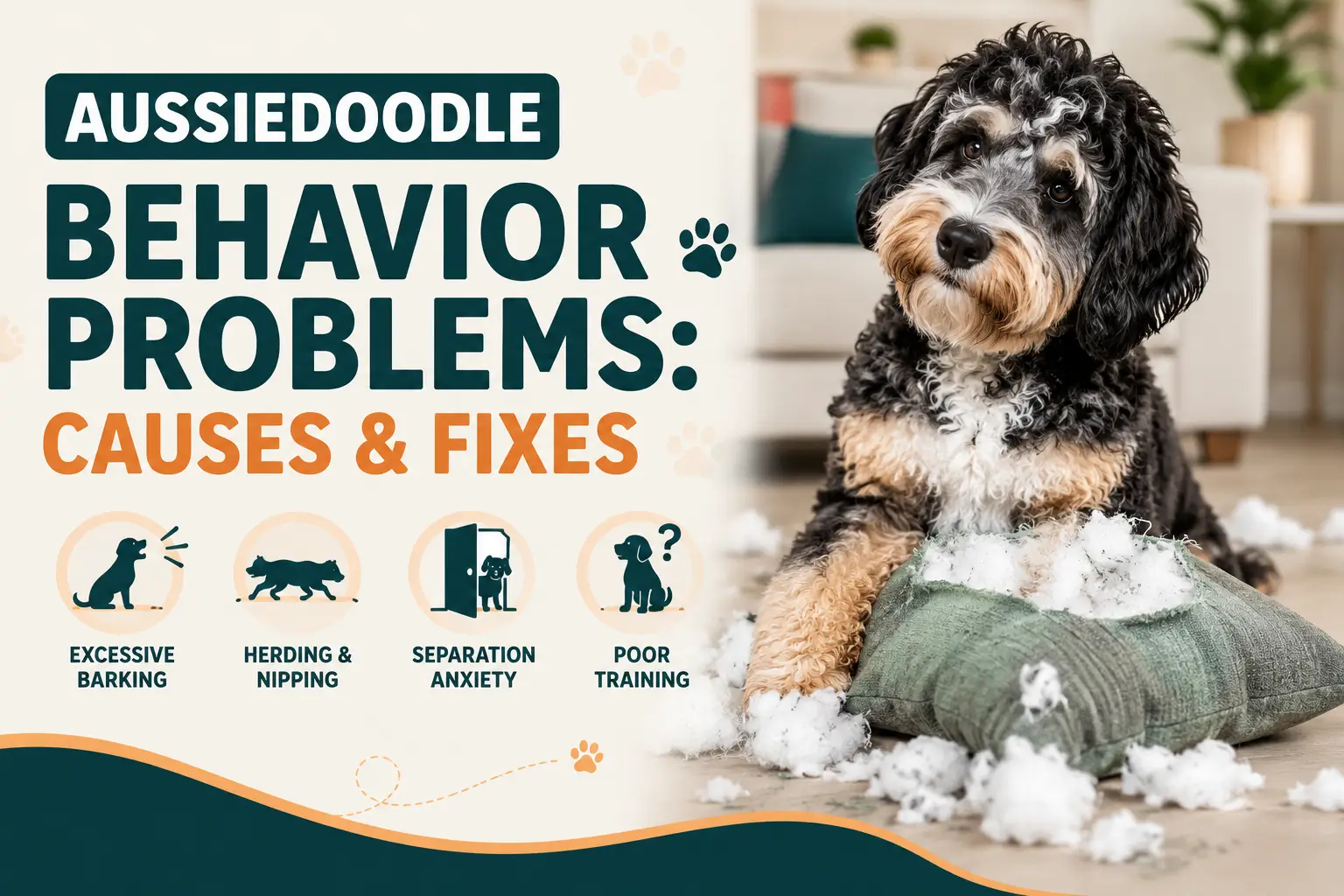
Most Aussiedoodle behavior problems trace back to one of four causes: not enough mental or physical stimulation, an unfinished socialization window, herding instinct with no legal outlet, or a genuinely anxious temperament that needs more than exercise to fix. The behavior itself — barking, nipping, chewing, panicking when you leave — is rarely the real problem. It’s the symptom. Fix the cause, and most of these resolve within weeks, not months.
That’s the short version. Here’s the long version, broken down by the specific problem you’re actually dealing with.
Quick Diagnostic: Match the Behavior to the Cause
| Behavior you’re seeing | Most likely cause | First fix to try |
|---|---|---|
| Barking, howling, destruction only when alone | Separation anxiety | Short, low-drama practice separations; no dramatic goodbyes |
| Nipping at heels, kids, or moving objects | Herding instinct | Redirect to a flirt pole or ball; teach “leave it” |
| Chewing furniture, digging, shredding | Under-exercise or under-stimulation | Increase daily physical exercise plus 10–15 minutes of puzzle-toy or scent work |
| Lunging, barking at other dogs on leash | Leash reactivity | Increase distance from trigger, reward calm behavior, avoid flooding |
| Growling or snapping over food or toys | Resource guarding | Trade-up training; never punish the growl itself |
| Jumping on counters, bolting through doors | Impulse control gap, common in adolescence | Structured “wait” and “place” training at every doorway and counter |
| Sudden new fearfulness or aggression | Possible medical cause or under-socialization | Rule out pain/thyroid with a vet before assuming it’s “just behavior” |
The Real Reason Aussiedoodles Develop Behavior Problems

An Aussiedoodle is a cross of two working breeds — the Australian Shepherd, bred to herd livestock for hours a day, and the Poodle, bred as a retrieving gun dog with notably high trainability and sensitivity. Neither parent breed was designed to lie around.
When that combined drive doesn’t get an outlet, it doesn’t disappear. It comes out sideways, as barking, chewing, herding the kids, or pacing.
Add in a short and easy-to-miss socialization window — roughly 8 to 16 weeks of age — and you get the second major driver of Aussiedoodle behavior problems.
Puppies that weren’t calmly exposed to a wide range of people, sounds, surfaces, and other dogs during that window are more likely to develop fear-based reactivity and anxiety later, regardless of how well-bred or naturally stable the parents were.
A third factor is inconsistency. Aussiedoodles are quick learners from both parent lines, which cuts both ways — they pick up good habits fast, and bad ones just as fast. Mixed signals from different family members, or training that’s enthusiastic for a week and then dropped, tend to produce a dog that tests boundaries rather than one that settles.
Separation Anxiety
Separation anxiety is the single most commonly reported Aussiedoodle behavior problem, and it shows up as barking, howling, pacing, destructive chewing near doors and windows, or house-training regression — but only when the dog is alone. If the same behavior happens with you in the room, it isn’t separation anxiety; it’s something else on this list.
Why it happens:
Aussiedoodles form strong attachments to their people, a trait inherited from both parent breeds. Puppies that go straight from constant company to being left alone for full workdays, without any practice in between, are the ones most likely to develop it. It also tends to spike after a life change — a move, a new job, a household member leaving.
What actually fixes it, not just manages it:
- Practice separations before you need to, starting with a few minutes and building gradually — the mistake most owners make is only starting once they’re already leaving for eight hours.
- Keep departures and returns boring. No big goodbye, no excited greeting. Emotional highs on either end teach the dog that your leaving is a big event worth being anxious about.
- Give the dog something to do in the first ten minutes alone — a stuffed food toy or long-lasting chew — since that’s usually the highest-anxiety window.
- Use a crate or a defined safe space, introduced positively well before it’s needed for real absences.
- If the anxiety is severe — self-injury, non-stop vocalizing, panic at the sight of keys or shoes — this has moved past a training issue and needs a veterinary behaviorist, sometimes alongside short-term medication support.
Herding, Nipping, and Heel-Biting
Nipping at ankles, circling family members, or trying to “gather” kids during play is instinctive herding behavior, not aggression. It’s most common with children, since fast, unpredictable movement is exactly what triggers a herding response.
It’s manageable, but it isn’t something to ignore — an unredirected herding habit around small children can escalate into real nipping. Interrupt the behavior with a calm “leave it” or “down,” then immediately give the dog a legal outlet: a ball to chase, a flirt pole, or a structured game.
Consistency matters more than intensity here — a dog that gets away with it half the time will keep testing it.
Excessive Barking
Barking in Aussiedoodles is almost always communication, not defiance: alerting to something at the door, demanding attention, or venting pent-up energy. The fix depends on which one it is. Alert barking responds well to a “thank you, that’s enough” cue paired with redirection.
Boredom barking responds to more exercise and mental work, not more corrections. Attention-seeking barking gets worse if you respond to it and improves when you reward quiet instead.
Chewing, Digging, and Destructive Behavior
This is rarely spite, and it’s almost never random — it’s nearly always a math problem: more energy in than is going out. An Aussiedoodle that isn’t getting enough physical exercise and mental stimulation will create its own projects, and those projects are usually your couch, your baseboards, or your yard.
The fix is arithmetic, not punishment: increase daily exercise, add 10–15 minutes of dedicated mental work (puzzle feeders, scent games, short training sessions), and puppy-proof anything irreplaceable in the meantime.
If destructive behavior is isolated to when the dog is left alone, revisit the separation anxiety section instead — it’s a different problem with the same symptom.
Leash Reactivity
Lunging, barking, or stiffening at other dogs on leash usually comes from a combination of movement sensitivity (inherited from the herding side) and frustration at being physically restrained from investigating or controlling what it sees. It’s rarely true aggression.
Increase distance from the trigger until your dog can stay calm, reward that calm state, and close the distance gradually over repeated sessions. Avoid “flooding” — forcing close proximity to a trigger in hopes the dog will just get used to it — since this reliably makes reactivity worse, not better.
Resource Guarding and Possessiveness
Growling, stiffening, or snapping over food, toys, or a favorite spot is resource guarding, and it’s a socialization and management issue far more often than a dominance issue. It tends to show up when a puppy wasn’t taught early that hands near their food or toys mean something good is coming, not that something is about to be taken.
Never punish a growl — it’s the dog’s warning system, and removing the warning without removing the underlying insecurity just produces a dog that bites without warning next time. Instead, use trade-up training: approach, offer something better than what the dog has, and only then take the original item, so the dog learns your approach predicts a good outcome.
For established resource guarding around multiple triggers, or any guarding involving a bite, a certified trainer or veterinary behaviorist should be involved rather than handling it solo.
Counter-Surfing and Door-Dashing
Both come down to the same root cause: an impulse-control gap, and both spike hard during adolescence. Structured “wait” cues at every doorway and consistent counter management (nothing left within reach, redirected to a mat or “place” command during food prep) close the gap faster than reactive correction after the fact.
Adolescence: Why Everything Gets Worse Around 6–18 Months?
If your easy, biddable puppy suddenly seems to have forgotten every command around six months old, that’s developmental, not regression. Canine adolescence brings real brain remodeling around impulse control and decision-making, and it commonly shows up as increased reactivity, selective “deafness” to known cues, and a temporary spike in exactly the behaviors covered above.
This is also when separation anxiety, resource guarding, and reactivity most often first appear, even in dogs that seemed rock-solid as young puppies.
The dogs that come out the other side well-adjusted are the ones whose owners keep training consistent through this phase instead of assuming the dog “already knows this.” Expect this stretch to be harder than early puppyhood, and plan for it rather than being blindsided by it.
When It’s Not “Just Behavior”: Medical and Vet-Behaviorist Red Flags
Rule out a medical cause before assuming any sudden behavior change is purely psychological. See a veterinarian first if you notice:
- Sudden aggression or fearfulness with no clear behavioral trigger, especially in a dog with a previously stable temperament
- New sensitivity to touch, which can indicate pain (joint, dental, or otherwise)
- Behavior change alongside weight change, lethargy, or coat changes — sometimes linked to thyroid function
- Any behavior severe enough to involve self-injury, a bite, or a level of distress that isn’t improving with consistent training over several weeks
A veterinary behaviorist — a vet with additional board certification in behavior — can assess whether medication support alongside training is appropriate. This isn’t a last resort or a sign of failure; for genuinely anxious individual dogs, it’s often the fastest path back to a manageable, comfortable life for both dog and owner.
Prevention: What Actually Works Long-Term
Across every issue above, the same pattern holds: a physically tired, mentally engaged Aussiedoodle with consistent, positive-reinforcement-based training rarely develops serious behavior problems. The same dog, under-exercised and under-stimulated, is a genuinely difficult pet to live with — not because the breed is flawed, but because its needs weren’t met.
Front-loading socialization in the 8–16 week window, practicing alone-time before it’s needed, and staying consistent through adolescence prevent the large majority of what’s covered in this article.
For day-to-day energy and stimulation needs by life stage, see our Aussiedoodle lifestyle guide. If a behavior change coincides with anything physical, our Aussiedoodle health guide covers the medical conditions most likely to present as behavior change.
And if you’re still choosing a puppy, temperament is shaped by breeding as much as raising — our breed overview covers what to look for in parent-dog temperament testing.
FAQs
Are Aussiedoodles generally an aggressive breed?
No. True aggression is uncommon in Aussiedoodles and, when it appears, is usually traceable to fear, pain, poor early socialization, or unaddressed resource guarding rather than an aggressive temperament. Reputable breeders temperament-test parent dogs specifically to screen against it.
Are Aussiedoodle behavior problems still common with modern, well-bred lines in 2026?
Yes, and it isn’t a sign of bad breeding on its own — even well-bred, temperament-tested Aussiedoodles from stable lines can develop separation anxiety, reactivity, or destructive habits if their exercise, socialization, and mental-stimulation needs aren’t met. Genetics sets the baseline; upbringing determines the outcome.
Aussiedoodle vs. Australian Shepherd: which has more behavior problems?
Purebred Australian Shepherds typically have a stronger, less diluted herding drive and higher baseline energy than most Aussiedoodles, which can make herding-related nipping and reactivity more pronounced. The Poodle side in an Aussiedoodle often (not always) softens intensity slightly, but doesn’t remove the need for the same exercise and socialization work.
How much does it cost to fix serious Aussiedoodle behavior problems?
Group or private obedience classes typically run in the range of a few hundred dollars for a multi-week course; a private consultation with a certified behaviorist runs higher, often several hundred dollars for an initial assessment, with follow-ups afterward.
Costs vary significantly by region and severity, but early intervention is consistently cheaper than addressing an entrenched problem later.
My Aussiedoodle was fine until about a year old and now seems anxious out of nowhere — is that normal?
This is a very common pattern and lines up with the developmental window (roughly 1–3 years) when clinically recognizable anxiety tends to first emerge, often triggered by a life change like a new job, move, or household change. It’s worth a vet check to rule out a medical cause first, then addressing it with consistent desensitization work.
Can Aussiedoodles be left alone during a normal workday?
Yes, most can, but it takes preparation rather than assumption. Dogs that practiced short separations from puppyhood, have a comfortable crate or safe space, and get adequate exercise before a long absence generally do fine.
Dogs pushed straight into full-day absences with no practice are the ones most likely to develop separation anxiety.
Conclusion
Aussiedoodle behavior problems almost always have an identifiable cause, and once you know what’s actually driving the barking, the nipping, or the panic at the door, the fix is usually more straightforward than it feels in the moment.
The breed isn’t difficult by nature — it’s demanding in specific, predictable ways, and meeting those demands consistently resolves the large majority of what shows up on this list.