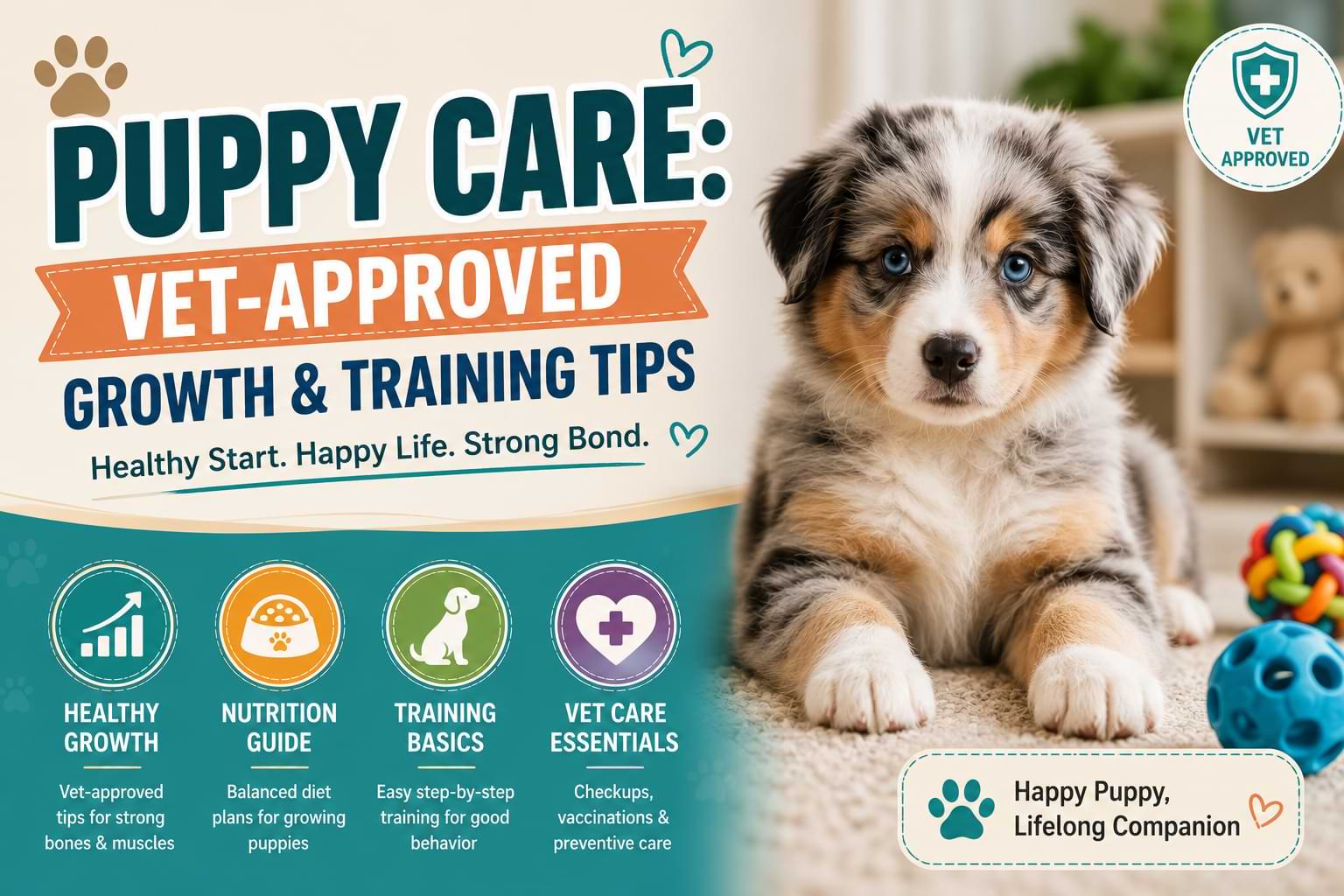
Quick Answer:
Aussiedoodle puppy care centers on four things done on schedule: 3–4 small AAFCO-approved puppy meals a day until 12 months, core vaccines (DHPP, leptospirosis, rabies) starting at 6–8 weeks and finishing around 16 weeks per AAHA guidelines, safe socialization starting 7–8 days after the first vaccine set (per AVSAB), and short, frequent exercise rather than long runs while joints are still developing.
This Guide For:
This guide is for first-time and soon-to-be Aussiedoodle owners planning the first 12–16 weeks at home. Get these four routines right early and most common first-year problems — bloat risk, fear-based behavior issues, and joint strain — become far less likely.
An Aussiedoodle is a cross between a Poodle and an Australian Shepherd, bred for a low-shedding coat and high trainability. Raising one well in the first year comes down to four overlapping routines: feeding, veterinary care, socialization, and exercise.
Get the sequencing wrong — free-feeding an 8-week-old, skipping the vaccine-to-socialization window, or over-exercising a growing joint — and you’re solving avoidable problems at six months instead of preventing them at eight weeks.
Feeding Schedule by Age
Aussiedoodle puppies need more frequent, smaller meals than adults because their stomachs are small and their energy needs — relative to body weight — are higher.
PetMD recommends feeding puppies an AAFCO-approved puppy-specific formula (AAFCO sets the nutrient standards most US commercial pet foods are formulated to meet) until roughly 12 months old, then transitioning to an adult formula.
| Age | Meals per day | Notes |
|---|---|---|
| 8–12 weeks | 3–4 | Free access to water; avoid gulping — use a slow-feeder bowl if your puppy inhales food |
| 3–6 months | 3 | Watch body condition, not just the bag’s suggested amount |
| 6–12 months | 2 | Transition toward adult portions as growth slows |
| 12 months+ | 2 | Switch to adult formula once growth plates have closed |
Why this matters beyond convenience:
Aussiedoodles can inherit bloat (GDV) risk from their Poodle side. Feeding smaller, more frequent meals and avoiding hard exercise right after eating is a standard precaution vets recommend for deep-chested and Poodle-lineage breeds — not a myth, a routine risk-reduction habit.
Vaccination & Vet Schedule
The American Animal Hospital Association (AAHA), the body whose 2022 guidelines (updated 2024) most US vet clinics follow, sets the standard puppy core-vaccine timeline: the combination DHPP (distemper, adenovirus, parvovirus, parainfluenza) shot starting at 6–8 weeks and repeated every 3–4 weeks until at least 16 weeks; leptospirosis as two doses starting no earlier than 12 weeks; and a single rabies dose between 12–16 weeks, timed to state law.
| Age | Vet task |
|---|---|
| 6–8 weeks | First DHPP dose, deworming, weight/health check |
| 10–12 weeks | DHPP booster, start leptospirosis series |
| 12–16 weeks | Final DHPP dose, rabies vaccine, leptospirosis booster |
| ~1 year | Booster round, then most core vaccines shift to a roughly 3-year cycle |
Skipping the 16-week (or later) dose is the single most common vaccination mistake — maternal antibodies can block earlier doses at an unpredictable age, so the final dose is the one that actually confirms immunity.
Socialization: The Window That Doesn’t Come Back
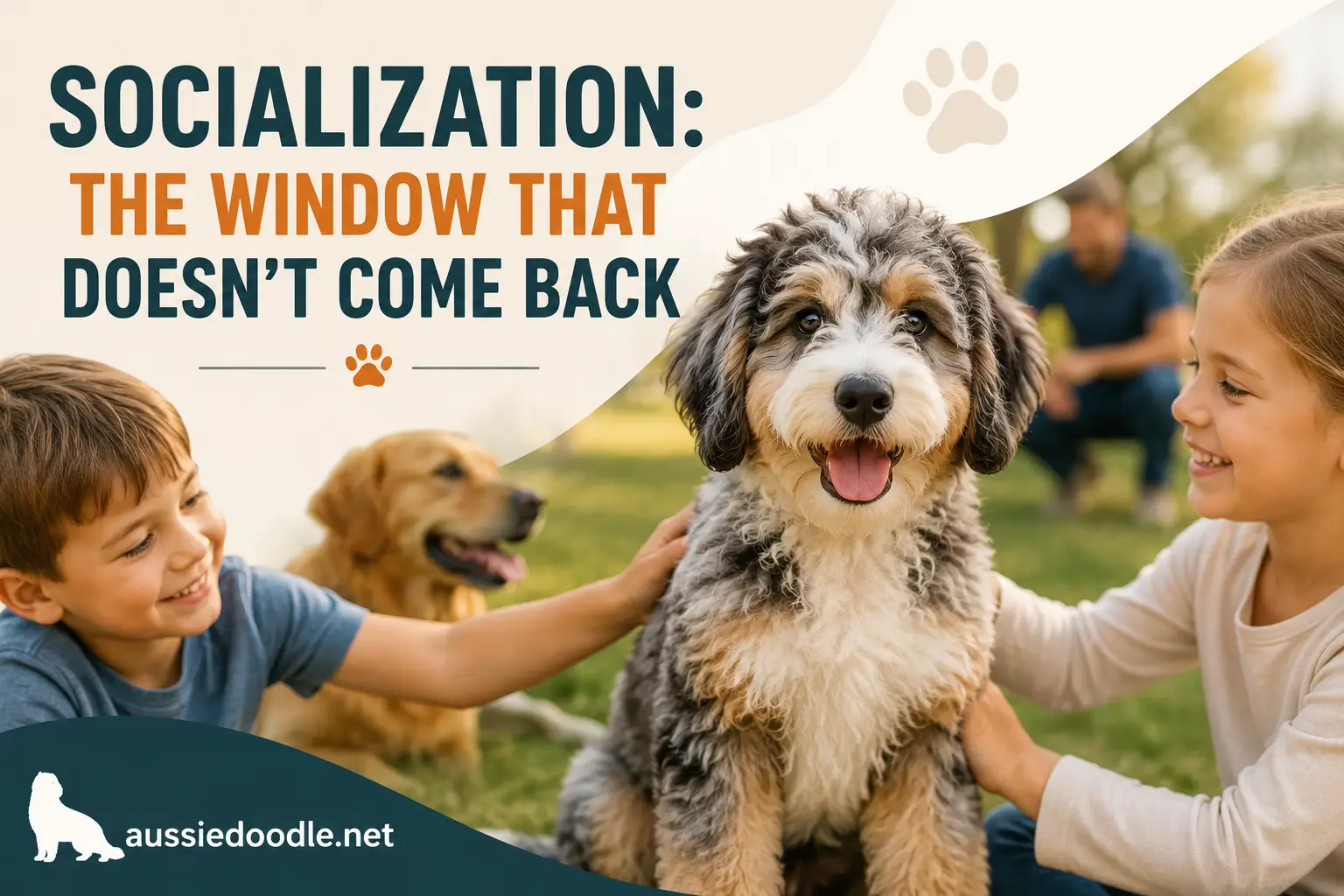
This is where most first-time owners either overcorrect (isolating the puppy until “fully vaccinated,” often past 16 weeks) or undercorrect (unrestricted exposure with no vaccine at all). The American Veterinary Society of Animal Behavior (AVSAB) — the vet body that sets US behavioral-medicine position statements — takes a clear stance: puppies should start safe socialization roughly one week after their first vaccine dose, not after the full series.
AVSAB’s position statement notes that behavioral problems, not infectious disease, are the leading cause of death in dogs under three, and that the first three months are the primary window when sociability outweighs fear.
In practice, that means: puppy classes or controlled, healthy-dog playdates can start around 7–8 weeks, roughly a week after that first shot — avoiding unknown-vaccination-status dog parks, but not avoiding safe exposure altogether.
In the litters I’ve raised, the puppies who got structured exposure to new people, surfaces, and sounds before 12 weeks were consistently easier to introduce to groomers, vets, and new environments as adults than littermates who were kept more sheltered during that window — a pattern that lines up with what AVSAB describes, not an exception to it.
Exercise: Little and Often, Not Long and Hard
Aussiedoodle puppies inherit the Australian Shepherd side’s energy and the Poodle side’s intelligence, which means they need both physical and mental exercise — but growth plates in medium-to-large puppies typically don’t close until 12–18 months, so forced long-distance runs or repetitive jumping before then add unnecessary joint strain.
A practical, widely used guideline is roughly 5 minutes of structured exercise per month of age, twice a day, plus unstructured free play and short training sessions for mental stimulation. A 3-month-old, for example, gets about 15 minutes of structured walking per session — not an hour-long hike.
Grooming Basics From Day One
Aussiedoodle puppies don’t need professional grooming appointments immediately, but early, gentle handling of paws, ears, and coat — even just a few minutes a few times a week — builds tolerance for the brushing and trimming they’ll need for life.
Starting this before the adult coat comes in (usually by 9–12 months) makes the transition to a regular grooming routine far less stressful than starting cold. For the full brushing-frequency and bathing-interval breakdown once the adult coat is in, see the site’s dedicated grooming guide.
Common First-Year Mistakes
- Free-feeding a young puppy instead of scheduled meals, which makes housetraining and weight monitoring harder.
- Waiting for “fully vaccinated” before any socialization, which misses the AVSAB-identified window and raises later fear/behavior risk.
- Skipping the 16-week vaccine dose because the puppy “seems fine” after earlier shots.
- Over-exercising on the assumption that a high-energy breed mix needs adult-length walks from week one.
- Delaying grooming handling until the coat actually mats, instead of building tolerance early.
Key Takeaways
- Aussiedoodle puppies need 3–4 small AAFCO-approved meals daily from 8–12 weeks, dropping to 2 meals by 12 months.
- AAHA’s guidelines call for core vaccines (DHPP, leptospirosis, rabies) starting at 6–8 weeks and finishing at 16 weeks or later.
- AVSAB recommends starting safe socialization about a week after the first vaccine dose — not waiting for the full series.
- A rough exercise guideline is 5 minutes of structured activity per month of age, twice daily, until growth plates close around 12–18 months.
- Behavioral problems, not infectious disease, are the AVSAB-cited leading cause of death in dogs under three — making the socialization window a health decision, not just a training one.
FAQs
Is it normal for an Aussiedoodle puppy to nip and bite a lot?
Yes — mouthing is normal puppy behavior, especially in an intelligent, high-drive mix like the Aussiedoodle, and it typically fades with consistent redirection and continues through teething. If biting is paired with growling or is escalating past 6 months, it’s worth a session with a certified trainer rather than assuming it will resolve on its own; see the site’s behavior problems guide for a fuller breakdown.
Do Aussiedoodle puppies need a special diet?
Not a special diet, but a life-stage-appropriate one: an AAFCO-approved puppy formula until around 12 months, sized to their eventual adult weight (Toy, Mini, or Standard), since overfeeding a fast-growing joint-sensitive breed mix contributes to later hip and elbow strain.
Is Aussiedoodle puppy care still worth the effort in 2026 compared to just getting an adult rescue?
Puppy-specific care (structured feeding, the vaccine series, the AVSAB socialization window) exists precisely because that early period shapes adult temperament and health in ways that can’t be fully recreated later — but it is more hands-on than adopting a trained adult.
If the daily routine described here isn’t feasible right now, an adult Aussiedoodle from a rescue is a legitimate lower-maintenance alternative; see Aussiedoodle for Adoption.
How is Aussiedoodle puppy care different from caring for an adult Aussiedoodle?
The core differences are feeding frequency (3–4 meals vs. 2), vulnerability to infectious disease before the vaccine series is complete, and exercise limits tied to open growth plates — an adult Aussiedoodle can handle longer runs and eats on a simpler twice-daily schedule.
How much does the first year of Aussiedoodle puppy care actually cost?
Beyond the puppy’s purchase or adoption price, expect the core vaccine series to run roughly $75–250 at a general practice clinic, plus food, supplies, and a first-year wellness exam — costs that vary by region and whether you use a low-cost clinic versus a full-service hospital.
What’s the biggest thing new Aussiedoodle owners get wrong in the first few weeks?
Based on questions we see repeatedly from new owners, it’s timing — either isolating the puppy too long before socializing (past the AVSAB-recommended window) or pushing exercise and off-leash freedom before the puppy is vaccinated or physically ready.