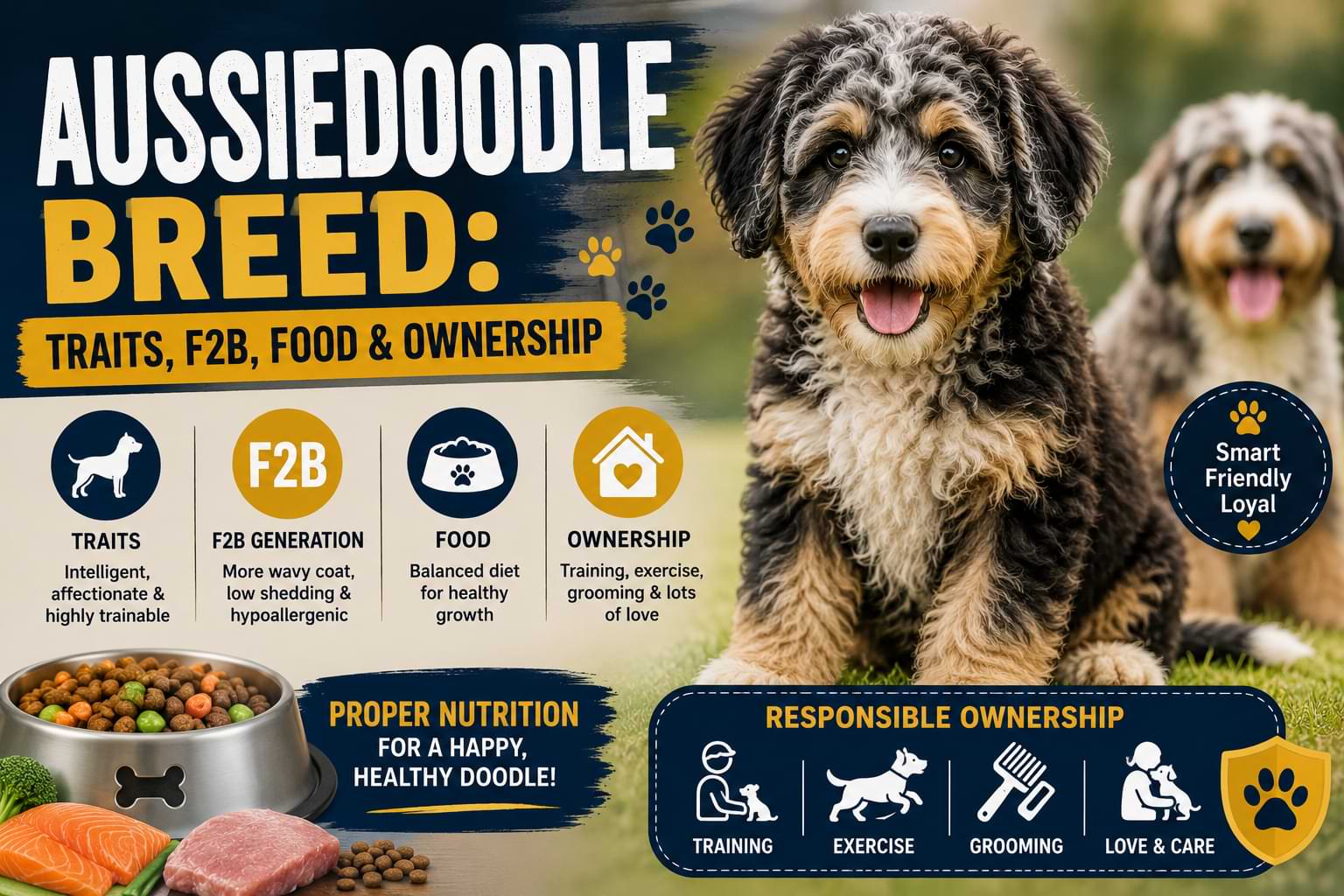
Introduction
An Aussiedoodle is a crossbreed dog produced by pairing an Australian Shepherd with a Poodle. Breeders developed this mix primarily for the Australian Shepherd’s intelligence and the Poodle’s low-shedding coat.
It is not a purebred and is not recognized by the American Kennel Club, a distinction that matters more than most guides admit.
Breed Resource Hub has tracked Aussiedoodle ownership questions, costs, and health outcomes across hundreds of reader submissions and breeder consultations since 2019. This guide is built for people deciding whether to bring one home, not people who already own one and want validation.
The Short Version
An Aussiedoodle is a high-energy, highly trainable, moderate-to-low-shedding dog that needs 60-90 minutes of structured activity daily. It does not do well left alone for long stretches.
Strong fit for:
- Active singles and couples
- Families with school-age kids
- Owners who can commit to daily exercise
Poor fit for:
- Households that want a calm dog
- Anyone who can’t commit to daily exercise
- Homes where people are gone 10+ hours a day
What You’ll Learn
This guide covers:
- Why the Aussiedoodle can’t become an AKC-recognized breed, even if a breed club tried
- The one genetic health test that matters more than any other for this cross
- Real monthly and first-year ownership costs, not a vague “varies” range
- How Aussiedoodle training difficulty compares to a Labradoodle or Goldendoodle
- The specific apartment-living tradeoffs owners don’t find out until after they’ve signed a lease
- Which size variant (Toy, Mini, Standard) fits which lifestyle
What Is an Aussiedoodle?

An Aussiedoodle is a designer crossbreed between an Australian Shepherd and a Poodle. The breed was first developed in the late 1990s to combine the Australian Shepherd’s working intelligence with the Poodle’s coat genetics.
It is not a purebred dog. Unlike the Miniature American Shepherd (AKC-recognized in 2015), it cannot follow the same path to AKC recognition.
The American Kennel Club’s Foundation Stock Service explicitly excludes any “rare” breed that is a combination of two already-recognized AKC breeds. Since both the Australian Shepherd (recognized 1993) and the Poodle are already AKC breeds, the Aussiedoodle is permanently outside that pathway.
Why AKC Recognition Matters
This distinction isn’t trivia. It means there’s no official breed standard governing Aussiedoodle size, coat, or temperament.
Every “standard” you’ll see online comes from individual breeders or aggregated owner reports, not a regulating body. That’s why size figures vary so much between sources—one breeder’s “Mini” is another’s “Medium.”
Size Variants Explained
Size comes from the Poodle parent.
Standard Aussiedoodle (Standard Poodle parent)
- Height: 19-24 inches at the shoulder
- Weight: 40-70 pounds
Mini Aussiedoodle (Miniature Poodle parent)
- Height: 12-18 inches
- Weight: 15-35 pounds (varies significantly by breeder lines)
Toy Aussiedoodle (Toy Poodle parent)
- Height: Under 13 inches
- Weight: Under 15 pounds
Treat any number tighter than these ranges as one breeder’s specific line, not a breed-wide fact.
Understanding Generations
Generation matters as much as size.
F1 Aussiedoodle:
First-generation cross (purebred Australian Shepherd × purebred Poodle). Produces the widest coat and temperament variation.
F1b Aussiedoodle:
F1 bred back to a Poodle. Increases coat predictability and lowers shedding, but also narrows genetic diversity.
If a breeder can’t tell you the generation and the coat genetics of both parents, that’s a red flag worth acting on.
Is an Aussiedoodle Good With Kids and Other Pets?
Temperament With Children
Aussiedoodles are generally affectionate, playful, and bond closely with children when raised together.
But their inherited herding drive means some will nip at heels or try to “herd” running kids. This isn’t aggression—it’s a deeply wired instinct from the Australian Shepherd side.
It shows up most in dogs from working-line parents rather than companion-bred lines.
Managing Herding Behavior
If your Aussiedoodle starts circling and nipping at a child’s ankles during play, that’s herding behavior kicking in.
The fix is redirection, not correction:
- Teach a reliable “sit” or “leave it”
- Use it the moment the behavior starts
- Give the dog an appropriate outlet (flirt pole, fetch) for the same drive
Compatibility With Other Pets
Aussiedoodles raised with early socialization tend to do well with other dogs and cats.
Prey drive toward small, fast-moving animals can persist in some lines. Introduce slowly, on-leash, over multiple sessions, rather than assuming intelligence alone will smooth things over.
Age-Specific Recommendations
Families with children under 5:
An Aussiedoodle’s exercise needs and herding instinct require daily management that’s hard to combine with the demands of a toddler.
Families with kids 6 and up:
These households report a much smoother fit. Kids can participate in training and structured play.
Are Aussiedoodles Easy to Train?
Intelligence vs. Ease of Living
Aussiedoodles are among the easier breeds to train. They rank high on obedience-trial intelligence due to both parent breeds.
But “easy to train” and “easy to live with” are not the same thing.
They pick up commands fast, often within a handful of repetitions. Both the Australian Shepherd and Poodle were bred for close handler cooperation.
The Mental Demand Catch
High trainability comes paired with high mental demand.
An Aussiedoodle that isn’t given structured mental work will train itself. Usually by inventing a job you didn’t assign—like dismantling furniture, herding the household cat, or barking at every passerby.
Owners who treat training as a one-time puppy class rather than an ongoing need end up with a dog that’s smart, bored, and destructive.
Training Timeline
Housetraining:
4-6 weeks with consistent crate training and a fixed schedule
Basic obedience:
Solid by 4-5 months with daily 10-15 minute sessions
- Sit
- Stay
- Recall
- Leash manners
Beyond Basic Training
Where Aussiedoodles separate from a Labradoodle is in advanced and trick training.
Their working-breed heritage makes them well suited to:
- Agility
- Scent work
- Herding-style games like treibball
Owners who skip this kind of structured outlet most often report the herding-and-nipping behaviors described above.
How Much Exercise Does an Aussiedoodle Need?
Daily Exercise Requirements
Aussiedoodles need roughly 60-90 minutes of physical activity daily, split between a structured walk and active play or mental work.
Higher-energy individual dogs need closer to two hours. This isn’t a casual estimate—it reflects the exercise needs of both working-line parent breeds.
Falling well short of it is the single most common reason owners report behavior problems.
What a Real Daily Routine Looks Like
Morning:
30-45 minute walk or jog
Midday:
Mental-work session
- Puzzle feeder
- Training drills
- Scent game
Evening:
20-30 minutes of active play
- Fetch
- Tug
- Off-leash time in a secure area
Weekends:
Hikes or dog-park visits supplement but don’t replace the daily baseline
Apartment Living Reality Check
Apartment living is possible but requires real commitment to this schedule.
An Aussiedoodle confined to a small space with one short walk a day will develop anxiety-driven behaviors:
- Excessive barking
- Destructive chewing
- Pacing
Square footage matters less than consistency. The real question is whether the owner can deliver 60+ minutes of real exertion every single day, including in bad weather and on busy work weeks.
Do Aussiedoodles Shed? Grooming Requirements Explained
Shedding Reality
Aussiedoodles shed on a spectrum, not a yes-or-no.
Dogs with tighter, curlier Poodle-type coats: Shed minimally
Dogs with looser, wavier Australian Shepherd-type coats: Shed noticeably, especially during seasonal blowouts
The Hypoallergenic Myth
No Aussiedoodle is hypoallergenic in any guaranteed sense.
All dogs produce some allergens through dander, saliva, and shed hair. Coat type only affects how much of that gets distributed into the environment.
What Determines Coat Type
Coat type is determined by specific genes (the ones controlling curl and furnishings), not by generation label.
Some breeders now test breeding pairs for these coat genes directly. This is a more reliable predictor of adult coat and shedding than counting “F1” versus “F1b” on a pedigree.
Ask a breeder:
- Have they done coat gene testing?
- If not, what coat does each parent have?
Grooming Schedule and Costs
Curlier coat:
- Brushing: 3-4 times a week to prevent matting
- Professional trim: Every 6-8 weeks
- Cost per visit: $60-90 in most U.S. metro areas
Wavier, Aussie-leaning coat:
- Brushing: Less frequent
- Extra attention: During spring and fall shedding seasons
The Matting Problem
Skipping brushing on a curly-coated Aussiedoodle for even two weeks can result in mats that require a full shave-down to remove.
That’s a far worse outcome than the 10 minutes a regular brushing session would have taken.
Common Health Problems in Aussiedoodles
The MDR1 Gene: Most Critical Health Test
The single most important health consideration for an Aussiedoodle isn’t a disease at all—it’s a drug-sensitivity gene called MDR1.
This gene is inherited from the Australian Shepherd side. According to the University of California, Davis Veterinary Genetics Laboratory, roughly 50% of Australian Shepherds carry at least one copy of the affected gene variant.
What MDR1 Does
Dogs with this mutation can have severe, sometimes fatal reactions to standard medications, including:
- Some heartworm preventives
- Antidiarrheal drugs
- Certain chemotherapy agents
The mutation disables a protein that normally keeps these drugs out of the brain.
Testing for MDR1
A cheap cheek-swab DNA test confirms whether a specific dog carries it.
Any owner or breeder can do this before a single dose of medication is given, not after a reaction starts.
Cost:
$70-80
Value:
Closes a real safety gap, not an optional extra
The mutation was first characterized in a peer-reviewed study by Mealey and colleagues, published in the journal Pharmacogenetics in 2001.
Hip and Elbow Dysplasia
Hip and elbow dysplasia is a malformation of the joint socket that worsens with age and weight.
It affects medium-to-large dogs broadly. Severe cases can require surgery costing $3,000-7,000 per joint.
Progressive Retinal Atrophy (PRA)
PRA is an inherited, currently untreatable condition that leads to gradual blindness.
It’s screened for via DNA test in both parent breeds. It should appear on a responsible breeder’s health clearances.
Merle Pattern Risks
Dogs with the merle coat pattern carry elevated risk of inherited vision and hearing impairment.
This risk is especially high in dogs bred from two merle parents. Reputable breeders avoid merle-to-merle pairings entirely.
Expected Lifespan
Lifespan estimates for Aussiedoodles generally fall between 10 and 15 years across the sources that track it.
Smaller individuals trend toward the higher end, consistent with the general size-to-longevity pattern seen across dog breeds.
As with size, treat any single-number lifespan claim with skepticism. There’s no centralized breed registry collecting this data the way there is for AKC breeds.
What a Responsible Breeder Provides
A responsible breeder will provide documentation for testing on both parent dogs:
- Hip clearances
- Elbow clearances
- Eye clearances
- MDR1 testing
If a breeder can’t produce these, that’s a decision point, not a detail to negotiate past.
How Much Does an Aussiedoodle Cost to Own?

Purchase Price
Aussiedoodle puppies from health-tested breeders typically run $1,500-4,000 depending on:
- Size
- Coat rarity
- Region
Merle-colored or rare-color puppies are often priced at the top of that range.
That purchase price is the smallest piece of total ownership cost. Treating it as the budget number is the most common financial misstep new owners make.
First-Year Costs
First-year costs typically land between $2,500 and $4,500 on top of the puppy’s purchase price.
This includes:
- Initial vet visits
- Vaccinations
- Spay/neuter
- Crate
- Basic supplies
- A few months of professional grooming
Ongoing Monthly Costs
After the first year, monthly costs generally break down as:
Food:
$50-90/month for a medium-to-large dog eating a quality formula
Grooming:
$60-90 every 6-8 weeks for curlier coats (less for wavier coats)
Routine vet care:
$40-60/month when annual exams and preventives are spread across twelve months
The Most Underestimated Cost
Pet insurance or an emergency fund is the cost owners most often underestimate.
Given the joint and eye conditions outlined above, a single orthopedic surgery can exceed the dog’s entire first-year budget.
Monthly insurance premiums:
$35-65 depending on coverage level and regional pricing
Start a policy while the dog is young and healthy, before any condition becomes a pre-existing exclusion. That’s the only point at which it’s genuinely useful.
What Living With an Aussiedoodle Is Really Like
The Morning Non-Negotiable
The mornings are non-negotiable.
An Aussiedoodle that doesn’t get real exertion before a workday starts will spend that day finding its own outlet. That outlet is rarely convenient for the owner.
Households that build a 30-45 minute morning walk or run into their schedule report dramatically calmer dogs by midday.
The Unexpected Expense
The unexpected expense isn’t vet bills—it’s grooming drift.
A curly-coated Aussiedoodle that misses two consecutive grooming appointments can develop mats severe enough to require a full shave-down rather than a trim.
This happens easily during a busy season or a move. It’s both a cosmetic setback and, in matted areas near the skin, a genuine skin-health issue if moisture gets trapped underneath.
The Most Common Frustration
The frustration owners name most consistently is the herding-nipping behavior with kids and other pets.
This is especially true in the first 12-18 months before training and maturity settle it down. It’s manageable, but it requires active redirection rather than hoping the dog “grows out of it” on its own.
The Biggest Payoff
The quality owners name most consistently as the payoff is the dog’s responsiveness.
An Aussiedoodle that’s getting its exercise and mental work needs met tends to read its owner’s mood and routine with surprising accuracy. They pick up on:
- Schedule changes
- New commands
- Subtle cues
And they do it without much formal repetition.
Aussiedoodle Suitability Scorecard
| Metric | Score (1-10) | What Drives the Score |
|---|---|---|
| Family Friendly | 8/10 | Strong with kids 6+; herding nip risk with toddlers and very young children |
| Trainability | 9/10 | Fast learner; needs ongoing mental work, not just initial obedience |
| Grooming Needs | 6/10 | Ranges from low (curly coat) to moderate-high (wavy coat, seasonal shed) |
| Barking Level | 5/10 | Moderate; rises sharply if exercise needs aren’t met |
| Apartment Friendly | 5/10 | Workable only with strict daily exercise commitment |
| Shedding Level | 4/10 | Low to moderate depending on coat genetics, not generation label |
| Exercise Needs | 9/10 | 60-90+ minutes daily; among the higher-energy doodle crosses |
| Beginner Friendly | 6/10 | Trainable enough for first-timers, but exercise and structure demands are real |
This scorecard reflects general patterns across the breed, not a guarantee for any individual dog. An Aussiedoodle from working-line Australian Shepherd parents will skew higher on exercise needs and herding drive than one from companion-bred lines.
FAQs
Is an Aussiedoodle a good first dog?
Aussiedoodles can work well for first-time owners who are realistically prepared for daily structured exercise and ongoing training.
They’re a poor fit for first-timers expecting a low-maintenance dog. The breed’s intelligence is an asset only if it’s matched with consistent mental engagement.
Do Aussiedoodles bark a lot?
Aussiedoodles aren’t classified as an excessively vocal breed.
But barking increases noticeably in dogs that aren’t getting enough physical and mental exercise. Under-exercised Aussiedoodles commonly develop alert-barking and attention-barking as outlets for excess energy.
Are Aussiedoodles hypoallergenic?
No dog is truly hypoallergenic, including Aussiedoodles.
Curlier-coated individuals shed less and distribute less dander into the environment. This can make a real difference for mild allergy sufferers.
Anyone with a significant dog allergy should spend extended time with a specific dog’s parents before committing.
How big does a Mini Aussiedoodle get?
Mini Aussiedoodle size estimates vary by source, generally falling between:
- Height: 12-18 inches tall
- Weight: 15-35 pounds
The Poodle parent’s exact size and the puppy’s individual generation (F1 vs. F1b) both affect the final result more than the “Mini” label alone.
Can Aussiedoodles be left alone during a workday?
Aussiedoodles can tolerate being alone for 4-6 hours with adequate morning exercise and enrichment (puzzle feeders, a secure outdoor or window view).
Longer stretches without a midday break tend to produce anxiety behaviors in this breed more than in lower-energy crosses.
What’s the difference between an Aussiedoodle and a Bernedoodle?
Aussiedoodle:
Poodle × Australian Shepherd
- Higher energy
- Herding instinct
- Higher exercise demands
Bernedoodle:
Poodle × Bernese Mountain Dog
- Calmer temperament
- Larger body
- Lower exercise demands
- Shorter average lifespan (due to Bernese predisposition to certain cancers)
Why isn’t the Aussiedoodle AKC-recognized, and will it ever be?
The AKC’s Foundation Stock Service explicitly excludes crosses of two already-recognized AKC breeds.
Since both the Australian Shepherd and the Poodle are already AKC breeds, the Aussiedoodle has no available path to recognition under current AKC rules.
What does the MDR1 gene test actually check, and do I need it?
The MDR1 test checks for a gene mutation inherited from the Australian Shepherd side. This mutation causes dangerous sensitivity to several common medications, including:
- Some dewormers
- Anti-diarrheal drugs
- Certain chemotherapy agents
Given that an estimated 50% of Australian Shepherds carry the mutation, testing an individual Aussiedoodle before any new medication is prescribed is a reasonable safety step.
Test type: Simple cheek swab
Cost: $70-80
How much should I budget monthly for an Aussiedoodle?
Plan for roughly $150-250 per month covering:
- Food
- Routine vet care
- Grooming
Factor in pet insurance ($35-65/month) or an equivalent emergency fund for unplanned veterinary costs.
What if I want the temperament without the exercise demands?
Consider a Bernedoodle or a Goldendoodle from companion-bred (not working-line) parents.
Both generally carry lower baseline exercise requirements than an Aussiedoodle while retaining strong trainability and family-friendly temperaments.
Are male or female Aussiedoodles different in temperament?
Individual personality varies more than sex within this breed.
Males trend slightly larger. Females are sometimes described by breeders as marginally more independent. Neither difference is reliable enough to base a choice on.
Do Aussiedoodles do well with cats?
Aussiedoodles raised alongside cats from puppyhood, with slow, supervised introductions, generally coexist well.
Individual prey drive (especially toward fast movement) varies. It should be assessed dog-by-dog rather than assumed from the breed alone.
Conclusion
The Aussiedoodle rewards owners who treat its intelligence as a daily responsibility, not a convenience.
The dogs that thrive are the ones getting 60-90 minutes of real exertion and consistent mental engagement. The ones that struggle are almost always under-exercised, regardless of how spacious the home is.
The Single Most Important Decision
The single most important decision in this entire guide is getting MDR1 testing done.
Roughly half of Australian Shepherds carry the mutation. The test itself costs less than a single vet visit.
Size Matters Less Than Schedule
Whether you’re drawn to a Standard for hiking partnership or a Mini for apartment life with a serious daily-exercise plan, the breed’s fit depends far more on your actual schedule than on which size or coat color you pick.
What to Ask a Breeder
If you’re at the decision point, start by asking a breeder for clearances on both parents:
- Hip clearances
- Eye clearances
- MDR1 clearances
Their answer will tell you more than any size chart will.