
Quick Answer:
An Aussiedoodle fits most living situations — apartments, family homes, single-owner households, and even senior households — as long as the owner can give it 45–60 minutes of real exercise plus daily mental stimulation, regardless of square footage.
Who This Guide Is For:
This isn’t a generic “Aussiedoodles are great family dogs” page. It’s built for six specific readers: the apartment renter weighing a pet-deposit decision, the parent deciding if a herding-breed mix is safe around toddlers, the single or couple with an active weekend routine, the senior or retiree wanting companionship without a demanding routine,
The person exploring an Aussiedoodle as an emotional support animal, and the current owner whose situation just changed (a move, a new baby, a return to office). Each section below is written for one of those readers, not all of them at once.
Aussiedoodles in Apartments: What Actually Matters?
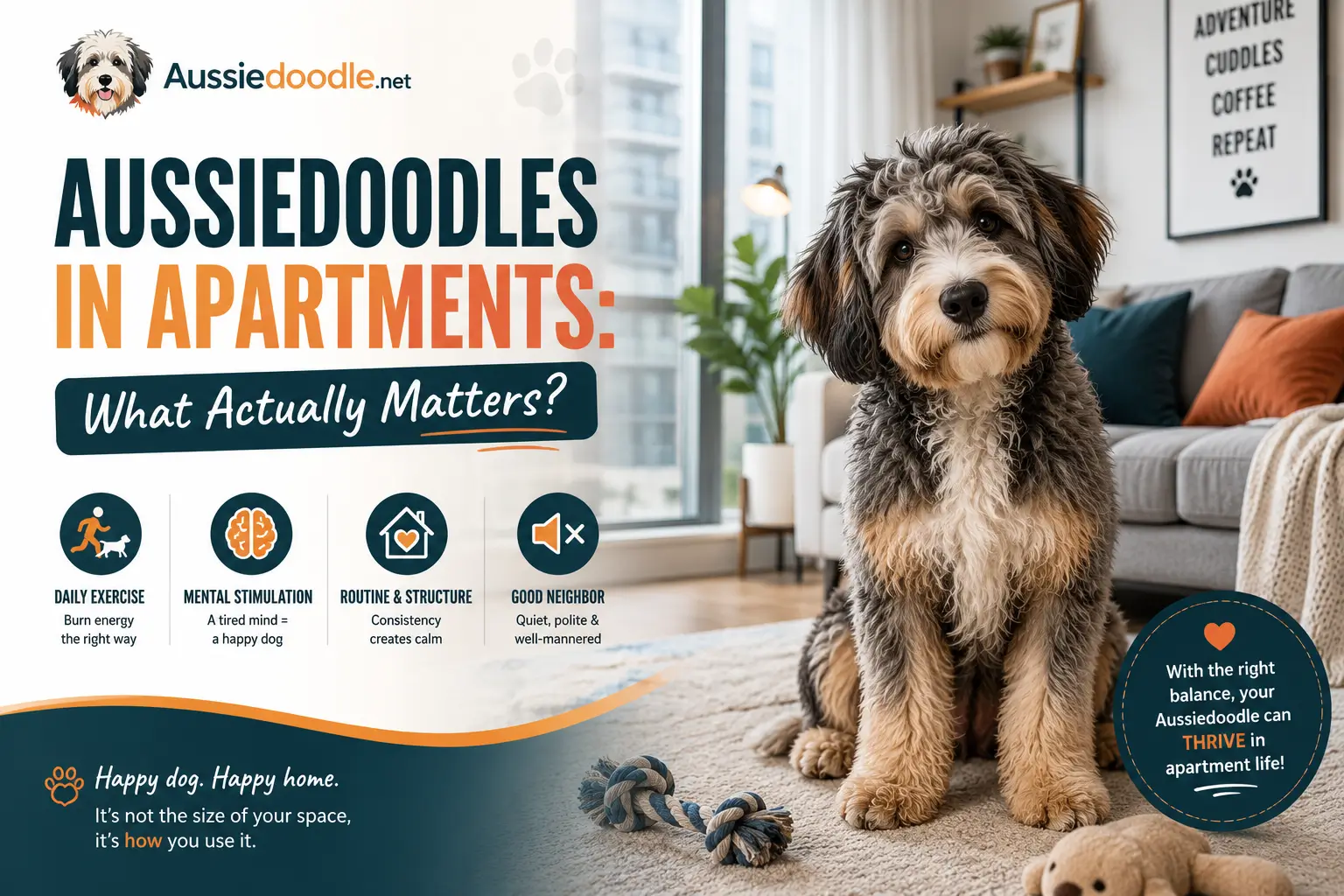 Apartment living with a dog is now the norm, not the exception. In 2023, 40% of renters reported having at least one dog, up from 31% in 2019, according to Zillow rental-market data.
Homeownership still correlates with higher dog-ownership rates overall — Pawlicy’s 2026 analysis of APPA data found 58% of homeowners own a dog compared with 39% of renters — but that gap reflects cost and landlord restrictions more than a dog’s actual ability to live in a smaller space.
For an Aussiedoodle specifically, size tier matters more than square footage:
- Toy/Mini Aussiedoodle (under ~30 lbs): Adapts well to apartments. Needs two structured outings a day, not just yard access (which apartments don’t have anyway).
- Standard Aussiedoodle (40–75 lbs): Can live in an apartment, but the margin for error shrinks — skipped walks show up fast as chewing, barking, or door-dashing.
The real apartment-fit test isn’t the lease size, it’s the exercise budget: can you commit to 45–60 minutes of real activity daily, split across the day, rain or shine? If yes, floor plan is a minor factor. If no, even a house with a yard won’t fix an under-exercised Aussiedoodle’s behavior.
Aussiedoodles With Families and Kids
Aussiedoodles generally do well with children because both parent breeds — Australian Shepherds and Poodles — were bred to work closely with people, not independently.
That said, the Australian Shepherd side carries a herding instinct, which can show up as nipping at heels or circling running kids, especially before six months of age. This isn’t aggression; it’s an instinct that needs redirecting through training, not punishment.
A concrete example:
A first-time Aussiedoodle owner with a toddler and a Mini Aussiedoodle puppy found the heel-nipping showed up specifically during backyard chase games — not during calm play — and stopped within about three weeks once the family switched the puppy onto a flirt-pole and structured fetch instead of letting it join unstructured running games.
That’s the pattern worth watching for: the behavior is context-specific (running games), not a general temperament flaw, and it responds to a training fix, not a breed-suitability verdict.
Lifestyle Fit at a Glance
| Living Situation | Fit Level | What Makes or Breaks It |
|---|---|---|
| Apartment, no yard | Good (Toy/Mini) / Moderate (Standard) | 45–60 min structured exercise daily is non-negotiable. |
| Family with young kids | Good | Supervise chase games and redirect heel-nipping early. |
| Single/couple, active | Excellent | Best match — an ideal dog-sport and outdoor-activity partner. |
| Senior/retired, calmer pace | Good (Toy/Mini best fit) | A consistent routine matters more than high energy output. |
| WFH / hybrid schedule | Good | Built-in midday exercise breaks help prevent boredom behaviors. |
| Long hours away from home (9+ hrs) | Poor without a plan | A dog walker, daycare, or change in routine may be necessary. |
| ESA candidate | Good | No task training is required, but professional documentation may be needed. |
| Service-dog candidate | Case-by-case | Requires early temperament testing with a qualified trainer. |
Aussiedoodles for Singles, Couples, and Active Owners
This is the easiest lifestyle match. An Aussiedoodle bred from two working-line parent breeds does best with an owner who wants a running, hiking, or dog-sport partner, not just a couch companion. Agility, obedience, and scent work all suit the breed’s intelligence and give it the mental workout that plain walking alone doesn’t.
Aussiedoodles for Seniors and Retired Owners
Aussiedoodles can work well for seniors, but with a caveat competitors rarely state plainly: a Toy or Mini Aussiedoodle with a manageable exercise routine fits a slower-paced household far better than a Standard.
A retired owner with a consistent daily schedule and time for two shorter walks is often a better match for this breed than a busy working-age household — routine matters more than raw energy for this breed’s wellbeing.
Emotional Support and Service Aussiedoodles
Aussiedoodles are sometimes chosen as ESA or service-dog candidates because of their trainability and people-focused temperament. An ESA has no public-access rights and needs no formal task training — it provides comfort through its presence, typically supported by a letter from a licensed mental health professional.
A service dog is trained to perform specific tasks for a person with a disability and has legal public-access rights under the ADA. Not every Aussiedoodle is a fit for service work: the herding instinct and higher energy of some lines need extensive early temperament testing before task training begins, and this should be done with a qualified trainer, not assumed from breed reputation alone.
Key Takeaways
- Space matters less than time: a Toy/Mini Aussiedoodle in an apartment with two structured daily walks fits better than a Standard left alone all day in a house.
- 40% of renters reported owning a dog in 2023, up from 31% in 2019 (Zillow), so apartment living with an Aussiedoodle is increasingly the norm, not an exception.
- Herding-instinct nipping around kids is context-specific — it shows up during chase games, not calm play — and typically resolves with redirected structured play, not a suitability verdict.
- Owners away from home 9+ hours without a walker, daycare, or routine change are the one group where this breed consistently struggles.
- An ESA Aussiedoodle needs professional documentation, not task training; a service-dog candidate needs early, qualified temperament testing.
FAQs
Is an Aussiedoodle good for apartment living?
Yes, especially Toy and Mini Aussiedoodles, as long as the owner provides 45–60 minutes of daily structured exercise. Standard Aussiedoodles can also adapt, but skipped exercise shows up faster as unwanted behavior in a smaller space.
Are Aussiedoodles still a good choice for families in 2026?
Yes. Their people-focused temperament, inherited from both Australian Shepherd and Poodle lines, makes them well-suited to family life, provided herding-instinct behaviors like heel-nipping are redirected through training during puppyhood.
Aussiedoodle vs. Labradoodle for apartment living — which fits better?
Both can adapt to apartments, but Aussiedoodles generally need more structured mental stimulation due to their herding-breed heritage, while Labradoodles (from a retrieving background) are often more content with straightforward walks alone.
How much does it cost to keep an Aussiedoodle in a rental with pet fees?
Beyond the puppy’s purchase or adoption cost, budget for a landlord pet deposit or monthly pet rent (increasingly standard, per 2026 rental-housing industry data), food, grooming every 6–12 weeks, and routine vet care.
Can an Aussiedoodle be left alone all day while I work?
Not comfortably beyond about 4–6 hours without a midday break. For a 9+ hour workday, plan on a dog walker, doggy daycare, or a hybrid work schedule — this is the one lifestyle gap the breed doesn’t adapt around well.
Do Aussiedoodles do well with other pets in a shared household?
Generally yes, especially with early socialization, though the herding instinct can mean chasing smaller pets like cats until trained. Supervised introductions and consistent redirection work best.
Is an Aussiedoodle a good emotional support animal?
Yes — their affectionate, people-oriented temperament suits ESA use, and no formal task training is required, only documentation from a licensed mental health professional.