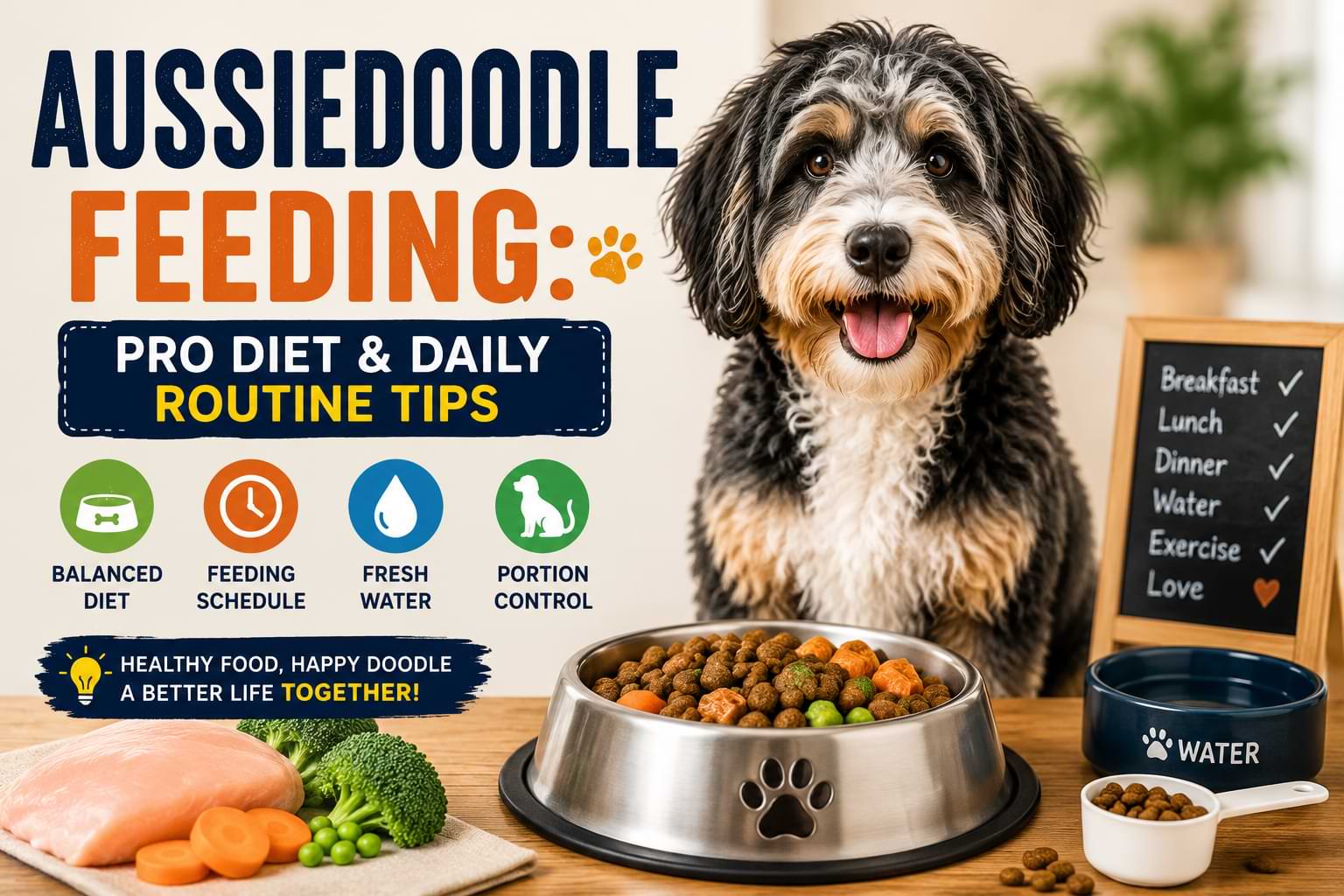
Aussiedoodle Feeding: Pro Diet & Daily Routine Tips

Table of Contents

Introduction

Aussiedoodle feeding depends on your dog’s size, age, and activity level — there is no single portion that fits every dog in this breed. An Aussiedoodle is a crossbreed between the Australian Shepherd and the Poodle, and it comes in three distinct sizes: Toy, Mini, and Standard. Each size carries different calorie requirements, and what works for a 15-pound Mini Aussiedoodle will significantly underfeed or overfeed a 60-pound Standard.

At Aussiedoodle.net, we’ve tracked feeding patterns across hundreds of owners and observed the same common mistakes: overfeeding puppies, underestimating adult calorie needs during high-activity periods, and switching foods too quickly. This guide gives you a breed-specific feeding chart, age-by-age schedules, a food comparison matrix, and the portion guidance vets recommend — so you can feed your dog right from the first week home to the senior years.

This guide is for first-time Aussiedoodle owners, families choosing between food types, and anyone whose dog is gaining or losing weight without an obvious reason. It is not a substitute for veterinary diagnosis of food allergies or GI disease.

What You’ll Learn

  • Exactly how much to feed a Toy, Mini, or Standard Aussiedoodle at every life stage, with a breed-specific chart from 8 weeks to senior
  • A day-by-day feeding schedule for puppies from 8 weeks through 12 months
  • How to compare dry kibble, fresh food, raw, wet, and homemade diets — with a clear decision matrix
  • Which foods are toxic to Aussiedoodles and which fruits and vegetables are safe additions
  • How to manage weight, measure body condition score, and adjust portions without guessing
  • The single most common feeding mistake new owners make (and how to avoid it from day one)

Aussiedoodle Nutritional Needs by Size and Life Stage

Aussiedoodle feeding requirements vary by size more than almost any other factor — a Toy weighs 10–15 lbs while a Standard can reach 45–70 lbs, meaning calorie needs can differ by 400% between the two. The Association of American Feed Control Officials (AAFCO) sets minimum nutritional standards for all life stages, but portion size and meal frequency must account for the specific dog in front of you.

The Australian Shepherd parent is a working breed with a high metabolic rate. The Poodle parent, depending on size, is an active but leaner-framed dog. Their offspring inherit variable energy demands — Mini and Toy Aussiedoodles are often more energetic per pound than Standards, which affects how you calculate daily intake.

Calorie Requirements by Weight and Activity Level

Use these daily calorie targets as a starting baseline. Adjust based on visible body condition (see the Weight Management section below).

Dog Weight Low Activity Moderate Activity High Activity
10 lbs (Toy) 210 kcal 275 kcal 340 kcal
15 lbs (Mini) 295 kcal 385 kcal 475 kcal
25 lbs (Mini/Standard) 450 kcal 590 kcal 730 kcal
40 lbs (Standard) 660 kcal 865 kcal 1,065 kcal
55 lbs (Standard) 850 kcal 1,110 kcal 1,375 kcal
65 lbs (Standard) 975 kcal 1,275 kcal 1,575 kcal

Calorie estimates based on the Resting Energy Requirement (RER) formula: 70 × (body weight in kg)^0.75, multiplied by activity factor. Source: Merck Veterinary Manual, 2023.

These numbers apply to healthy adult dogs at maintenance weight. Puppies need more calories per pound. Pregnant or nursing dogs may need up to double their usual intake. Senior dogs often need 20–30% fewer calories, depending on mobility.

Life Stage Nutritional Priorities

Puppies (under 12 months):

Need higher protein (22–28% on a dry matter basis per AAFCO puppy standards), more calcium and phosphorus for bone growth, and DHA for brain and eye development. Feed food labeled “for growth” or “all life stages.”

Adults (1–7 years):

Protein should remain above 18% dry matter minimum (AAFCO adult maintenance standard), though most quality adult foods run 24–30%. Fat provides energy for active breeds; 12–18% dry matter is typical for active Aussiedoodles.

Seniors (7+ years for Mini/Toy; 6+ for Standard):

Lower phosphorus to support kidney health, added glucosamine and chondroitin for joint health, and controlled calories to prevent obesity. Senior-labeled foods are not strictly required — but they should reduce the calorie density and keep protein moderate-to-high to prevent muscle loss.

Puppy Feeding Schedule: 8 Weeks to 12 Months

Feed Aussiedoodle puppies three to four times per day until six months, then drop to twice daily — this prevents blood sugar dips in small breeds and supports steady growth without overloading the digestive system. Puppies have small stomachs and fast metabolisms. Three evenly spaced meals reduce the risk of hypoglycemia in Toy Aussiedoodles and support consistent energy levels in Minis and Standards.

Most puppies arrive home at 8 weeks. If your breeder was feeding a specific food, get a two-week supply to transition from — cold-switching causes loose stool in most puppies, regardless of the new food’s quality.

Feeding Schedule by Age

8–12 Weeks

  • Meals per day: 4 (every 4–5 hours; last meal no later than 7 PM)
  • Toy Aussiedoodle: 1/4 to 1/3 cup dry kibble per meal
  • Mini Aussiedoodle: 1/3 to 1/2 cup per meal
  • Standard Aussiedoodle: 1/2 to 3/4 cup per meal
  • Key nutrients: DHA (brain development), calcium-to-phosphorus ratio 1:1 to 1.8:1
  • Watch for: soft stool from overfeeding; common mistake is giving full adult portions

3–6 Months

  • Meals per day: 3 (morning, midday, evening)
  • Toy Aussiedoodle: 1/3 to 1/2 cup per meal
  • Mini Aussiedoodle: 1/2 to 3/4 cup per meal
  • Standard Aussiedoodle: 3/4 to 1 cup per meal
  • Growth phase: rapid bone and muscle development; do not restrict food below package guidance
  • Common mistake: dropping to 2 meals too early at this stage. Toy and Mini Aussiedoodles can experience mild hypoglycemia if meal gaps exceed 8 hours before 6 months.

6–12 Months

  • Meals per day: 2 (morning and evening)
  • Toy Aussiedoodle: 1/2 to 3/4 cup per meal
  • Mini Aussiedoodle: 3/4 to 1 cup per meal
  • Standard Aussiedoodle: 1 to 1.5 cups per meal
  • Transition to adult food: Toy and Mini Aussiedoodles at 9–10 months; Standards at 12 months
  • Body condition monitoring: ribs should be felt easily, not visible; waist visible from above

Package feeding guidelines on puppy food bags are designed as upper-range estimates for the average dog. Most Aussiedoodles do well at the lower third of the suggested range, especially Toy and Mini sizes.

How to Tell If You’re Feeding the Right Amount

Three checks, done weekly during the first year:

  1. Weight check: Weigh your puppy on a baby scale or at your vet. A Mini Aussiedoodle puppy should gain roughly 1–2 lbs per week from 8–16 weeks. Standards gain 2–4 lbs per week during peak growth.
  2. Rib check: Run your hand along the ribcage. You should feel individual ribs without pressing hard, but not see them from across the room.
  3. Stool check: Well-formed, firm stool indicates good digestion. Consistently soft stool with no medical cause usually means too much food or too much fat.

How Much to Feed an Adult Aussiedoodle

An adult Aussiedoodle needs between 2 and 4 cups of quality dry kibble daily, split into two meals — the exact amount depends on size, activity level, and the calorie density of the specific food. This range is wide because Standard Aussiedoodles at 65 lbs require three times the food of a Toy at 12 lbs.

Use the calorie chart in the Nutritional Needs section as your baseline, then check the calorie-per-cup figure on your food’s packaging (usually listed on the guaranteed analysis or manufacturer’s website). Divide your dog’s daily calorie target by the kcal/cup to get the right daily volume.

Example:

A moderately active 40-lb Standard Aussiedoodle needs approximately 865 kcal/day. If your kibble provides 360 kcal/cup, feed 2.4 cups per day (1.2 cups morning and evening).

Adjusting for Activity Level

Australian Shepherd genetics make most Aussiedoodles genuinely active dogs. A dog that hikes, swims, or plays fetch for 60+ minutes daily burns measurably more than one with a 20-minute neighborhood walk. Increase daily intake by 10–20% during high-activity periods. During low-exercise periods (recovery from surgery, winter sedentary phases), decrease by 10%.

One practical observation from Aussiedoodle owners: feeding amounts often need to drop by 15% after the first birthday when the rapid puppy growth phase ends. Dogs that were lean and active at 10 months can gain noticeable weight at 14 months on the same food amount. Adjust early.

Two-Meal vs. Free Feeding

Two scheduled meals per day outperform free feeding for Aussiedoodles. Free feeding (leaving food out constantly) removes the natural appetite cue that signals satiety, and Australian Shepherd-mix dogs in particular are prone to eating past fullness when food is always available. Two meals also give you a daily check on appetite, which is one of the earliest signs of illness.

Senior Aussiedoodle Diet

Senior Aussiedoodle Diet


Senior Aussiedoodles need fewer calories, higher-quality protein, and more joint support — and the right time to make those changes is before visible aging symptoms appear. Toy and Mini Aussiedoodles are generally considered senior at 7 years; Standard Aussiedoodles at 6 years, as larger dogs age faster.

Metabolism slows noticeably between ages 7 and 9 in most Aussiedoodles. Dogs that stayed lean on 800 kcal/day at age 5 may gain weight on the same amount by age 8. Reducing daily calories by 20–25% at the senior transition is reasonable for dogs whose activity level has also decreased.

Key Dietary Changes for Senior Dogs

Protein:

Counter-intuitively, senior dogs need more protein per pound, not less, to prevent muscle wasting (sarcopenia). The old advice to restrict protein for senior dogs was based on research in dogs with kidney disease — it does not apply to healthy seniors.

The National Research Council (NRC) recommends maintaining protein at or above adult maintenance levels in senior dogs without diagnosed kidney disease.

Joint support:

Glucosamine (400–600 mg/day for a 40-lb dog) and omega-3 fatty acids (EPA + DHA) reduce joint inflammation, which affects most Aussiedoodles as they age. These are available in senior-specific foods or as separate supplements.

Phosphorus:

Dogs with early kidney disease benefit from reduced dietary phosphorus. If your senior Aussiedoodle has elevated creatinine on bloodwork, your vet may recommend a prescription kidney diet. Do not restrict phosphorus in healthy senior dogs without veterinary guidance.

Hydration:

Kidney function declines with age. Adding water or low-sodium broth to meals, or switching partially to wet food, increases water intake and supports kidney health.

When to Switch to Senior Food

Switch when: your vet confirms early kidney changes on bloodwork, your dog’s weight is increasing despite maintained portions, or joint stiffness is visible. Breed-specific signals are more reliable than age alone. Many Aussiedoodles eat adult maintenance food through age 9 without issues.

Dry Kibble, Fresh, Raw, Wet, and Homemade: A Direct Comparison

No single food type is universally best for Aussiedoodles — the right choice depends on your dog’s health, your budget, and how much time you can commit to food preparation. Here is a direct comparison across the five main types.

Factor Dry Kibble Fresh/Gently Cooked Raw (BARF/PMR) Wet/Canned Homemade Cooked
AAFCO-certified options Many Growing (Nom Nom, The Farmer’s Dog) Few (most require supplementing) Many Rarely without vet formulation
Cost per month (30-lb dog) $40–$80 $120–$200 $90–$180 $150–$300 $60–$150 + prep time
Convenience High Moderate (subscription/delivered) Low (sourcing, handling) High Low
Digestibility Moderate High High (if balanced) High High (if balanced)
Bacterial risk Low Low Moderate–High (Salmonella, E. coli) Low Low
Shelf stability High Low (refrigerated/frozen) Low (frozen) Moderate None
Best suited for Most owners Dogs with GI sensitivity or picky eaters Experienced owners with time and knowledge Seniors, picky dogs, dental issues Owners with vet-formulated recipes
Biggest risk Overfeeding by volume Higher cost if not budgeted Nutritional imbalance without expert formulation High moisture = calorie underestimation Accidental nutrient deficiency

Dry Kibble

Kibble is the most practical choice for most Aussiedoodle owners and the easiest to portion accurately. Look for foods that list a named protein (chicken, salmon, beef) as the first ingredient, carry an AAFCO nutritional adequacy statement for the appropriate life stage, and meet WSAVA’s recommendation that the manufacturer employs a full-time veterinary nutritionist.

Kibble’s main limitation is variable moisture content (typically 8–10%) and ingredient quality between brands. Budget kibble brands frequently use corn, wheat gluten, and meat by-products as primary ingredients, which are adequate but less bioavailable than whole protein sources.

Fresh/Gently Cooked Food

Fresh-food delivery services like The Farmer’s Dog and Nom Nom (now Purina Pro Plan LiveClear alternatives aside) provide portioned, AAFCO-certified meals with higher moisture and minimal processing. These are well-suited for Aussiedoodles with sensitive stomachs.

The downside is cost: a 30-lb Aussiedoodle typically costs $120–$200/month on a fresh-food plan.

Raw Diets

Raw diets (BARF — Biologically Appropriate Raw Food, or PMR — Prey Model Raw) have genuine proponents, but the risk of bacterial contamination is real. The FDA’s 2018 study of commercially available raw pet foods found Salmonella in 7.7% of samples and Listeria in 15.5%.

Households with children under 5, elderly adults, or immunocompromised individuals should weigh this carefully. If you feed raw, source from reputable suppliers, freeze for at least 3 days before serving, and handle with the same precautions as raw meat in human food preparation.

Wet/Canned Food

Wet food works well as a partial diet or topper. Its high moisture content (75–80%) makes it valuable for seniors and dogs that don’t drink enough. Because water comprises most of the weight, wet food is more expensive per calorie than kibble.

Never compare a wet food’s protein percentage directly to kibble without converting to dry matter basis (divide the as-fed percentage by the dry matter percentage).

Homemade Cooked Diets

Home-cooked diets carry nutritional imbalance risk when owners don’t follow a vet-formulated recipe. A 2013 study published in the Journal of Nutritional Science examined 200 homemade dog food recipes and found 95% were deficient in at least one essential nutrient, most commonly calcium, zinc, and vitamin D.

If you want to feed homemade, work with a board-certified veterinary nutritionist (DACVN). Recipes from BalanceIt.com are formulated by veterinary nutritionists and are a reliable starting point.

Best Dog Food for Aussiedoodles

The best dog food for Aussiedoodles meets AAFCO nutritional standards for the correct life stage, comes from a manufacturer that employs a board-certified veterinary nutritionist, and uses high-quality protein as the primary ingredient. Brand name matters less than these three criteria.

WSAVA-Recommended Selection Criteria

The World Small Animal Veterinary Association (WSAVA) published updated pet food guidelines in 2022, and they remain the most cited standard for selecting a food. The five WSAVA criteria:

  1. The manufacturer employs at least one full-time board-certified veterinary nutritionist (DACVN)
  2. The company conducts and publishes AAFCO feeding trials (not just nutrient profiles)
  3. The company has a quality control process for incoming ingredients
  4. Nutritional research is conducted at the company or in partnership with universities
  5. The company will provide complete nutritional analysis on request

Brands that publicly meet these criteria include Hill’s Science Diet, Royal Canin, Purina Pro Plan, and Eukanuba. This is not an exhaustive list, but these brands have the most transparent nutritional documentation.

What to Read on the Label

AAFCO statement:

Look for “complete and balanced nutrition” for the life stage that matches your dog. “Complementary” or “supplemental” foods are not nutritionally complete.

Ingredient order:

Ingredients list by weight before cooking. A food listing “chicken” first may shift to mostly grain-based after moisture loss during processing. “Chicken meal” (dehydrated) weighs more per nutrient unit and is not a lower-quality ingredient.

Guaranteed analysis:

Protein and fat minimums are as-fed values. To compare foods, convert to dry matter basis: divide the nutrient percentage by 100% minus the moisture percentage.

Specific Product Recommendations by Life Stage

Note: Product formulations change. Verify current ingredients on the manufacturer’s website before purchasing.

Puppies (Toy and Mini):

  • Purina Pro Plan Puppy Small & Toy Breed (Chicken & Rice) — 30% protein, meets AAFCO puppy standards, DHA from fish oil
  • Hill’s Science Diet Puppy Small Paws — 25.5% protein, calcium optimized for small breed bone development

Puppies (Standard):

  • Purina Pro Plan Puppy Large Breed (Chicken & Rice) — formulated with lower fat to reduce excessive growth rate, which is a risk factor for joint problems in large-breed puppies
  • Royal Canin Medium Puppy — moderate protein and fat, supports controlled growth

Adults:

  • Purina Pro Plan Adult Sensitive Skin & Stomach (Salmon) — suited for Aussiedoodles with sensitive digestion, which is common in the breed
  • Hill’s Science Diet Adult Perfect Weight — for dogs trending overweight, lower calorie density without sacrificing protein

Seniors:

  • Purina Pro Plan Senior 7+ (Chicken & Rice) — higher protein formula designed to preserve muscle mass
  • Hill’s Science Diet Senior 7+ Small Bites — added L-carnitine for weight management

Foods That Are Dangerous for Aussiedoodles

Several common human foods are toxic to dogs and require immediate veterinary attention if ingested. The following list covers the most frequently encountered hazards, with the mechanism of toxicity noted.

Confirmed Toxic Foods (Never Feed)

Food Toxic Component Effect
Grapes and raisins Unknown (possibly tartaric acid) Acute kidney failure; even small amounts can be fatal
Xylitol (artificial sweetener) Xylitol Rapid insulin release; liver failure; found in peanut butter, gum, candy, baked goods
Onions, garlic, leeks, chives N-propyl disulfide Destroys red blood cells; causes hemolytic anemia; toxic in all forms (raw, cooked, powdered)
Chocolate Theobromine and caffeine Cardiac arrhythmia, seizures; dark chocolate and baking chocolate are most dangerous
Macadamia nuts Unknown Weakness, vomiting, tremors, hyperthermia
Alcohol Ethanol Rapid toxicity; much lower threshold than in humans
Caffeine Methylxanthines Similar to chocolate toxicity; affects heart and nervous system
Raw yeast dough Ethanol + expansion Bloat risk plus alcohol toxicity as dough ferments in the stomach
Avocado (fruit, leaves, pit) Persin Vomiting and diarrhea in dogs; pit is also a choking and obstruction hazard
Nutmeg Myristicin Hallucinations, increased heart rate, seizures

If your Aussiedoodle consumes any of these, call the ASPCA Animal Poison Control Center (888-426-4435) or the Pet Poison Helpline (855-764-7661) immediately. Do not wait for symptoms.

Safe Fruits and Vegetables as Treats

These can be offered in small amounts (under 10% of daily calories) and provide fiber, vitamins, and variety:

Safe fruits:

Blueberries, watermelon (seedless, no rind), apple slices (no seeds or core), banana (in small amounts — high sugar), mango (no pit), strawberries, pineapple (small amounts)

Safe vegetables:

Carrots (excellent dental treat), green beans, cucumber, sweet potato (cooked), broccoli (small amounts only — large amounts cause GI irritation), spinach (small amounts — contains oxalates), peas

Avoid:

Corn on the cob (choking/obstruction), cherry pits, citrus in large amounts

Managing Weight and Body Condition

Aussiedoodle obesity is more common than most owners expect — Australian Shepherd genetics give the impression of an always-active dog, but Aussiedoodles that live indoors with moderate exercise can gain weight quickly when portions are not adjusted. Use body condition scoring, not just weight, to assess whether your dog is at a healthy size.

Body Condition Score (BCS) — The 9-Point Scale

The World Small Animal Veterinary Association uses a 9-point Body Condition Score scale, where 4–5 is ideal.

Score 1–3 (Underweight):

Ribs, spine, and hip bones are clearly visible. No body fat. Immediate dietary increase and veterinary evaluation needed.

Score 4–5 (Ideal):

Ribs easily felt without pressing; slight fat covering. Waist visible from above. Abdominal tuck visible from the side.

Score 6–7 (Overweight):

Ribs difficult to feel under fat. Waist barely visible from above. Abdomen may appear rounded from the side.

Score 8–9 (Obese):

Ribs not palpable. No waist. Fat deposits on neck, limbs, and base of tail.

Check your Aussiedoodle’s BCS monthly. If your dog moves from a 5 to a 6 over two months, reduce daily intake by 10% before the trend progresses further.

Weight Loss Strategy for Overweight Aussiedoodles

Do not simply cut meals in half. Halving portions often causes behavioral problems (begging, food obsession) and nutrient gaps. Instead:

  1. Calculate your dog’s ideal target weight (ask your vet)
  2. Feed for the target weight, not the current weight, using the calorie chart
  3. Replace 10% of kibble calories with low-calorie vegetables (carrots, green beans) to maintain meal volume
  4. Increase structured exercise — two 20-minute walks per day rather than one 40-minute walk, as multiple sessions burn slightly more calories
  5. Recheck weight every 2 weeks. Target loss: no more than 1–2% of body weight per week

Seasonal Adjustments

Many owners don’t account for seasonal activity changes. A Standard Aussiedoodle that runs in the backyard for 90 minutes each summer day may exercise for only 20 minutes in winter. That difference can be 200–300 kcal/day. Adjust portions in November when outdoor activity drops, and increase again in spring.

Treats, Toppers, and Supplements


Treats should make up no more than 10% of your Aussiedoodle’s daily calorie intake — this is a standard guideline from the American Kennel Club’s nutritional guidance and most veterinary nutritionists. The problem isn’t one treat. It’s that the 10% boundary disappears fast when training sessions involve frequent rewards.

The 10% Rule in Practice

If your 30-lb Aussiedoodle needs 590 kcal/day at moderate activity, the treat budget is 59 kcal. A single commercial dog biscuit can be 50–70 kcal. Two training sessions with three treats each, plus a biscuit at bedtime, can consume 300+ kcal — half the day’s intake.

Lower-calorie training treats:

  • Zuke’s Mini Naturals: approximately 3.5 kcal per treat
  • Bil-Jac Soft and Chewy: approximately 4.5 kcal per treat
  • Freeze-dried chicken or turkey liver (break into rice-grain sizes): 1–2 kcal per piece
  • Dehydrated carrot or sweet potato slices: 3–5 kcal per slice

When training frequency is high, use kibble as a treat. Most Aussiedoodles accept their regular food as a training reward when given one piece at a time.

Food Toppers

Adding a small amount of wet food, sardines in water (not oil), plain pumpkin puree, or low-sodium chicken broth to kibble can encourage reluctant eaters and increase moisture intake. Keep toppers to 10–15% of the meal by volume so they don’t displace the nutritionally complete food.

Supplements

Most Aussiedoodles fed a complete and balanced commercial diet do not need supplementation. Exceptions:

Omega-3 fatty acids (EPA + DHA):

Most commercial kibble contains omega-6 at much higher levels than omega-3. Adding fish oil (wild salmon, anchovy, or sardine oil) at 20–55 mg EPA + DHA per pound of body weight per day supports coat health, joint health, and reduces inflammation. Avoid cod liver oil — it contains fat-soluble vitamins that can accumulate to toxic levels.

Probiotics:

For Aussiedoodles with recurring soft stool or digestive sensitivity. Purina FortiFlora and Nutramax Proviable are the most studied commercial options. Introduce during and after any food transition.

Joint support:

Glucosamine and chondroitin are appropriate for active adult Aussiedoodles over age 4 and all seniors. Cosequin DS and Dasuquin (both made by Nutramax Laboratories) have the most peer-reviewed evidence for canine joint health.

Transitioning Between Foods Without Stomach Problems

Switch Aussiedoodle foods over 7–10 days to prevent loose stool, vomiting, and food refusal — the digestive bacteria in a dog’s gut take time to adjust to new protein and fat sources. A cold switch (changing immediately from one food to another) causes GI upset in most dogs, particularly puppies and dogs with existing digestive sensitivity.

10-Day Transition Schedule

Days Old Food New Food
Days 1–2 75% 25%
Days 3–4 50% 50%
Days 5–6 25% 75%
Days 7–10 0% 100%


Common mistake at this step:
Rushing the transition because the new food “looks better” or because you’ve run out of the old food. Loose stool during a food change is almost always a transition-speed problem, not a sign of food intolerance. Slow down to a 14-day transition if soft stool persists.

Common mistake at step two (the 50/50 phase): Feeding the two foods separately at different meals rather than mixing them. Mix them in the same bowl so the dog can’t pick out one over the other.

When the Puppy Comes Home

If your breeder was feeding a food you don’t want to continue, get at least one week’s supply of the breeder’s food before switching. Begin the new food at 25% in week 1, 50% in week 2, 75% in week 3, and 100% in week 4. The slower timeline is worth it — GI upset in a new puppy adds stress to an already disorienting transition.

Signs That a Food Doesn’t Agree With Your Dog

  • Loose stool or diarrhea persisting more than 3 days after full transition
  • Vomiting occurring more than twice per week on the new food
  • Visible skin irritation or increased scratching within 4–6 weeks of starting a new protein source
  • Chronic ear infections developing shortly after a diet change (can signal food sensitivity)

These are reasons to consult your veterinarian — not necessarily to abandon the food immediately, since symptoms can also reflect underlying issues unrelated to diet.

FAQs

How often should I feed my Aussiedoodle?

Feed puppies 3–4 times daily until 6 months, then switch to twice daily for life. Two meals per day maintains consistent energy, supports appetite monitoring, and reduces bloat risk in Standard Aussiedoodles compared to once-daily feeding.

How much should an adult Aussiedoodle eat per day?

Most adult Aussiedoodles eat 1.5 to 3.5 cups of dry kibble per day, split into two meals. The exact amount depends on weight, activity level, and the calorie density of your specific food. Calculate using the calorie chart in this guide and your food’s kcal/cup figure, then adjust based on body condition over 2–3 weeks.

What is the best food for a Mini Aussiedoodle?

Mini Aussiedoodles do well on small-breed formulas with 26–30% protein and named protein as the first ingredient. Purina Pro Plan Small & Toy Breed and Royal Canin Mini are well-supported options that meet WSAVA criteria. Fresh food subscriptions like The Farmer’s Dog are appropriate for Minis with sensitive digestion.

Can Aussiedoodles eat grain-free food?

Grain-free diets have been associated with dilated cardiomyopathy (DCM) in dogs, particularly when the primary carbohydrates are peas, lentils, chickpeas, or potatoes. The FDA investigated this association from 2018–2022. The link is not fully resolved, but the American College of Veterinary Internal Medicine (ACVIM) recommends avoiding grain-free formulations unless medically necessary (confirmed grain allergy, which is uncommon). Most Aussiedoodles thrive on grain-inclusive diets.

How do I know if my Aussiedoodle is overweight?

Run your hand along the ribcage. If you can feel individual ribs without pressing firmly, weight is likely appropriate. If ribs are difficult to feel under a fat layer, your dog is likely overweight. Use the 9-point Body Condition Score monthly — a score of 6 or above warrants a reduction in daily calories.

What human foods can Aussiedoodles eat?

Safe in small amounts: plain cooked chicken, salmon, carrots, green beans, blueberries, watermelon (seedless), apple (no seeds), pumpkin puree, plain cooked eggs. Never give: grapes, raisins, xylitol, onions, garlic, chocolate, macadamia nuts, or avocado.

How do I transition my Aussiedoodle puppy from breeder food to a new food?

Get at least one week’s supply of the breeder’s food. Mix 25% new food with 75% old food for 2–3 days, then 50/50, then 75% new food, then 100% over 10–14 days. Soft stool during this process is normal if it resolves within a day or two. Persistent loose stool after the full transition is worth a veterinary check.

Should I feed my Aussiedoodle raw food?

Raw diets are possible but carry real risks: bacterial contamination (Salmonella, Listeria) and nutritional imbalance if not properly formulated. If you want to feed raw, work with a board-certified veterinary nutritionist to formulate a balanced recipe, and handle raw meat with the same precautions you’d use in human food preparation. It’s not appropriate for households with young children, elderly adults, or immunocompromised individuals.

How much water should an Aussiedoodle drink per day?

Dogs generally need about 1 ounce of water per pound of body weight per day. A 30-lb Aussiedoodle needs roughly 30 oz (nearly 4 cups) daily. Increase this during hot weather, after exercise, or if feeding primarily dry kibble. Senior dogs and dogs with kidney concerns need closer monitoring.

When should I switch my Aussiedoodle to senior food?

Switch when your vet recommends it based on bloodwork and body condition, not strictly by age. Most Toy and Mini Aussiedoodles can benefit from a senior transition around age 7; Standards around age 6. If your dog remains lean and active with no health changes, adult maintenance food may be appropriate longer.

Is it normal for Aussiedoodle puppies to be picky eaters?

Some pickiness at mealtime is normal during teething (3–6 months) and again at adolescence (6–12 months). Offer food for 15–20 minutes, then pick it up until the next meal. Do not add constant toppers to tempt a picky eater — this trains the dog to hold out for something better. If a puppy skips two consecutive meals, consult your vet.

How do I calculate treat calories for my Aussiedoodle?

Treats should not exceed 10% of daily calorie intake. Take your dog’s daily calorie target (from the chart in this guide), multiply by 0.10, and that’s your daily treat budget in kcal. Read the calorie count on treat packaging, or look it up on the manufacturer’s website. High-frequency training sessions should use low-calorie training treats (3–5 kcal each) or single pieces of the dog’s regular kibble.

Conclusion

Aussiedoodle feeding is not complicated, but it does require consistent adjustment over time. The size and life stage charts in this guide give you a starting point, but your specific dog’s body condition is the final measurement that tells you whether the portion is right. A dog at ideal body condition with good energy and firm stool is eating the right amount, regardless of what any chart says.

The single most important habit you can build is a monthly body condition check, starting at 8 weeks. Dogs that are assessed regularly rarely become significantly overweight because small corrections happen early. The owners who show up at a vet’s office with a severely obese 4-year-old Aussiedoodle almost always say the same thing: “I didn’t realize how much the weight had crept up.”

Aussiedoodle.net covers every part of Aussiedoodle nutrition in depth — from choosing between raw and fresh-food diets to managing food allergies and weight-related health conditions. Use the internal links throughout this guide to go deeper on any topic that applies to your dog’s situation.

Leave a Comment