Quick Answer:
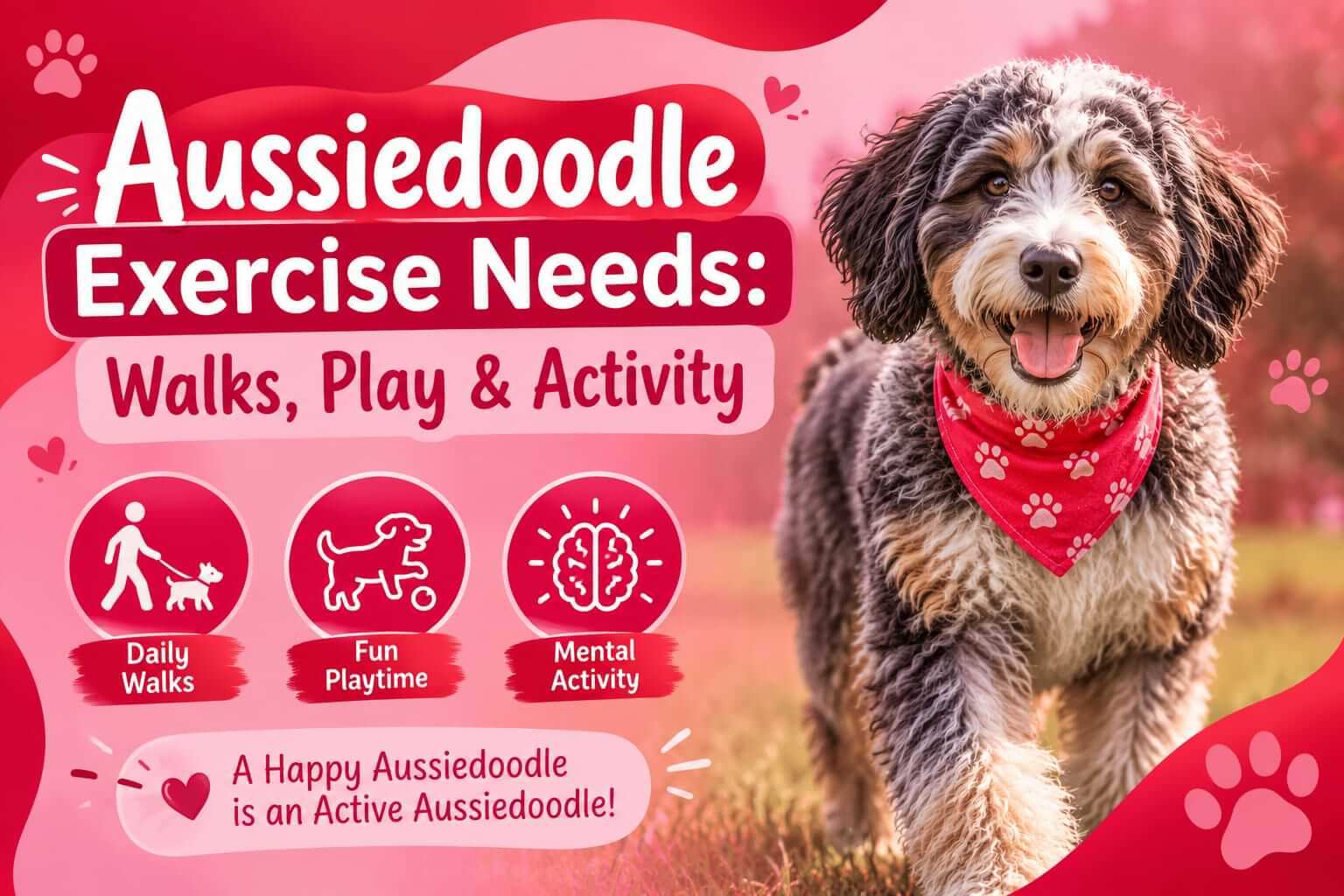
Adult Aussiedoodles require 45–90 minutes of exercise per day, divided into two sessions, with the exact amount determined by their Poodle parent’s size. Toy—cross Aussiedoodles typically need around 45 minutes, while standard-cross Aussiedoodles need approximately 90–120 minutes. Puppies follow the “5 minutes per month of age, twice a day” rule to protect growing joints.
The Guide For:
This guide is for current and prospective Aussiedoodle owners who need a concrete, age-and-size-specific exercise plan rather than a vague “moderate activity” answer. Skipping exercise doesn’t just cost fitness — an under-exercised Aussiedoodle is the single most common root cause of the barking, chewing, and hyperactivity owners later report as “behavior problems.”
Why Do Aussiedoodles Need So Much Exercise?
An Aussiedoodle — a hybrid of the Australian Shepherd, a herding breed developed to move livestock for hours at a stretch, and the Poodle, a working retriever bred for stamina in water — inherits a working-dog engine from both sides. That combination is why this breed’s exercise needs run higher than a lot of first-time owners expect, and why “how much exercise does my Aussiedoodle need” is one of the most common questions new owners ask.
Exercise Needs by Age and Size
| Life Stage | Toy Poodle Cross | Miniature Poodle Cross | Standard Poodle Cross |
|---|---|---|---|
| Puppy (3–12 months) | 5 min per month of age, 1x/day | 5 min per month of age, 2x/day | 5 min per month of age, 2x/day |
| Adult (1–7 years) | ~45 minutes/day | 60–90 minutes/day | 90–120 minutes/day |
| Senior (7+ years) | 20–30 minutes/day, gentler pace | 30–45 minutes/day, gentler pace | 45–60 minutes/day, gentler pace |
The puppy formula — 5 minutes of structured exercise per month of age, twice daily — exists because a puppy’s growth plates don’t fully close until 12–18 months. Over-exercising a growing Aussiedoodle (long runs, repeated jumping, hard surfaces) raises the risk of joint and growth-plate injury before the skeleton is ready to handle it.
Why Do Aussiedoodle Exercise Needs Vary by Size?
Vet Dr. Rebecca MacMillan puts the size effect directly: an Aussiedoodle with a Standard Poodle parent can need up to two hours of exercise a day, while a Toy Poodle cross may only need around 45 minutes. The Poodle side sets the physical ceiling; the Australian Shepherd side sets the mental floor — herding-line dogs are bred to work independently and problem-solve for hours, so even a low-exercise Toy Aussiedoodle still needs a job for its brain, not just its legs.
One real example:
A Miniature Aussiedoodle at 8 months old following the age formula gets 40 minutes of structured activity twice a day (two on-leash walks plus a training session) — noticeably less than the 60–90 minutes it will need once it reaches its first birthday and moves into the adult bracket.
Owners who keep using the puppy schedule past 12 months often see the pent-up energy show up as evening zoomies or destructive chewing.
Physical vs. Mental Exercise
A tired Aussiedoodle isn’t automatically a well-exercised one. Both parent breeds were bred for jobs that combine physical output with constant decision-making — herding requires reading livestock, retrieving requires marking and problem-solving. A 45-minute walk covers the physical side but leaves the working brain unused. Split daily activity roughly in half:
- Physical: on- or off-leash walks, fetch, swimming (many take to water from the Poodle side), structured running once fully grown
- Mental: obedience or trick training, scent games, puzzle feeders, agility-style obstacle courses
15 minutes of focused training can tire an Aussiedoodle out faster than 30 minutes of unstructured yard time, because it engages the same problem-solving drive the Australian Shepherd side was bred to use all day.
Feeding and Bloat Safety
Don’t exercise an Aussiedoodle within an hour of eating, and wait at least 30 minutes after exercise before feeding. Aussiedoodles aren’t a high-risk breed for gastric dilatation-volvulus (bloat), but any deep-chested, active dog carries some risk, and exercising on a full stomach is one of the more avoidable triggers.
Key Takeaways
- Adult exercise needs scale with Poodle-parent size: ~45 minutes (Toy), 60–90 minutes (Miniature), 90–120 minutes (Standard) per day.
- Puppies need 5 minutes of exercise per month of age, twice daily, until 12–18 months to protect developing joints.
- Split daily activity between physical exercise and mental work — the Australian Shepherd side needs a “job,” not just a walk.
- Avoid exercising within an hour of a meal to reduce bloat risk.
- An under-exercised Aussiedoodle is the most common root cause of hyperactivity, barking, and destructive behavior.
Shortest Key Takeaway:
Adult Aussiedoodles need 45–120 minutes of daily physical and mental exercise, depending on their Poodle parent’s size.
FAQs
How much exercise should an Aussiedoodle get?
Adult Aussiedoodles need 45–90 minutes of exercise daily on average, though Standard Poodle crosses can need up to 120 minutes and Toy crosses can settle around 45 minutes. Split it into two sessions and include both physical activity and mental work like training or puzzle toys.
How many hours do Aussiedoodles sleep?
Adult Aussiedoodles typically sleep 10–14 hours a day; a 2020 review in Current Opinion in Behavioral Sciences puts the average adult dog at about 10.1 hours daily, ranging from 7.7 to 16 hours depending on activity level and individual dog. Puppies sleep far more — commonly 18–20 hours a day — since sleep supports the rapid brain and bone development happening in the first year.
What are the training needs of an Aussiedoodle?
Aussiedoodles need 10–15 minutes of daily training from puppyhood. Use positive reinforcement, with a focus on obedience, socialization, recall, leash manners, and impulse control. Regular mental tasks help prevent boredom and destructive behavior.
At what age does an Aussiedoodle calm down?
Most Aussiedoodles begin to noticeably calm down around 18–24 months, as physical growth slows and adolescence ends. Some, especially Standard-size dogs and intact males, may take closer to 3 years. Consistent daily exercise and training can help reduce hyperactivity and encourage calmer behavior.
Is a tired Aussiedoodle always a well-exercised one?
No — this is the most common misconception owners have. Physical fatigue from a walk doesn’t satisfy the mental stimulation both parent breeds were bred to need; an Aussiedoodle can be physically tired and still destructive or restless if its brain wasn’t engaged. Pairing a shorter walk with 10–15 minutes of training or a puzzle feeder is usually more effective than a longer walk alone.
Do Aussiedoodles need more exercise than Goldendoodles?
Aussiedoodles generally need more mental stimulation than Goldendoodles because of the Australian Shepherd’s herding instincts. Both need exercise based on their Poodle-parent size, but Aussiedoodles are more prone to behavior issues when mentally under-stimulated.