Quick Summary:
F1 is 50% Australian Shepherd, 50% Poodle. F1B is an F1 bred back to a Poodle (~75% Poodle). F2 comes from two F1 parents. Multigen means several generations of Aussiedoodle-to-Aussiedoodle breeding to stabilize a low-shedding coat.
Shortest Key Takeaway:
More Poodle percentage = less shedding, better for allergies. More Australian Shepherd percentage = stronger hybrid vigor, less predictable coat.
Entity Disambiguation:
“Generation” means an Aussiedoodle’s breeding history (F1, F1B, F2, multigen) — not the dog’s age.
What Does “Generation” Mean in Aussiedoodles?
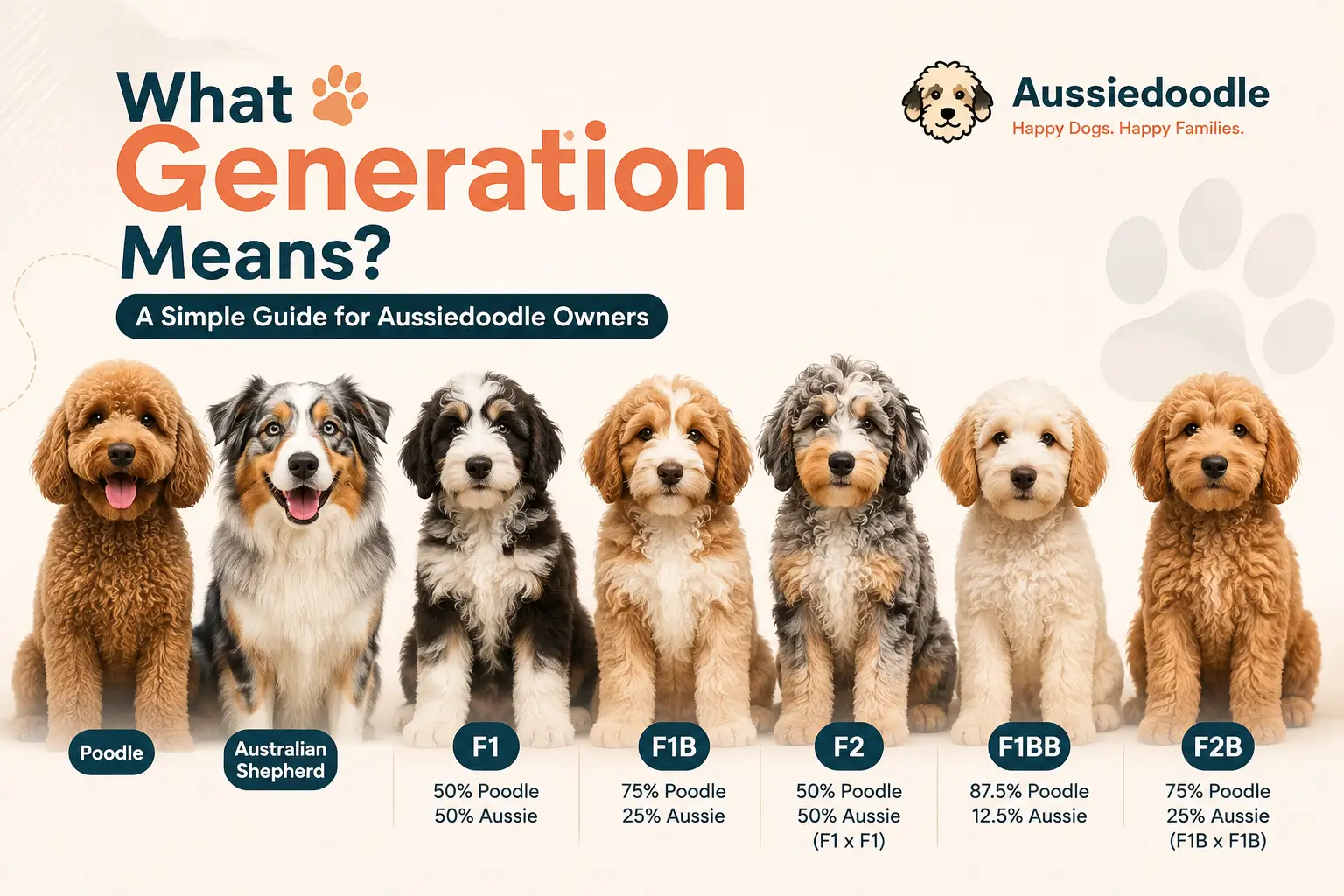
The “F” in F1, F2, etc. stands for filial — a generation of offspring. The number and letters track exactly how far back a dog’s genes trace to the original Australian Shepherd × Poodle cross, and what percentage of each breed it carries. That percentage is what drives coat type, shedding, and how predictable a litter will be.
Generation Comparison Table
| Generation | Breeding | Breed Mix | Shedding | Predictability |
|---|---|---|---|---|
| F1 | Aussie × Poodle | 50/50 | Low-moderate, variable | Low |
| F1B | F1 × Poodle | ~75% Poodle | Very low | High |
| F1BB | F1B × Poodle | ~87.5% Poodle | Minimal | Very high |
| Reverse F1B | F1 × Aussie | ~75% Aussie | Moderate-higher | Low |
| F2 | F1 × F1 | 50/50 (recombined) | Widely variable | Lowest |
| F2B | F2 × Poodle | ~62.5% Poodle | Low | Moderate-high |
| Multigen (F3+) | Aussiedoodle × Aussiedoodle | Stabilized | Consistently low | Highest |
| Ultra Aussiedoodle | Multigen bred for max coat consistency | Heavily Poodle | Lowest | Very high |
F1: The Original Cross
An F1 is a direct 50/50 cross. Because neither parent breed has been crossed before, F1s carry the widest genetic diversity — which is the biological basis of hybrid vigor: crossbred offspring tend to avoid the concentrated inherited issues seen in closely related purebred lines.
<cite index=”26-1″>VetCompass-based research notes hybrid vigor has been demonstrated across species for traits like viability and longevity</cite>. The trade-off: coat and shedding are the least predictable of any generation.
F1B, F1BB, and Reverse F1B
F1B (F1 bred back to a Poodle) lands around 75% Poodle — the generation most allergy-focused families choose. F1BB pushes to ~87.5% Poodle for the most consistently low-shedding coat outside multigen.
Reverse F1B flips this, backcrossing to an Australian Shepherd instead — a niche choice for buyers who want classic Aussie temperament over low shedding.
F2, F2B, and Multigen
F2 (two F1 parents bred together) has the same 50/50 percentage as F1 but recombined genetics, making it the least predictable generation — littermates can vary widely. F2B narrows that by backcrossing to a Poodle.
Multigen (F3 and beyond) is several generations of Aussiedoodle-to-Aussiedoodle breeding aimed at stabilizing coat, size, and temperament. Ultra Aussiedoodle is multigen bred specifically for the lowest possible shedding, at the highest price point.
The Genes Behind the Percentages
Four genes actually determine what a breed percentage produces: RSPO2 (facial furnishings), KRT71 (curl), the SD locus (shedding amount), and FGF5 (coat length). This is why percentage alone isn’t a perfect predictor — a dog can be mostly Poodle by percentage and still shed more than expected without the low-shedding SD variant.
Breeders who test parent dogs for these genes give far more accurate coat predictions than generation label alone.
How Does Generation Affect Allergies in Aussiedoodles?
Roughly, from most to least allergy-friendly: Ultra/high multigen → F1BB → F1B → F2B → early multigen → F2 → F1 → Reverse F1B. No generation is guaranteed hypoallergenic — allergens come mostly from dander and saliva, not fur, so lower shedding reduces but doesn’t eliminate exposure.
Generation and Health: Why Diversity Matters?
Every backcross and multigen step narrows genetic diversity slightly versus the original F1 cross. Geneticists track this with the coefficient of inbreeding (COI) — the odds a dog inherits duplicate genes from a shared ancestor.
<cite index=”21-1″>Independent analysis of VetCompass data has linked higher inbreeding coefficients directly to shorter life expectancy in dogs</cite>, which is the practical health case for an F1’s wider gene pool — and why a responsible multigen breeder should be able to show you COI data on their pairs, not just a generation label.
Choosing a Generation
- Severe allergies: F1BB, Ultra, or a low-COI multigen line
- Mild sensitivity: F1B or F2B
- No allergy concerns, want max hybrid vigor: F1
- Want classic Aussie temperament: Reverse F1B
- Want the most predictable litter: an established multigen line, gene-tested
Ask any breeder for the specific pairing behind a litter — not just the generation label — plus genetic test results and COI where available.
FAQs
What’s the difference between F1 and F1B?
F1 is a direct 50/50 Aussie-Poodle cross; F1B is that F1 bred back to a Poodle, landing near 75% Poodle with lower, more consistent shedding.
Is multigen better than F1?
Not objectively — multigen gives predictable low shedding; F1 gives stronger hybrid vigor and health diversity. They optimize for different things.
Is generation still worth tracking in 2026?
Yes — it’s a real, traceable percentage, though the best breeders now pair it with genetic testing rather than relying on the label alone.
Does generation affect price?
Yes — F1BB, multigen, and Ultra lines cost more because they require more controlled breeding cycles and often genetic testing.
Do all puppies in a litter share the same traits?
No — especially in F1 and F2 litters, individual puppies can vary significantly from their labeled “average.” Multigen and F1BB litters are far more uniform.