Quick Answer:
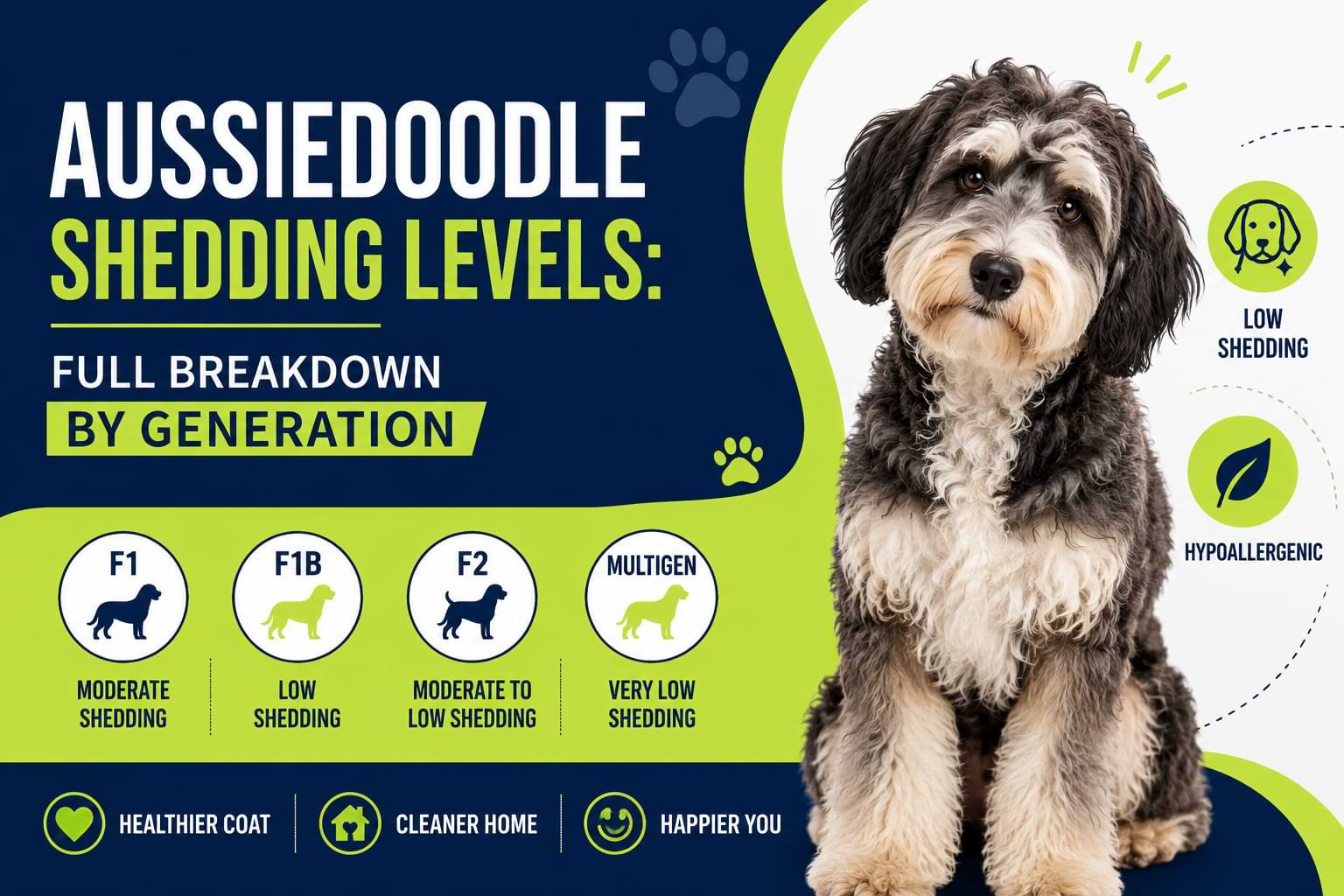
Aussiedoodle shedding depends almost entirely on generation and coat type, not on the breed name alone. F1 Aussiedoodles (50% Australian Shepherd, 50% Poodle) usually shed lightly to moderately, especially if they inherit a looser, straighter coat. F1B and F1BB Aussiedoodles (75%+ Poodle) shed the least because they inherit more of the Poodle’s curl genetics. No Aussiedoodle is truly non-shedding, and peer-reviewed allergen research has found no dog breed is genuinely hypoallergenic — so shedding level is a useful planning factor, but not a guarantee against allergies.
Entity Disambiguation:
An Aussiedoodle is a cross between an Australian Shepherd and a Poodle, not a purebred dog recognized by major kennel clubs. F1, F1B, F2B describe how many Poodle “backcross” breedings are in a dog’s ancestry — the higher the letter/B count, the more Poodle genetics it carries. “Blowing coat” refers to a dog shedding its undercoat heavily over a short window, usually tied to seasonal daylight change, and is different from the low-level shedding a dog does year-round.
Shortest Key Takeaway:
Poodle-heavy generations with curly coats shed the least; Aussie-heavy generations with straighter coats shed the most — and neither is allergy-proof.
If you’re weighing an Aussiedoodle against your allergies or your vacuum cleaner’s workload, the honest answer is: it depends which Aussiedoodle you end up with. This guide breaks down exactly why, using the same coat-genetics and allergen research that groomers and veterinary dermatologists reference — not just breeder marketing.
How Much Do Aussiedoodles Shed, by Generation?
| Generation | Poodle % | Typical Coat | Shedding Level |
|---|---|---|---|
| F1 (Aussie x Poodle) | 50% | Wavy, sometimes straight | Light to moderate |
| F1B (F1 x Poodle) | 75% | Curly to wavy | Very low |
| F1BB (F1B x Poodle) | 87.5% | Tight curl | Very low, close to non-shedding |
| F2 (F1 x F1) | 50% | Variable — can favor either parent | Moderate, unpredictable |
| F2B (F2 x Poodle) | 62.5%–75% | Wavy to curly | Low |
| Multigen (F3+) | 87.5%+ | Consistently curly | Very low |
Generation is the single strongest predictor of shedding, because it sets the rough ratio of Poodle-to-Australian-Shepherd genetics a puppy inherits. But it’s a probability, not a guarantee — two puppies from the same F1B litter can still land on slightly different points of the coat spectrum.
Why Shedding Varies: The Genetics Behind the Coat
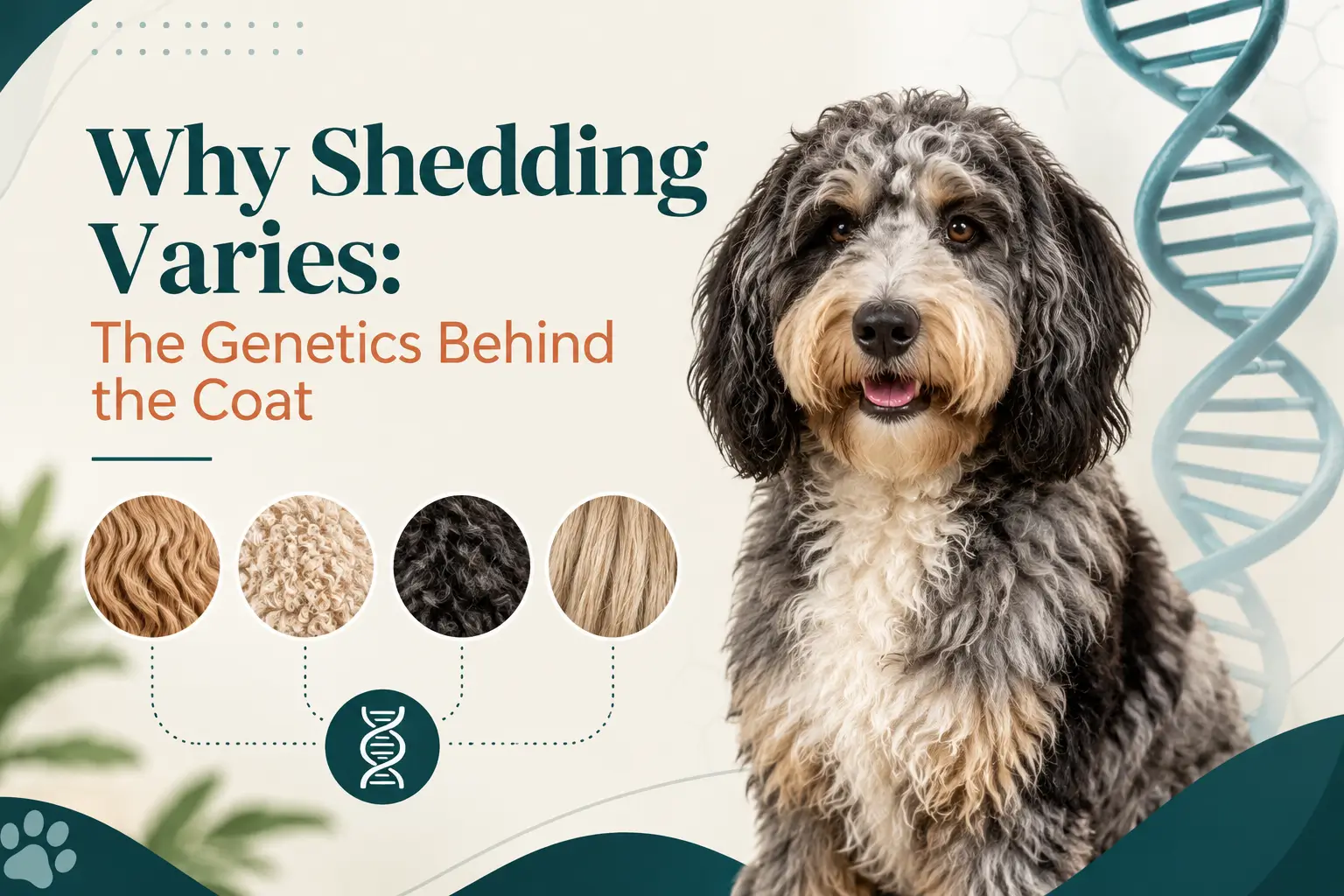
Coat type in dogs isn’t governed by hundreds of genes — it comes down mainly to three. A 2009 genome-wide study in the journal Science examined more than 1,000 dogs across 80 breeds and found that variants in three genes — RSPO2 (the “furnishings” gene, responsible for eyebrows and a beard), FGF5 (hair length), and KRT71 (curl) — account for most coat phenotypes in purebred dogs.
In plain terms: an Aussiedoodle that inherits the Poodle’s curl-producing KRT71 variant and the furnishings-producing RSPO2 variant will grow a tighter, curlier coat that traps loose hair close to the skin instead of releasing it — which is why curly coats look like they “shed less,” when what’s really happening is that the dead hair gets caught in the curl rather than falling to the floor.
That’s also why curly-coated Aussiedoodles need more brushing, not less: the hair is still shedding, it’s just not landing on your furniture until it mats.
Aussiedoodles that favor the Australian Shepherd side and carry the double-coat trait — a soft insulating undercoat beneath a coarser topcoat — will shed that undercoat in clumps during seasonal transitions, a process groomers and owners commonly call “blowing coat.” This is a normal, temperature-and-daylight-driven process, not a health problem, and it’s most noticeable in spring and fall.
Coat Type and Shedding: Curly, Wavy, and Straight
- Curly coat: Closest to the Poodle. Traps shed hair inside the curl. Lowest visible shedding, highest matting risk without regular brushing.
- Wavy/fleece coat: The most common Aussiedoodle coat. Sheds lightly, easier to maintain than a tight curl, moderate matting risk.
- Straight/flat coat: Closest to the Australian Shepherd. Can carry a true double coat and will shed the most, especially seasonally.
Are Aussiedoodles Actually Hypoallergenic?
This is where a lot of shedding guides quietly get it wrong. Low shedding and being hypoallergenic are not the same thing, and the research backs that up clearly.
A 2012 study in the Journal of Allergy and Clinical Immunology measured Can f 1, the primary protein that triggers most dog allergies, in the hair, coat, and home environments of dogs marketed as “hypoallergenic” — including Labradoodles and Poodles — against non-hypoallergenic breeds like Labrador Retrievers.
The result: so-called hypoallergenic breeds actually had higher Can f 1 levels in their hair and coat samples, and there was no meaningful difference in allergen levels measured in the homes themselves.
Dr. Tania Elliott, an allergist and spokesperson for the American College of Allergy, Asthma and Immunology, has explained that the “hypoallergenic” label became attached to low-shedding breeds mostly through word of mouth, not clinical evidence — because people assumed less visible hair meant less allergen exposure. In reality, most dog allergy reactions come from dander (dead skin cells) and proteins in saliva and urine, which a low-shedding coat doesn’t eliminate.
Practical takeaway:
Alow-shedding Aussiedoodle will likely mean less visible hair on your clothes and furniture, and possibly a more manageable environment for mild allergy sufferers — but it is not a medical guarantee, and anyone with a diagnosed dog allergy should spend real time with an individual dog (ideally an adult, since puppy coats can still shift) before committing.
What This Looks Like in Practice?
Over multiple Aussiedoodles raised from puppy to senior, the difference between generations has been the most reliable thing I’ve observed — more reliable than anything a breeder guessed at the time of placement. An F1 in my own experience carried a looser wave and needed a weekly brush, plus visibly more hair around the house during the spring coat change.
A later F1B needed brushing more often — every two to three days, because the tighter curl mats fast — but almost nothing showed up on furniture or clothing even during shedding season. Same breed mix, same household, genuinely different day-to-day experience, and it tracked exactly with what the generation percentages predict.
Managing Shedding Day to Day
- Brush curly and wavy coats every 2–3 days; straighter, double coats 2–3 times a week, more during seasonal blowouts.
- Use a slicker brush for curls and a undercoat rake for straighter, double-coated Aussiedoodles.
- A consistent bath schedule helps loosen dead undercoat before it mats — see our Aussiedoodle Bath Frequency guide for how often that should be.
- Diet and skin health affect coat quality; a dog shedding unusually heavily outside of a seasonal window is worth a vet check, not just a new brush.
- If you’re still deciding which generation fits your household, our Aussiedoodle Lifestyle & Match Quiz factors in shedding tolerance alongside energy level and living space.
Key Takeaways
- Generation predicts shedding better than the breed name alone — F1B and higher Poodle-percentage dogs shed the least.
- Curly coats don’t shed less hair; they trap it, which is why they need more frequent brushing.
- “Blowing coat” is normal seasonal undercoat loss, most common in Aussie-leaning coats.
- No dog, including high-Poodle-percentage Aussiedoodles, is scientifically proven hypoallergenic — Can f 1 allergen research found no meaningful difference in home allergen levels by breed.
- Meet the individual adult dog if allergies are a serious concern; generation odds are not a medical guarantee.
FAQs
Do Aussiedoodles shed as much as Australian Shepherds?
No. Even Aussie-leaning Aussiedoodles shed noticeably less than a purebred Australian Shepherd, because every Aussiedoodle carries at least some Poodle genetics that soften the double coat. A straight-coated F1 will still shed more than a curly F1B, but less than a purebred Aussie.
Are Aussiedoodles really hypoallergenic?
Not in a way backed by clinical evidence. Peer-reviewed allergen research (Vredegoor et al., 2012) found no proof that any breed, including low-shedding “hypoallergenic” ones, produces meaningfully less allergen in the home. Lower shedding can mean less visible hair, but not a guaranteed reduction in allergy triggers.
Which Aussiedoodle generation sheds the least?
F1B and F1BB Aussiedoodles, which carry 75% or more Poodle genetics, shed the least and are generally the closest to non-shedding.
Do Aussiedoodles blow their coat seasonally?
Aussiedoodles with more Australian Shepherd influence and a true double coat can “blow coat” — shed the undercoat heavily — during spring and fall daylight transitions. Curly, Poodle-heavy coats rarely do this.
How can I tell how much my Aussiedoodle puppy will shed?
Ask the breeder for the puppy’s specific generation (F1, F1B, F2B, etc.) and, if possible, see the coat type of both parents. Puppy coats can still shift somewhat by 12–18 months, so generation percentage is a better predictor than a young puppy’s current coat feel.
How much does it cost to manage Aussiedoodle shedding?
Budget for a slicker brush or undercoat rake ($15–$30), and professional grooming every 6–8 weeks for curly/wavy coats ($60–$100 per session), more often for double-coated dogs during seasonal shedding.
Is an Aussiedoodle still a good choice in 2026 if you have allergies?
It can be, if you manage expectations correctly: choose a higher-Poodle-percentage generation, meet the adult dog beforehand if possible, and understand that “low shedding” is a real, useful trait — but “hypoallergenic” is a marketing term the research doesn’t fully support.