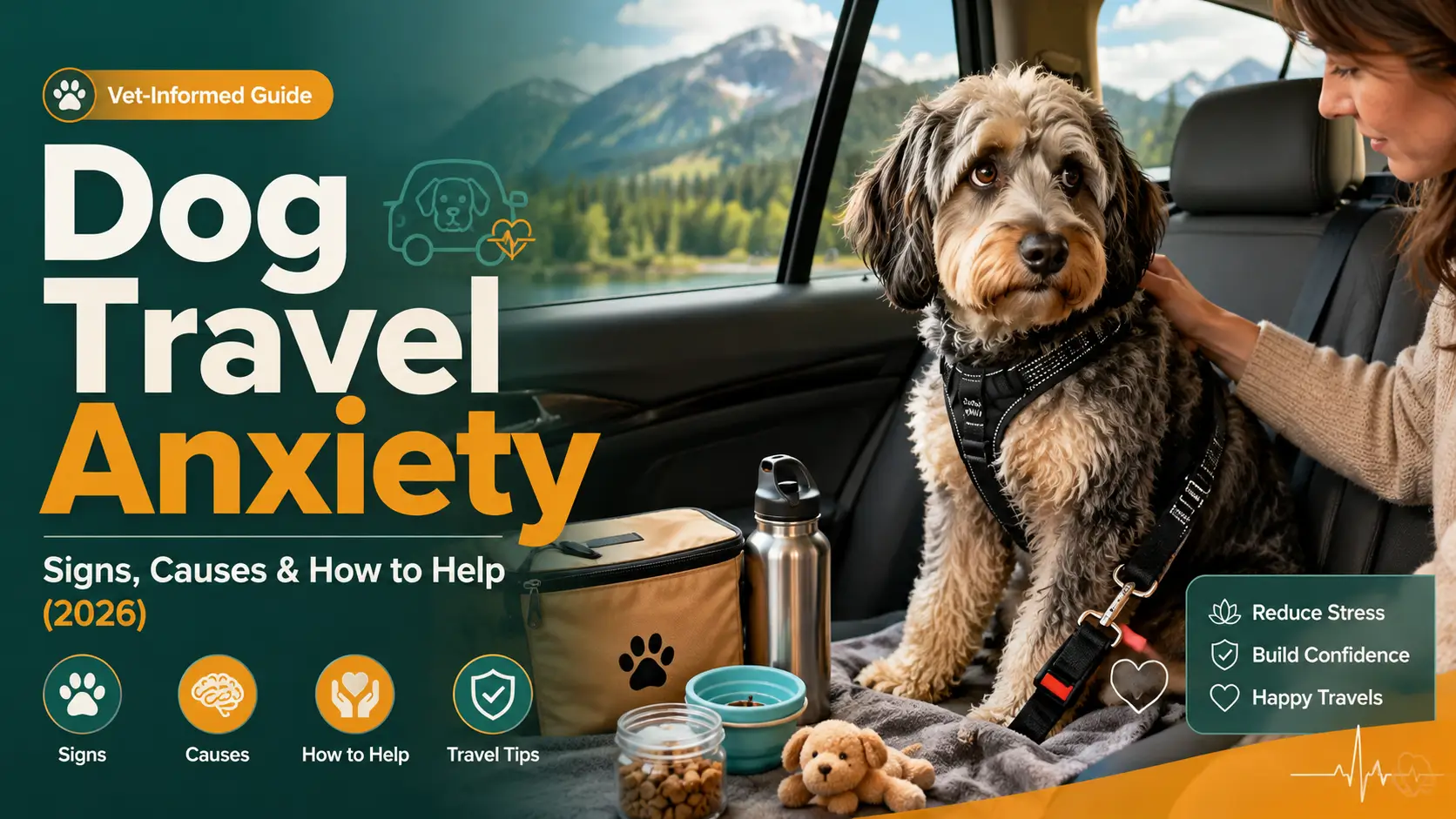
Quick Summary:
Dog travel anxiety is stress triggered by car rides or unfamiliar travel, often causing symptoms such as panting, drooling, pacing, whining, or reluctance to load. It affects roughly 25–40% of dogs. Aussiedoodles may be especially sensitive due to the combination of traits from both parent breeds. Desensitization is the first-line approach, with medication reserved for cases that need additional support.
Shortest Key Takeaway:
If your dog dreads the car, it’s usually learned fear, not stubbornness — and it’s trainable.
What’s the Difference Between Travel Anxiety and Motion Sickness in Dogs?
“Travel anxiety” is a fear/stress response to the act of traveling — not the same thing as motion sickness, which is a physical nausea response to movement. A dog can have either, both, or neither, and the fix is different for each.
What Dog Travel Anxiety Actually Is?
Dog travel anxiety is an emotional stress response to car rides, air travel, or unfamiliar environments — not a behavioral flaw and not the same condition as motion sickness. It shows up as drooling, panting, restlessness, whining, trembling, or refusal to enter the car, and it usually stems from one of three things: physical discomfort (motion sickness), a learned negative association (the car always ends at the vet), or general environmental overload from unfamiliar sights, sounds, and smells.
Research published in Frontiers in Veterinary Science has shown that car travel elevates cortisol and heart rate in dogs — both standard physiological stress markers — which is part of why a dog that “just doesn’t like the car” often isn’t being dramatic. The stress response is measurable, not imagined.
How Common It Actually Is
Two peer-reviewed surveys give a real range instead of a vague “many dogs” claim. A 2010 epidemiology study in the Journal of Veterinary Behavior surveyed 155 dogs and found 43.6% showed travel-related problems, with panting (47.7%), restlessness (43.1%), and vocalizing (40%) as the leading signs.
A separate 2012 survey of 907 dog owners published in Veterinary Record found a lower but still significant rate — roughly one in four dogs showed some travel-related issue, with about 6.7% of dogs reacting negatively every single time they traveled.
Related vet-visit data adds context: at the 2019 WSAVA Congress, presenters cited that 77.8% of dogs and cats studied were already fearful before entering the clinic — meaning for a lot of dogs, the anxiety isn’t really about the car itself, it’s about where the car is going.
Why Aussiedoodles Run Hotter on This Than Average?
 Aussiedoodles can be prone to car anxiety and heightened reactivity because both parent breeds are highly alert and sensitive. The Australian Shepherd side may make them quick to notice unfamiliar sounds, movement, smells, and changes around the vehicle, while the Poodle side can contribute to environmental and emotional sensitivity. As a result, stressful handling or an anxious owner may increase a sensitive Aussiedoodle’s arousal during car travel.
Aussiedoodles may inherit the MDR1 (ABCB1) mutation from their Australian Shepherd lineage. Washington State University’s College of Veterinary Medicine reports that MDR1 variants are more common in herding breeds, including Australian Shepherds, and can cause serious reactions to certain medications, including acepromazine.
Before using medication for travel anxiety, discuss your dog’s medication history and MDR1 status with a veterinarian; genetic testing can determine whether the mutation is present..
Symptoms: Anxiety vs. Motion Sickness
| Sign | More Likely Travel Anxiety | More Likely Motion Sickness |
|---|---|---|
| Timing | Starts before the car even moves, or at the sight of the leash/carrier | Starts once the car is in motion |
| Drooling | Present, often with pacing/whining | Present, often with lip-licking, then vomiting |
| Vomiting | Uncommon unless anxiety is severe | Common |
| Settles with stillness | No — anxiety persists even parked | Yes — symptoms ease when the car stops |
| Response to destination | Worse en route to vet/groomer, better en route to park | Consistent regardless of destination |
If it’s unclear which one you’re dealing with, a vet visit is the right next step — both conditions are manageable, but they’re treated differently, and a dog can genuinely have both at once.
What Actually Helps Dogs With Car Anxiety?
Desensitization and counterconditioning are effective ways to reduce car anxiety in dogs. Start with short, positive car exposures and gradually increase driving time while using treats or play. A brief walk before the trip, a familiar blanket, secure restraint, and a cool car can also improve comfort. Taking occasional fun trips can help dogs stop associating car rides only with stressful destinations.
Medication is a backup, not a first move, and should always go through a vet — especially for an Aussiedoodle, given the MDR1 consideration above. Trazodone is one of the more commonly prescribed situational options for travel-related anxiety in dogs; if your vet has recommended it, the site’s Trazodone Dosage Calculator for Dogs is a useful reference for the dosing conversation — it isn’t a substitute for a vet’s prescription, but it helps you understand the range being discussed.
When to Call a Vet?
Persistent vomiting, a dog that never improves despite weeks of gradual desensitization, or anxiety severe enough that the dog injures itself trying to escape a crate or seatbelt are all reasons to loop in a vet or a certified veterinary behaviorist rather than continuing to manage it alone.
FAQs
Is my dog’s car anxiety a training problem or a medical one?
It can be either, and often it’s both. Learned fear (bad associations, lack of exposure) responds well to desensitization training. Physical discomfort from motion sickness needs a vet’s input, since anti-nausea medication won’t fix fear-based anxiety and desensitization alone won’t fix true motion sickness.
Is dog travel anxiety still a real concern in 2026, or is it overstated?
It’s a documented, measurable condition — not overstated. Peer-reviewed surveys put the rate of travel-related problems in dogs somewhere between roughly one in four and four in ten, and researchers have recorded elevated cortisol and heart rate in dogs during car travel, confirming the stress response is physiological, not just behavioral guessing.
How is travel anxiety different from separation anxiety in an Aussiedoodle?
Travel anxiety is triggered by the car, carrier, or destination itself and can happen with the owner present the whole time. Separation anxiety is triggered by being left alone, regardless of whether a car is involved. Aussiedoodles are prone to both because of the same underlying breed sensitivity, but they’re addressed with different training approaches — see the site’s separation anxiety guide for that specific issue.
Are calming wraps and pheromone sprays actually worth trying before medication?
They’re reasonable first steps for mild cases and carry low risk. Pressure wraps and synthetic dog-appeasing pheromone products are commonly recommended as an early-stage, non-drug option, though owners should still address the underlying desensitization training rather than relying on a wrap alone to solve a car-avoidance habit that’s already established.
Can I just give my Aussiedoodle Benadryl or a sedative I have at home before a trip?
Not without checking with a vet first. Beyond the general risk of getting dosing wrong, Aussiedoodles carry Australian Shepherd ancestry, which is linked to the MDR1 gene mutation affecting how some sedatives are metabolized — a normal dose in a non-herding breed can cause a severe reaction in an MDR1-affected dog. A vet visit (and MDR1 testing, if not already done) is the safer starting point.
How long does it typically take to desensitize a dog to car travel?
It varies by dog and severity, but most desensitization protocols run several weeks of short, gradually lengthening sessions rather than days. Dogs with mild anxiety may improve faster; dogs with a strong negative association (repeated bad vet trips, for example) usually need a longer, more patient timeline.
Does motion sickness usually go away as puppies get older?
It’s common in puppies and many do outgrow it as their inner ear and balance mature, but not all do — some adult dogs continue to experience motion sickness and need ongoing management or vet-prescribed anti-nausea medication for travel.