Quick Answer:
An Aussiedoodle emergency care checklist covers three things: knowing your dog’s normal vital signs, having a stocked first-aid kit with emergency contact numbers on hand, and knowing which symptoms mean “call now” versus “go now.” This matters most for Aussiedoodle owners because the breed’s Poodle lineage carries elevated bloat (GDV) risk and its Australian Shepherd lineage can carry the MDR1 drug-sensitivity mutation — two breed-specific factors that change how fast you need to act. Build the kit and learn the numbers before an emergency happens, not during one.
Every dog owner hopes they’ll never need this information. The dogs that do best in an emergency are the ones whose owners already knew what “normal” looked like and had a plan ready. That’s the whole purpose of an emergency care checklist: it turns a panicked 2 a.m. decision into a rehearsed one.
What Counts as a Dog Emergency?
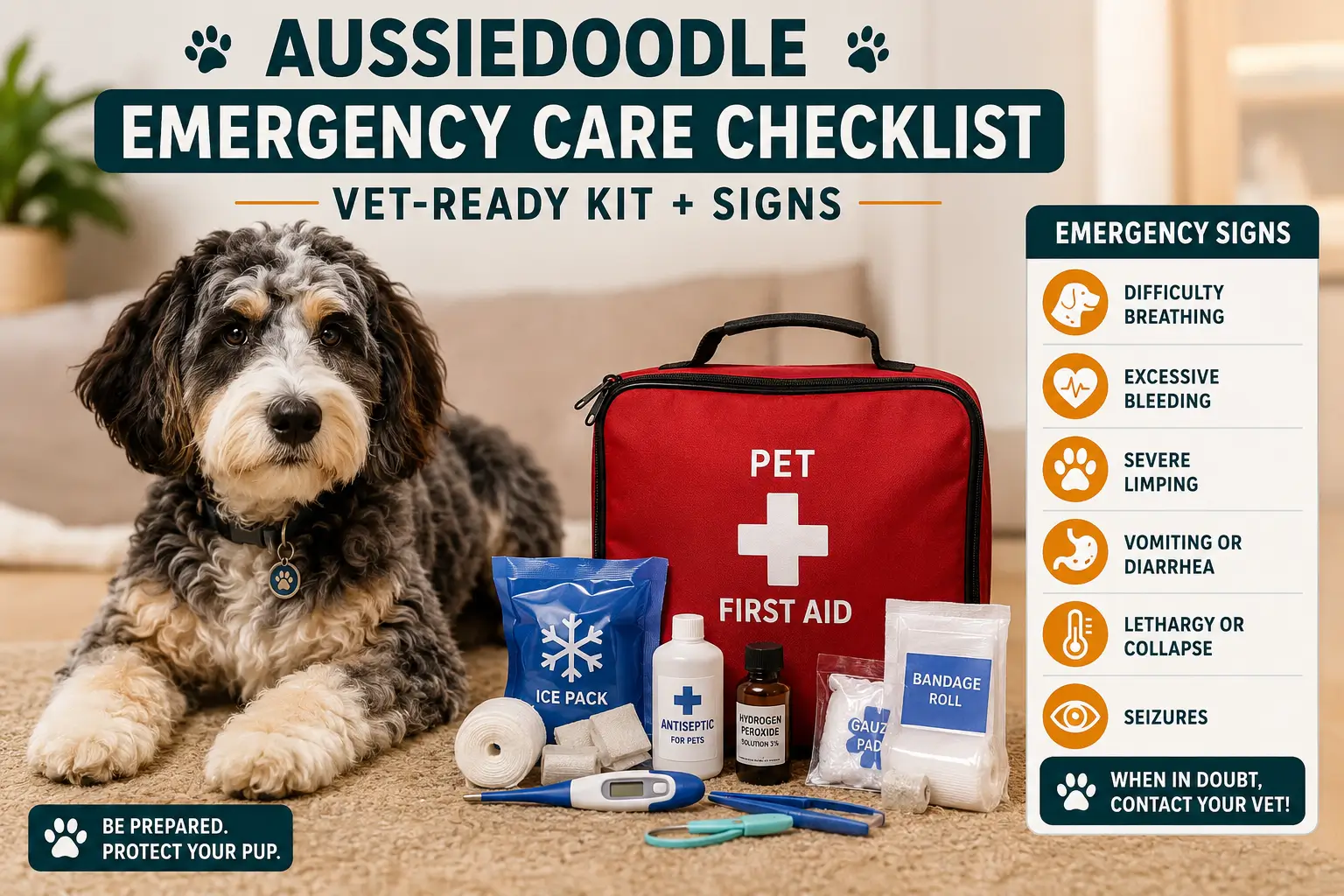
A true emergency is anything that could become life-threatening within minutes to hours: collapse, seizures, uncontrolled bleeding, labored breathing, a swollen or distended abdomen, repeated unproductive retching, suspected poisoning, or a body temperature outside the normal range. Less urgent issues — a limp with no swelling, mild vomiting once, a small surface scrape — still deserve a same-day vet call, but they don’t require an emergency-room trip.
Know Your Dog’s Normal Vital Signs
You can’t recognize “abnormal” without knowing “normal” first.
| Vital sign | Normal range (adult dog) | Concerning |
|---|---|---|
| Temperature | 101.0–102.5°F (38.3–39.2°C) | Below 99°F or above 104°F |
| Heart rate | 60–140 beats per minute (varies with size) | Very fast, very slow, or irregular |
| Breathing rate | 10–35 breaths per minute at rest | Rapid, shallow, open-mouth breathing at rest |
| Gum color | Bubblegum pink, snaps back in under 2 seconds when pressed | Pale, white, blue, or brick red; slow snap-back |
Check your dog’s resting vitals once when they’re healthy so you have a baseline to compare against later.
Build the Kit Before You Need It
A functional Aussiedoodle emergency kit includes:
- Sterile gauze pads and self-adhering bandage wrap
- Antiseptic wipes or spray made for animals
- Blunt-tip scissors and tweezers
- A digital rectal thermometer
- 3% hydrogen peroxide (only used if a vet or poison control tells you to induce vomiting — never on your own judgment)
- Printed vaccination records, current medications, and your dog’s weight
- Muzzle or soft strip of cloth (even gentle dogs may bite in pain)
- Contact numbers: your regular vet, the nearest 24-hour animal ER, and ASPCA Animal Poison Control at (888) 426-4435
Poisoning: The Numbers Behind the Risk
In 2024, the ASPCA Animal Poison Control Center responded to more than 451,000 calls related to toxic substance, plant, and poison exposures in animals, a nearly 4% increase from the year before. Over-the-counter human medications were the single largest category, making up 16.5% of exposures, with food and drink — including the sweetener xylitol, along with grapes, raisins, onions, garlic, and chocolate — close behind at 16.1%. Keep these items stored where your dog cannot reach them, and if you suspect ingestion, call poison control immediately rather than waiting for symptoms.
Aussiedoodle-Specific Risks Most Checklists Skip
| Risk | Why it applies to Aussiedoodles | What to do |
|---|---|---|
| MDR1 drug sensitivity | A gene mutation common in herding breeds, including Australian Shepherds, that can prevent some drugs from clearing the brain normally, causing severe reactions to standard doses. | Ask your vet about MDR1 testing and flag it before any sedation, anesthesia, or antiparasitic prescription. |
| Bloat (GDV) risk | A 2026 Dog Aging Project cohort study in the Journal of the American Veterinary Medical Association newly identified Poodles and Poodle mixes as the breed group with the highest occurrence of GDV, ahead of Great Danes and German Shepherds. | Learn the signs — a distended abdomen, unproductive retching, restlessness, and rapid breathing — and treat any of them as a “go now” emergency, not a “wait and see.” |
What to Do in the First Five Minutes?
- Stay calm and restrain gently. A muzzle or cloth strip protects you; even a friendly dog may snap when frightened or in pain.
- Check airway, breathing, and gum color before anything else.
- Control visible bleeding with direct pressure using gauze — don’t remove a soaked pad, add more on top.
- If bloat is suspected (distended belly, retching without vomit, restlessness), do not give food, water, or home remedies — go straight to an emergency vet.
- If poisoning is suspected, call ASPCA Poison Control or your vet before attempting any home treatment; some substances make vomiting more dangerous, not less.
- Call ahead to the ER so the team is ready when you arrive.
When to Call vs. When to Go Now?
Call your regular vet for guidance when symptoms are mild, isolated, and your dog is otherwise alert and eating. Go straight to an emergency vet for collapse, seizures, a distended or hard abdomen, pale or blue gums, uncontrolled bleeding, suspected poisoning, or a temperature outside the normal range. When in doubt, treat it as “go now” — the cost of an unnecessary ER visit is far lower than the cost of a delayed one.
Having raised Aussiedoodles through multiple life stages, the pattern that matters most isn’t any single symptom — it’s trusting a sudden, out-of-character change in behavior even before other signs show up. Dogs are good at masking pain, and a subtle shift in energy or posture is often the earliest warning sign available.
Key Takeaways
- Know your dog’s normal temperature (101.0–102.5°F), heart rate, breathing rate, and gum color so you can spot deviations fast.
- Build and store an emergency kit — with vet, ER, and poison control numbers — before a crisis, not during one.
- OTC medications and food items like xylitol, grapes, and chocolate are the leading causes of the 451,000+ annual ASPCA poison control calls.
- Aussiedoodles carry two breed-specific risk factors: possible MDR1 drug sensitivity from Australian Shepherd lineage, and elevated GDV/bloat risk from Poodle lineage.
- A distended abdomen with unproductive retching is a “go now” emergency — never a “wait and see” situation.
FAQs
Is bloat really a concern for Aussiedoodles, since they’re not a giant breed?
Yes. A 2026 JAVMA study of the Dog Aging Project cohort found Poodles and Poodle mixes had the highest occurrence of GDV of any breed group studied, which extends the risk to Poodle-crosses like Aussiedoodles regardless of overall body size.
What is MDR1 and should I test my Aussiedoodle for it?
MDR1 is a gene mutation common in herding breeds that can cause severe reactions to standard doses of certain sedatives, anesthetics, and antiparasitic drugs. Since Aussiedoodles carry Australian Shepherd ancestry, ask your vet about a simple cheek-swab MDR1 test before any procedure requiring sedation.
Is a dog first-aid kit still worth having in 2026 with 24/7 vet telehealth available?
Yes. Telehealth is useful for guidance, but a stocked kit still lets you control bleeding, take an accurate temperature, and reach poison control or an ER faster — none of which telehealth can do for you in the first critical minutes.
How is a dog emergency kit different from a general first-aid kit for humans?
A dog kit needs animal-safe antiseptic (human products can be toxic if licked), a rectal thermometer, and — critically — it should never include human pain relievers, since drugs like ibuprofen and acetaminophen are toxic to dogs even at doses safe for people.
What’s the single fastest way to tell if my dog needs the ER right now?
Check gum color and breathing. Pale, white, or blue gums combined with labored breathing are among the clearest signs of a true emergency and should never wait for a “let’s see how it goes” approach.
When should I call ASPCA Poison Control versus just going to the vet?
Call poison control immediately if you know or suspect what your dog ingested — they can tell you within minutes whether it’s dangerous at that dose and whether home care or an ER visit is needed, which is faster than waiting for a vet appointment.