Quick answer
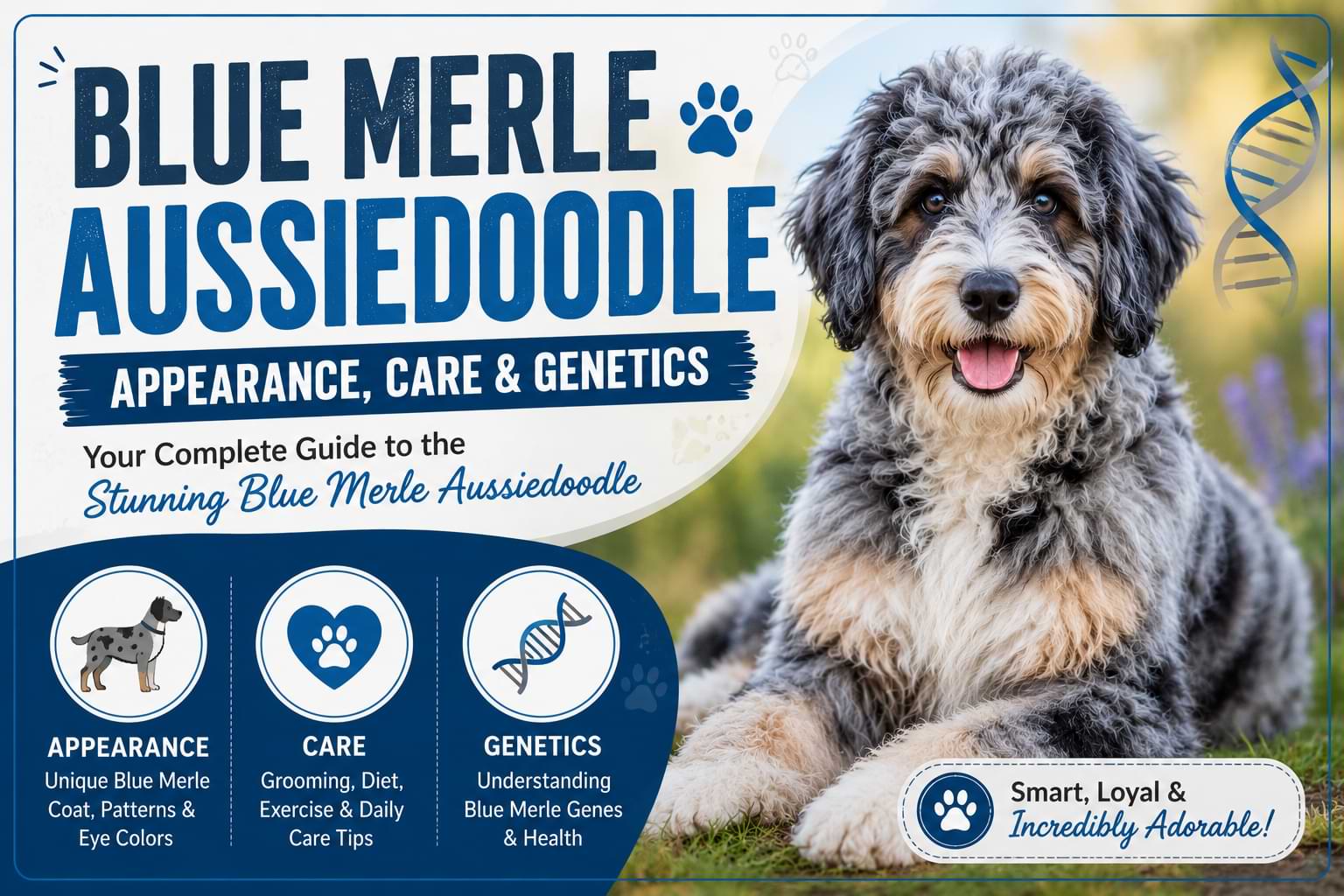
A Blue Merle Aussiedoodle is an Aussiedoodle (Australian Shepherd x Poodle) carrying one copy of the merle gene on a black-based coat, which produces a marbled pattern of gray, black, and white. Expect to pay $1,500–$4,500 from a health-tested breeder, and never pair two merle-carrying parents — that combination produces “double merle” puppies with a high risk of blindness and deafness.
Quick Facts
| Trait | Detail |
|---|---|
| Base color required | Black (not red/liver) |
| Pattern | Marbled gray, charcoal, and black patches over a lighter base |
| Eye color | Blue, amber, brown, or split/marbled (“odd eyes”) |
| Typical price | $1,500–$4,500, breeder and size dependent |
| Rarity | Uncommon but not rare — one of the more sought-after Aussiedoodle colors |
| Key health risk | Only in “double merle” pairings (merle x merle), not in single-merle dogs |
| Coat change | Pattern often softens or “fades” as the adult coat grows in |
What Is a Blue Merle Aussiedoodle?
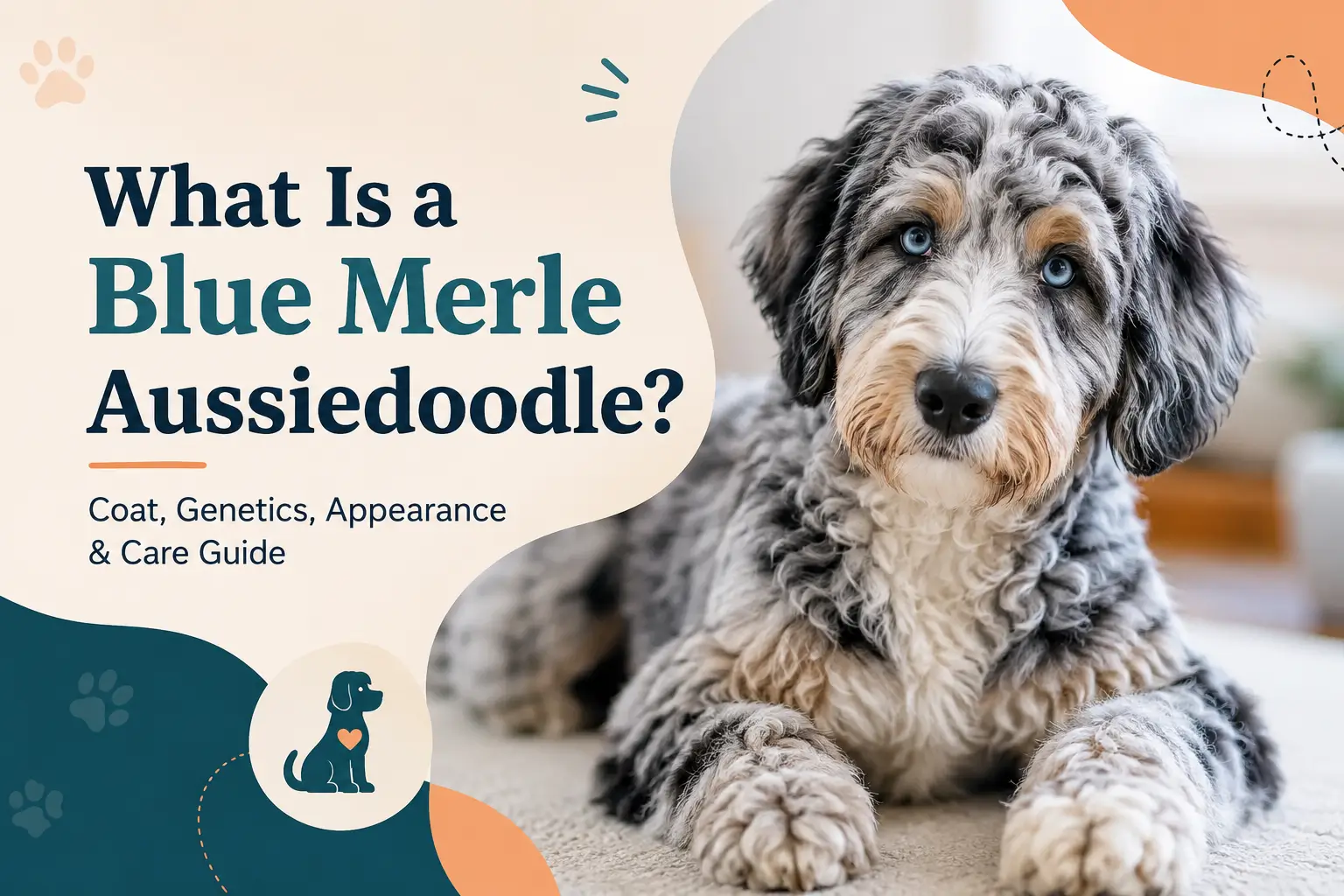
A Blue Merle Aussiedoodle is simply an Aussiedoodle whose coat carries the merle gene on a black pigment base. The merle gene doesn’t add color — it dilutes patches of the existing black pigment into gray and slate, leaving the rest of the coat its natural shade. The result is the marbled, almost watercolor look that makes this one of the most photographed Aussiedoodle colors.
Because the Australian Shepherd side of the Aussiedoodle’s ancestry carries merle naturally, this color shows up across generations — F1, F1B, F2, and multigenerational litters can all produce blue merle puppies, though the odds depend on which parent dogs carry the gene.
“Blue” in blue merle doesn’t mean the dog is literally blue. It’s dog-breeding shorthand for a diluted black — the same naming convention used in Australian Shepherds, Border Collies, and other merle breeds.
What Causes the Blue Merle Coat?
The merle pattern comes from a single dominant gene (often written as the M allele) that interrupts pigment production in random patches during coat development. One copy of the gene (Mm) produces the classic merle look with no health effects tied to the gene itself. The base coat color underneath determines whether the result reads as blue merle (on a black base) or red merle (on a red/liver base).
A puppy needs at least one merle-carrying parent to be born merle. Whether that puppy is blue or red merle depends on which base-color genes it inherits alongside the merle allele — not on which parent is which color.
Blue Merle vs. Other Aussiedoodle Colors
| Color | Base pigment | Common features | How it compares to blue merle |
|---|---|---|---|
| Blue merle | Black | Gray/charcoal marbling, blue or split eyes | The subject of this guide |
| Red merle | Red/liver | Cinnamon and beige marbling, amber eyes | Same gene, different base color |
| Phantom (any base) | Black or red | Solid body with tan/copper points | Can also appear merle (“phantom merle”) |
| Tri-color | Black | Black, white, and copper patches, no merling | No merle gene present |
| Solid black/red | Black or red | Single flat color | No merle gene present |
| Parti / sable / sable merle | Varies | Large white patches or agouti banding | Merle can layer on top of any of these patterns |
Blue merle and red merle are genetically the same trait expressed on different base colors — they are not separate genes. A litter can produce both from the same two parents if one parent carries the red gene recessively.
How Much Does a Blue Merle Aussiedoodle Cost?
Blue merle is one of the higher-demand Aussiedoodle colors, and pricing usually reflects that.
| Price range | What you’re typically getting |
|---|---|
| Under $1,200 | Backyard or unverified breeder; genetic testing unlikely |
| $1,500–$2,800 | Established breeder, basic health testing, standard support |
| $2,800–$4,500 | Full genetic panel testing (including merle testing), health guarantees, size and generation premium |
| $4,500+ | Rare eye color/size combinations, high-demand bloodlines, waitlist breeders |
Merle puppies, and blue merle in particular, often carry a $300–$800 premium over solid-colored littermates purely because of demand — not because the puppy is inherently healthier or better bred. A responsible breeder’s price reflects health testing (hips, elbows, eyes, and a merle/MDR1 DNA panel), not coat color alone.
The Double Merle Risk: What Every Buyer Needs to Know
This is the single most important health fact tied to this color, and it’s worth understanding before you fall in love with a photo.
A single merle gene is not a health problem. A dog with one copy (Mm) is a normal, healthy blue or red merle with no coat-related health issues.
Two merle genes is a serious problem. If two merle-carrying dogs are bred together, roughly a quarter of the resulting puppies inherit two copies of the merle gene (MM) — called “double merle.” These puppies typically have excessive white in the coat, often around the head, and carry a significantly elevated risk of congenital deafness, microphthalmia (abnormally small eyes), and blindness.
This is why every reputable breeder DNA-tests both parents for the merle gene — including parents that don’t visually look merle, since the gene can hide underneath a red or cream coat (“cryptic merle”). If a breeder can’t tell you the merle status of both parents, or is breeding two visibly merle dogs together, that’s a direct red flag.
Coat Changes: Fading, Darkening, and Grooming
Blue merle patterns aren’t fixed for life. Common changes owners report:
- Fading with length: The marbled pattern often looks bolder on a shorter puppy coat and softens as the adult coat grows longer and curlier from the Poodle side.
- A shorter groom “reveals” pattern: Many owners keep a shorter trim specifically because it makes the merle marbling more visible.
- Sun-bleaching: Prolonged sun exposure can lighten the darker patches over time, similar to what’s seen in Australian Shepherds.
- No two dogs fade identically: Even littermates can age differently — one pattern staying bold while another softens.
Eye Color in Blue Merle Aussiedoodles
The merle gene affects pigment in the eyes as well as the coat, which is why blue merle Aussiedoodles are more likely than solid-colored littermates to have:
- Fully blue eyes
- One blue and one brown/amber eye (heterochromia)
- A single eye that’s split or marbled between two colors
Eye color is a cosmetic trait tied to pigment distribution, not a sign of the vision problems associated with double merle breeding described above.
Finding a Responsible Blue Merle Breeder: A Checklist
- DNA panel testing on both parents, including merle status (not just a visual check)
- Hip, elbow, and breed-relevant eye clearances on both parents
- Never two visually merle parents bred together
- Willingness to explain the parents’ merle genetics in plain terms
- Health guarantee in writing
- Puppies raised in-home with early socialization, not kennel-only
Common Mistakes Buyers Make
- Paying a premium for color without checking health testing. A stunning coat says nothing about hips, eyes, or temperament.
- Assuming “double merle” means “double the merle pattern.” It’s the opposite — it’s a genetic overload that causes health problems, not a more dramatic coat.
- Not asking about the non-merle parent’s hidden genetics. A red or cream parent can still carry merle invisibly.
- Judging adult appearance from an 8-week-old photo. Pattern and eye color can shift noticeably by 12–18 months.
FAQs
What is a blue merle Aussiedoodle?
A blue merle Aussiedoodle is an Australian Shepherd–Poodle mix carrying one copy of the merle gene on a black coat base, producing a marbled pattern of gray, charcoal, and black. It’s a coat color variation, not a separate breed, and it can appear in F1, F1B, and multigenerational litters alike.
Why are blue merle dogs expensive?
Blue merle costs more mainly because of demand, not because it requires different care. Buyers actively seek out the marbled pattern and blue-eyed look, so breeders price merle puppies $300–$800 above solid-colored littermates from the same litter.
Proper health testing — hip, elbow, eye, and merle DNA panels — adds to the base cost regardless of color.
What are the rare colors of Aussiedoodles?
True rarity in Aussiedoodles comes down to genetics, not popularity. Solid red merle with minimal white, phantom merle combinations, and merle paired with the sable pattern are the least commonly produced, since they require specific gene combinations from both parents.
Blue merle is sought-after and premium-priced, but it’s genetically more common than these combinations.
Are merle doodles rare?
Merle is uncommon relative to solid colors across doodle breeds generally, but within Aussiedoodles specifically it’s one of the more frequently produced patterns, since the Australian Shepherd parent breed carries merle naturally.
“Rare” and “in high demand” aren’t the same thing — merle Aussiedoodles are popular and priced accordingly, but they aren’t scarce the way some Poodle-driven doodle colors are.
Is blue merle just a coat color, or does it affect health or temperament?
On its own, a single merle gene has no effect on temperament and no direct health impact — it’s purely a pigment pattern. The health risk only appears when two merle-carrying dogs are bred together, producing “double merle” puppies with elevated risk of deafness and vision problems.
A single-merle dog from responsibly tested parents is just as healthy as a solid-colored littermate.
Blue merle vs. red merle Aussiedoodle — what’s the difference?
Both come from the exact same merle gene; the only difference is the base coat color it’s expressed on. Blue merle sits on a black base and produces gray/charcoal marbling with blue or amber eyes. Red merle sits on a red or liver base and produces cinnamon and beige marbling, usually with amber eyes.
A single litter can produce both colors if the parents carry the genes for each base color.
Do blue merle Aussiedoodles need special care?
No — coat color doesn’t change grooming, exercise, or feeding needs. Care requirements follow the dog’s generation, coat type, and size, the same as any other Aussiedoodle color. The one color-specific consideration is cosmetic: a shorter trim will keep the merle marbling more visible as the coat grows and lightens with length.
Will my blue merle Aussiedoodle’s coat change color as it grows?
Very likely, at least somewhat. It’s common for the marbled pattern to look bolder as a puppy and soften once the adult coat comes in around 9–12 months, especially as the Poodle-inherited curl lengthens the hair. Some dogs also lighten with sun exposure over the years. This is normal pigment behavior, not a sign of a health issue.
Conclusion
The Blue Merle Aussiedoodle earns its popularity honestly — no two coats look exactly alike, and the marbled gray-and-black pattern paired with striking eye color is genuinely one of the most distinctive looks in the doodle world. But the color itself is the easy part to evaluate.