Introduction
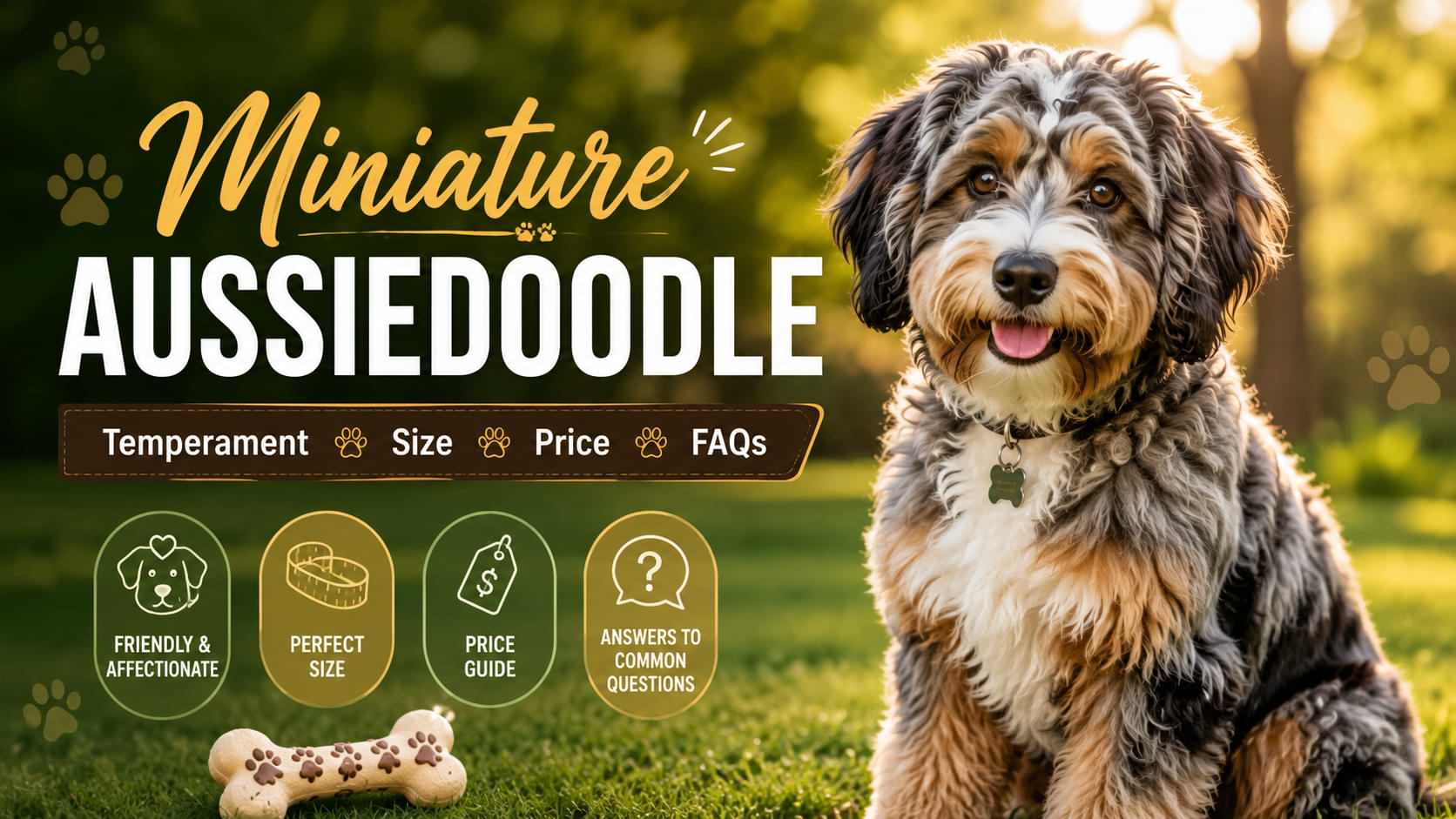
A Miniature Aussiedoodle is a cross between a Mini Australian Shepherd and a Miniature Poodle. Adults typically weigh 12–25 pounds and stand 10–15 inches at the shoulder. They are highly intelligent, energetic, and affectionate — but they carry the mental demands of two working breeds in a smaller frame, which is the single most important thing to understand before buying one.
If you want a compact dog that’s easy to train and great with families, the Mini Aussiedoodle delivers. If you want a low-maintenance apartment dog that’s happy being left alone, this isn’t it.
What Is a Miniature Aussiedoodle?
A Miniature Aussiedoodle is a hybrid dog produced by crossing a Mini Australian Shepherd with a Miniature Poodle. Both parent breeds are working dogs bred for high intelligence and sustained activity — the Mini Aussie for herding livestock, the Miniature Poodle originally for retrieving waterfowl.
The combination produces a dog that is remarkably easy to train, highly bonded to its owner, and genuinely in need of daily mental engagement.
Parent Breeds: Mini Australian Shepherd × Miniature Poodle
The Mini Australian Shepherd (sometimes called North American Shepherd) is a selectively bred smaller version of the standard Australian Shepherd. It was developed in the 1960s by breeding smaller individuals from standard Aussie lines — not by crossing with another breed.
The Miniature Poodle stands 10–15 inches at the shoulder and is one of the most trainable dogs recognized by the American Kennel Club.
One clarification worth making early: the term “Mini Aussiedoodle” sometimes confuses buyers because the Australian Shepherd side is already smaller than many people expect. When a breeder says “Mini Aussiedoodle,” they mean a Poodle cross using the Mini Australian Shepherd, not a miniaturized version of a standard Aussiedoodle.
If you’re seeing a breeder offer “Mini Aussiedoodles” from Standard Australian Shepherd parents, ask for clarification — that’s a different dog and a different size outcome.
Neither the Mini Australian Shepherd nor the hybrid Aussiedoodle itself is recognized by the American Kennel Club as a breed. The AKC does recognize both the Miniature Poodle and the standard Australian Shepherd, which establishes the legitimate lineage of both parent lines.
How Big Does a Miniature Aussiedoodle Get?
A fully grown Miniature Aussiedoodle weighs between 12 and 25 pounds and stands 10 to 15 inches at the shoulder. Most reach their adult size between 11 and 13 months of age, though some from larger Mini Aussie parents may continue filling out until 14 months.
Toy vs. Mini vs. Standard Aussiedoodle — Size Comparison
| Variant | Adult Weight | Height at Shoulder | Full-grown by |
|---|---|---|---|
| Toy Aussiedoodle | 6–12 lbs | Under 10 inches | 7.5–11 months |
| Miniature Aussiedoodle | 12–25 lbs | 10–15 inches | 11–13 months |
| Standard Aussiedoodle | 25–70 lbs | 15–23 inches | 12–16 months |
What Actually Determines Final Size
Breeders who guarantee adult weight in pounds are offering a marketing promise, not a genetic certainty. Final size depends on which parent’s genetics dominate in a given puppy, the actual measured size of the parent dogs (not just their classification), and generation — an F1B Mini Aussiedoodle backcrossed to a Miniature Poodle tends to run slightly smaller than a straight F1. Ask your breeder for the documented weights of both parents, not just a verbal description. If they can’t provide that, it’s a flag.
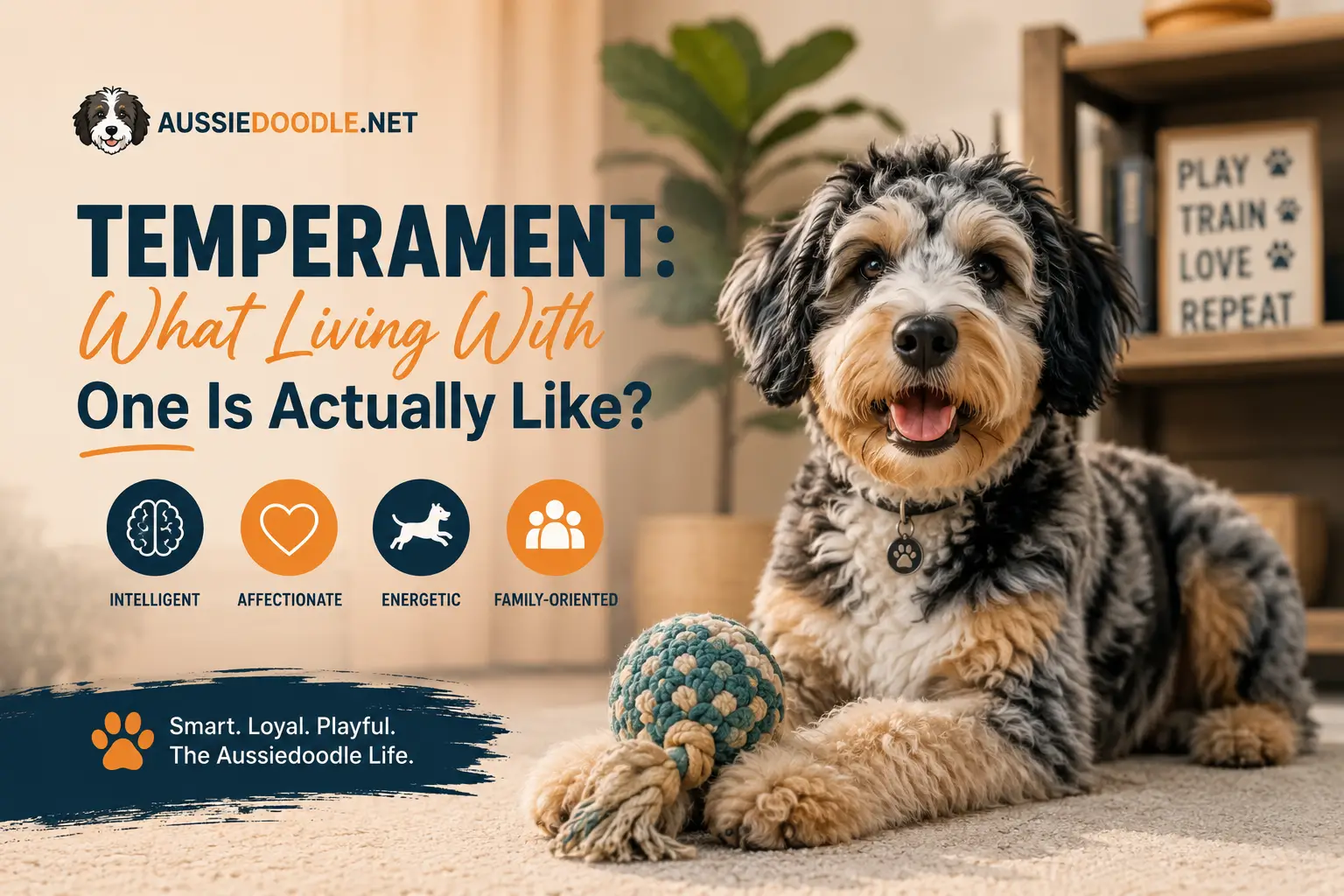
Miniature Aussiedoodle Temperament — What Owners Actually Experience
The Mini Aussiedoodle’s temperament is the main reason people love them and the main reason some people are unprepared for them. Both parent breeds rank in the top tier of Stanley Coren’s The Intelligence of Dogs — the Border Collie and Poodle are #1 and #2 respectively, and while the Mini Australian Shepherd isn’t directly assessed in Coren’s list, it shares the herding intelligence profile of the standard Australian Shepherd, which ranks #16. When you combine herding and retrieving intelligence, you get a dog that figures things out fast and gets bored faster.
Intelligence and Trainability
Mini Aussiedoodles typically pick up basic obedience commands in under a week of consistent training. That’s genuinely impressive — and genuinely risky if you’re inconsistent. A dog that learns fast also learns that jumping on guests gets attention, that barking opens the back door, and that stealing socks starts a chase game. The intelligence works in both directions. Consistent positive reinforcement training, started in the first week home, is not optional with this breed — it’s structural.
Energy Level and the Herding Instinct
I’ve raised Aussiedoodles across multiple life stages — Muhammad Rehan Iqbal, co-founder of Aussiedoodle.net — and one behavioral shift that breeders often don’t warn new owners about is what happens between 14 and 18 weeks.
This is approximately when the herding instinct “switches on” in Mini Aussiedoodles with stronger Australian Shepherd genetics. Before that window, the puppy is playful and chaotic in a normal puppy way. After it, you’ll notice the dog beginning to circle, crouch, and eye-stalk moving objects — children running, other dogs, even a rolling ball in a specific pattern.
It’s not aggression. It’s a working behavior looking for a job. If you redirect it at this exact window — with structured fetch, agility groundwork, or even basic “go around” cone exercises — it channels cleanly into trainability.
If you ignore it, it shows up as nipping at ankles and obsessive chasing behavior that’s much harder to interrupt at 9 months than at 16 weeks.
How They Are With Children and Other Pets
Mini Aussiedoodles are generally excellent with children above the age of 6 who understand how to interact with dogs. The herding instinct creates a specific and real risk with toddlers who run — the dog isn’t being aggressive, but a nip to redirect a “straying” toddler is still a bite. Early, structured socialization with children is essential, not assumed.
With other dogs, Mini Aussiedoodles tend to do well, particularly when raised with or introduced carefully to another dog in the household. They are social animals and can struggle with isolation. Leaving a Mini Aussiedoodle alone for 8+ hours regularly without a companion or enrichment is a reliable path to separation anxiety and destructive behavior.
Are Mini Aussiedoodles Hypoallergenic?
No dog breed is truly hypoallergenic. “Hypoallergenic” means a dog produces fewer allergens than average — it does not mean allergen-free.
The primary dog allergen that triggers human reactions is a protein called Can f 1, found in saliva, urine, and dander. Mini Aussiedoodles with curly, Poodle-dominant coats shed less dander than most breeds, which reduces allergen spread in the home. But the protein is still there.
What actually varies between individual Mini Aussiedoodles is shedding volume and dander dispersal. A curlier coat (more Poodle genetics, typically an F1B) sheds less and keeps dander closer to the coat. A wavy coat sheds more and disperses dander more widely.
If allergies are a genuine concern in your household, the correct approach is to spend 30–60 minutes with the specific puppy you’re considering before committing — not to assume any doodle is safe. Ask the breeder if you can visit and interact with a previous litter’s adult dog as well, since adult coats and dander levels differ from puppy coats.
F1, F1B, and F2 Mini Aussiedoodles — Which Generation Is Right for You?
Generation refers to where in the breeding program a specific puppy sits. It directly affects coat type, shedding, and genetic diversity.
What Each Generation Means
F1 (First generation):
50% Mini Australian Shepherd, 50% Miniature Poodle. This is the most genetically diverse cross. Coats range from wavy to loosely curly. Shedding is moderate and variable. These dogs tend to have strong hybrid vigor — generally healthy, with broad genetic resilience. Coat outcome is the least predictable.
F1B (First generation backcross):
An F1 Aussiedoodle bred back to a Miniature Poodle. The result is approximately 75% Poodle and 25% Mini Aussie. Coats are curlier, shedding is lower, and this generation is the most appropriate choice for households with mild dog allergies. The trade-off is slightly reduced hybrid vigor compared to F1.
F2 (Second generation):
Two F1 Aussiedoodles bred together. The most genetically variable result — you can get offspring that look and act like either parent breed, with coat outcomes ranging from nearly straight to tightly curled. Not recommended for allergy-sensitive households. Less commonly offered by reputable breeders precisely because of this unpredictability.
Most reputable Mini Aussiedoodle breeders focus on F1 and F1B litters. If a breeder is producing primarily F2 litters, ask why — the answer should be a clear breeding philosophy, not a vague response.
Mini Aussiedoodle Health — What to Know Before You Buy
This section covers health conditions that carry real consequences for your dog’s quality of life and your veterinary costs. All conditions named here are documented in one or both parent breeds.
Common Health Conditions
Hip dysplasia is a malformation of the hip joint that causes pain and reduced mobility. It’s inherited and documented in both Australian Shepherds and Poodles. Responsible breeders screen both parents through the Orthopedic Foundation for Animals (OFA) before breeding. You can verify a parent dog’s OFA status at ofa.org using the dog’s registered name. If a breeder can’t provide OFA clearance numbers, that’s not a minor paperwork issue — it’s a sign the breeding wasn’t health-tested.
Progressive Retinal Atrophy (PRA) is a degenerative eye condition that leads to blindness. It’s inherited recessively, meaning two carriers can produce affected offspring even if neither parent shows symptoms. Both Australian Shepherds and Poodles carry PRA gene variants. The OFA’s CAER (Companion Animal Eye Registry) exam, conducted by a board-certified veterinary ophthalmologist, is the standard screening. Ask for the CAER certificate number for both parents.
Epilepsy is documented in Australian Shepherds at a rate higher than the general dog population. While not universal in Mini Aussiedoodles, it’s a condition to be aware of and to ask your breeder about in the family history of their lines.
Sebaceous adenitis is a skin condition more commonly documented in Poodles. It causes progressive destruction of the sebaceous glands, leading to scaling, hair loss, and secondary infections. It’s rare but worth knowing about.
The MDR1/ABCB1 Gene Mutation — A Safety Issue Most Articles Skip
The MDR1 mutation (also called the ABCB1 mutation) is inherited from the Australian Shepherd side of the Mini Aussiedoodle’s genetics. It affects a protein that regulates the blood-brain barrier, determining which drugs can pass into the central nervous system.
Dogs with this mutation can have severe, potentially fatal reactions to drugs that are safe at standard doses in other dogs. The most commonly implicated drugs include:
- Ivermectin — the active ingredient in many heartworm preventatives (though at the doses used in most modern heartworm pills, the risk is lower than in older paste formulations — verify with your vet)
- Loperamide (Imodium) — a common over-the-counter antidiarrheal that owners sometimes give without realizing the risk
- Certain anesthetics and sedatives
- Some chemotherapy agents
The test is straightforward. The Washington State University Veterinary Clinical Pharmacology Lab offers the definitive MDR1 gene test, and consumer DNA services including Embark and Wisdom Panel now include ABCB1 mutation screening in their standard panels.
What to do:
Test your Mini Aussiedoodle before your first vet visit if possible, or at minimum tell your veterinarian on day one that your dog is an Australian Shepherd mix and to check MDR1 status before prescribing any of the implicated drug classes.
This is not a rare edge case — the mutation is estimated to affect approximately 50% of Australian Shepherds (Washington State University College of Veterinary Medicine).
Lifespan
Mini Aussiedoodles typically live 12 to 15 years. Smaller body size generally correlates with longer lifespan in mixed-breed dogs, which gives the Mini variant a modest longevity advantage over the Standard Aussiedoodle.
Hybrid vigor from the cross also contributes to overall health resilience, though this is not a substitute for health-tested parent dogs.
How Much Exercise Does a Mini Aussiedoodle Need?

An adult Mini Aussiedoodle needs a minimum of 45 to 60 minutes of structured activity per day. That’s not a walk around the block — that’s sustained movement with mental engagement.
The word “structured” matters here. A Mini Aussiedoodle that spends 20 minutes sniffing around a yard has not met its exercise requirement for the day.
Activities that actually meet the threshold include fetch with direction changes, off-leash trail time, agility practice, or training sessions that combine physical movement and command work.
Mental stimulation — puzzle feeders, nose work exercises, learning new commands — is often more exhausting for a Mini Aussiedoodle than physical exercise alone and should be built into the daily routine, not treated as a bonus.
When a Mini Aussiedoodle consistently gets less exercise than it needs, the behavioral consequences are predictable: furniture destruction, excessive and persistent barking, shadow-chasing, tail-chasing, and generalized hyperactivity that owners often mistake for the dog being “hyper by nature.” In most cases it’s a dog that hasn’t had its needs met.
Can they live in an apartment? Yes — with commitment.
A Mini Aussiedoodle in an apartment with a dedicated owner who runs, hikes, or trains daily will be calmer and better-adjusted than a Mini Aussiedoodle in a house with a yard and an owner who assumes the yard handles it. The yard doesn’t handle it. You do.
Grooming a Mini Aussiedoodle — The Real Time Commitment
Grooming a Mini Aussiedoodle is not difficult, but it is consistent. Underestimating this is one of the most common reasons owners end up with a matted, uncomfortable dog and a large emergency grooming bill.
Brushing:
Wavy coats need brushing 3–4 times per week. Curly coats need brushing every other day at minimum. Skipping sessions leads to mat formation, particularly behind the ears, under the collar, and in the armpits — areas of friction that tangle fastest. A slicker brush and a metal comb (not just a brush) are both necessary tools. The comb gets through to the undercoat; the brush only works the surface.
Professional grooming:
Budget for a professional groom every 8–12 weeks. Depending on your location and the dog’s coat condition, expect $60–$120 per session. If the dog arrives matted, the groomer will charge more and may need to shave the coat down rather than style it — at that point you’ve paid more and gotten less.
The puppy coat transition:
This is the grooming period most guides skip. Around 6–9 months of age, the soft puppy coat begins transitioning to the adult coat. During this 4–8 week window, the two coat textures exist simultaneously, and they tangle around each other far faster than either coat alone.
Brushing frequency needs to increase during this period — daily is not excessive. If you don’t know this is coming, this is the period where most Mini Aussiedoodle owners encounter their first serious mat problem. I’ve been through this transition with multiple Aussiedoodles, and the difference between owners who know to watch for it and owners who don’t is almost always visible in the dog’s coat by month 8.
Other maintenance:
Ear cleaning monthly (the Poodle-influenced ear canal can trap moisture and lead to infections), nail trimming every 3–4 weeks, and tooth brushing ideally 3 times per week round out the routine.
Miniature Aussiedoodle Price — What You’ll Actually Pay
Puppy Price from a Reputable Breeder
Miniature Aussiedoodles from health-tested breeders typically range from $1,500 to $4,500. That’s a wide range, and what sits at each end matters.
The high end ($3,000–$4,500) reflects: OFA health testing on both parents (hips, eyes, MDR1), limited litters per year, a waiting list, multi-generational breeding programs with documented lineage, and color premium — merle patterning in particular commands a significant markup because it’s visually striking and in high demand.
The low end (under $1,500) is not always a bargain. When a Mini Aussiedoodle puppy is priced significantly below market, ask specifically: What health tests were run on the parents? Can you see the OFA certificates?
How many litters does this breeder produce per year? A breeder who can’t answer the first two questions clearly, or whose answer to the third is “several,” is likely prioritizing volume over health — and the costs of that trade-off usually appear in your veterinary bills in years 3–7.
First-Year Costs Beyond the Purchase Price
| Expense | Estimated Range |
|---|---|
| Spay or neuter | $200–$500 |
| Initial vet visits and vaccines | $300–$500 |
| High-quality food (annually) | $400–$700 |
| Professional grooming (6 visits/year) | $480–$960 |
| Pet insurance | $300–$600 |
| Training classes (puppy + basic obedience) | $150–$300 |
| First-year total (beyond purchase price) | $1,830–$3,560 |
These are conservative estimates. Emergency veterinary costs are not included — pet insurance is the responsible way to manage that exposure, and on a breed with documented health risks, it’s genuinely worth the monthly premium.
Is a Mini Aussiedoodle Right for You?
This dog is a strong fit if you are active, home for significant portions of the day, have children over the age of 6, can commit to regular grooming, and want a dog that actively engages with you rather than simply existing alongside you.
This dog is a poor fit if you work long hours away from home, prefer a lower-maintenance companion, have toddlers who sprint unpredictably around the house, or have severe dog allergies and are hoping a doodle cross solves the problem entirely.
One honest opinion worth stating directly: The Mini Aussiedoodle is one of the most over-purchased dogs in the doodle category, and the “mini” label is part of why. Buyers assume smaller means easier. It doesn’t. The Mini Aussiedoodle carries the same working-dog intelligence and drive as the Standard — just in a package that fits in an apartment and costs less to feed.
That smaller body doesn’t reduce the mental demands. It just makes it easier to underestimate them.
If you go in with accurate expectations, this breed delivers — consistent, joyful, trainable, and deeply bonded to its family. If you go in expecting a chill companion who’s easy to manage, you will both be disappointed.
FAQs
How big will my Mini Aussiedoodle get?
A fully grown Miniature Aussiedoodle typically weighs 12–25 pounds and stands 10–15 inches at the shoulder. Most reach adult size between 11 and 13 months. Final size depends on parent size, generation (F1 vs. F1B), and which parent’s genetics are more expressed in that individual puppy.
Do Mini Aussiedoodles shed?
Mini Aussiedoodles with curly coats (more Poodle genetics, typically F1B) shed minimally. Those with wavy coats shed moderately. No Mini Aussiedoodle is completely non-shedding. The degree of shedding is primarily determined by coat type, which is influenced by generation and the specific genetics of the litter.
What is the difference between a Toy Aussiedoodle and a Mini Aussiedoodle?
Size is the primary difference. A Toy Aussiedoodle weighs 6–12 pounds and is produced using a Toy Poodle parent rather than a Miniature Poodle. A Miniature Aussiedoodle weighs 12–25 pounds. Both share the same behavioral profile — the Toy variant is not calmer or easier to manage simply because it is smaller.
How long do Mini Aussiedoodles live?
Mini Aussiedoodles typically live 12 to 15 years. Smaller mixed-breed dogs generally have a longevity advantage over larger breeds, and hybrid genetics from the Poodle cross contribute to overall health resilience — though neither factor substitutes for health-tested parent dogs.
Are Mini Aussiedoodles hard to train?
No — Mini Aussiedoodles are among the easiest dogs to train when the training is consistent and started early. Both parent breeds rank in the highest tiers of canine intelligence. The challenge is not teaching them; it’s that their intelligence means inconsistency gets exploited quickly. A Mini Aussiedoodle with a clear, consistent training framework from week one will learn faster than most breeds. One that goes untrained will develop its own rules at the same speed.