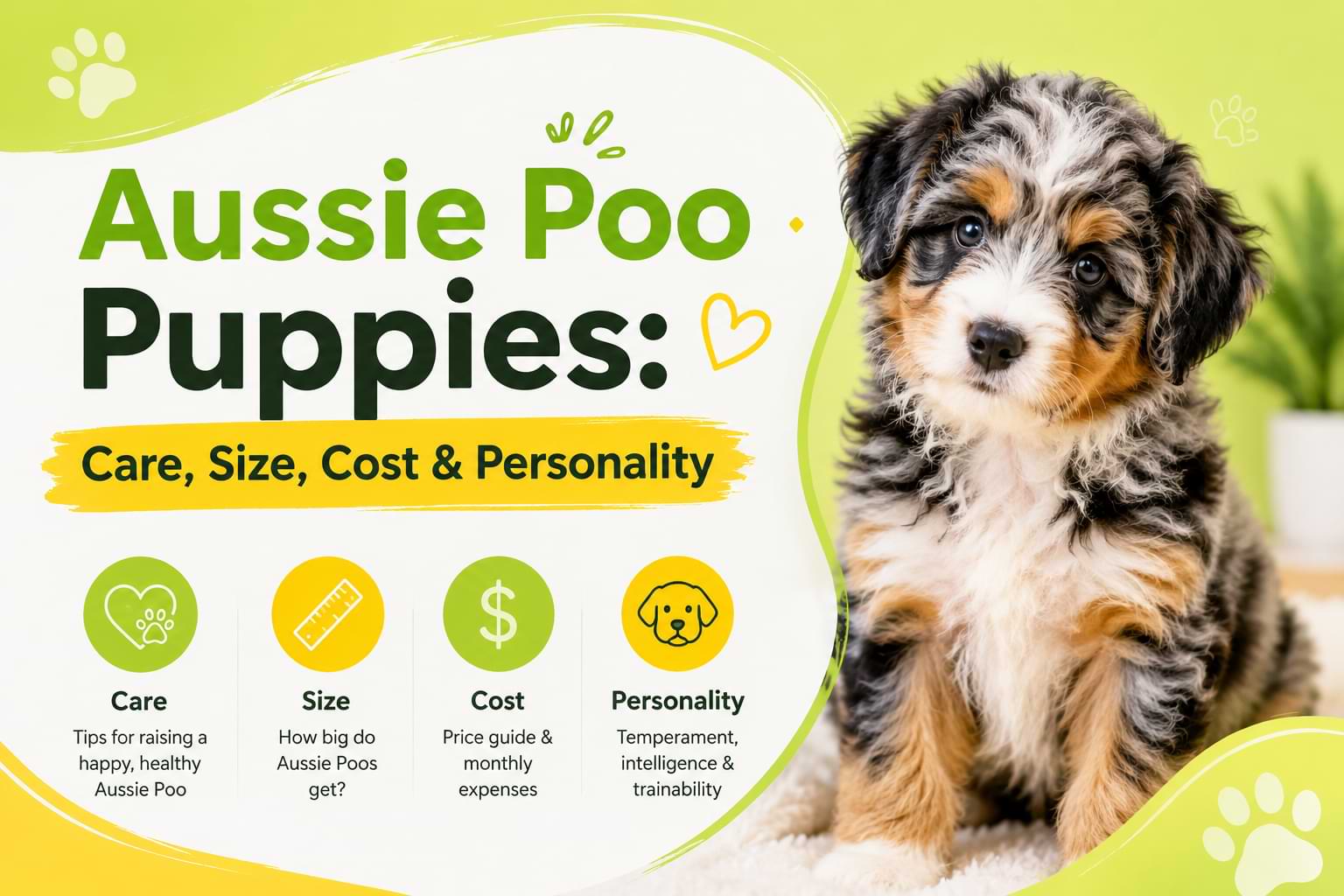
Quick Answer:
An Aussie Poo puppy is an Aussiedoodle — a cross between an Australian Shepherd and a Poodle — sold under an informal spelling of the same name. From a reputable breeder, prices typically run $1,200–$2,500, with premium litters reaching $3,500–$4,000. Adult size depends on the Poodle parent: Toy Aussie Poos stay around 12–25 lbs, Minis reach 25–40 lbs, and Standards grow to 40–70 lbs. They shed less than a purebred Australian Shepherd but are not fully non-shedding.
Who This Guide Is For
If you’re in the “researching before I buy” stage, this guide walks you through the exact questions to ask a breeder before you put down a deposit — not just breed trivia. If you already have a puppy and are checking whether their weight, shedding, or behavior at this age is typical, jump to the size table and the shedding section below; those are written against real growth and coat data, not general breed averages.
Either way, an Aussie Poo puppy isn’t a separate breed from the Aussiedoodle — it’s the same dog under a shortened, phonetic spelling that’s become common in casual search and social posts. Both names describe a first- or later-generation cross between a purebred Australian Shepherd and a Poodle, bred in three sizes depending on which size Poodle was used as a parent.
What Is an Aussie Poo, Exactly?
The Australian Shepherd contributes the herding drive, alertness, and merle or tricolor coat patterns most Aussie Poos are known for. The Poodle contributes a curlier, lower-shedding coat and a smaller size option, since Poodles themselves come in Toy, Miniature, and Standard.
Because the cross isn’t a purebred, the American Canine Hybrid Club recognizes it as a designer breed, but the American Kennel Club does not register it. That distinction matters if you’re comparing “papers” between breeders — an Aussie Poo will never have AKC registration, regardless of price.
How Much Does an Aussie Poo Puppy Cost?
Expect to pay $1,200–$2,500 for a typical Aussie Poo puppy from a screened breeder, with the most sought-after litters — rare colors like merle, or smaller sizes — running $3,500–$4,000. Dogster’s 2026 Aussiedoodle price guide reports the same range, noting that coat color and the Australian Shepherd’s merle patterning are the biggest drivers of the higher end.
Adoption through a doodle or Australian Shepherd rescue is almost always cheaper than buying, but Aussie Poo puppies are uncommon in shelters, so timing and patience matter more than with a purebred rescue.
Budget beyond the purchase price too. Here’s what I actually spent in the first year with my own Aussiedoodle, as a real reference point rather than a vague “budget extra”:
| Item | Approximate Cost |
|---|---|
| Puppy purchase price | $1,800 |
| First-year vaccines + wellness visits | $350 |
| Spay/neuter | $300 |
| Crate, bed, bowls, starter supplies | $180 |
| Microchip + registration | $45 |
| Grooming (6 visits at 6–8 week intervals) | $480 |
| First-year total (excluding food) | ~$3,155 |
That grooming line is the one buyers underestimate most — a curlier-coated Aussie Poo needs a trim every 6–8 weeks year-round, which a purebred Australian Shepherd owner never budgets for. Before you commit to a breeder, ask for three specific things: proof of health testing on both parents (hip and eye clearances at minimum), the size of both parents in pounds, and photos of a previous litter at 8 weeks and again at 6 months so you can see how much they actually changed.
How Big Do Aussie Poo Puppies Get?
Size is the single biggest variable, because it’s set by which size Poodle was used in the cross:
| Size | Poodle Parent | Adult Weight | Adult Height |
|---|---|---|---|
| Toy | Toy Poodle | 12–25 lbs | 10–14 in |
| Mini | Miniature Poodle | 25–40 lbs | 14–18 in |
| Standard | Standard Poodle | 40–70 lbs | 18–23 in |
A puppy’s paw size and litter-mate sizing at 8 weeks give a rough clue, but a breeder who can tell you the size of both parents will give you a far more reliable estimate than guessing from the puppy alone.
For a real data point: my Mini Aussiedoodle weighed 4.8 lbs at 8 weeks, 16 lbs at 4 months, and leveled off at 31 lbs by her first birthday — tracking almost exactly in the middle of the Mini range in the table above. That kind of steady, mid-range growth curve is what a legitimate Mini cross should look like; a puppy that’s already pushing 20+ lbs by 4 months is more likely to mature toward Standard size regardless of what the breeder labeled the litter.
Are Aussie Poos Good Family Dogs? Temperament
Aussie Poos are typically friendly, trainable, and eager to please — a blend of the Australian Shepherd’s intelligence and the Poodle’s people-focus. They do best in active households: both parent breeds were bred to work, not to lounge, so a bored Aussie Poo is a destructive or vocal one.
They generally do well with children and other pets when raised with consistent, positive-reinforcement training, but their herding instinct can show up as nipping at heels or chasing during play, which is worth managing early rather than after it becomes a habit.
When I brought my own Aussiedoodle puppy home at eight weeks, the biggest adjustment wasn’t the coat — it was the exercise and mental-stimulation need. A single 20-minute daily walk wasn’t enough; by week three she was chewing through a shoe every few days and pacing in the evenings.
Adding two 10-minute training sessions and a puzzle feeder at dinner changed that within about ten days — the pacing stopped, and the chewing dropped to almost nothing once she had a consistent outlet. That’s the practical version of “needs mental stimulation”: it’s not a vague warning, it’s roughly 30–40 minutes of structured engagement split across the day, not just a walk.
Do Aussie Poo Dogs Shed?
Yes, but less than a purebred Australian Shepherd. Coat type varies within a litter — wavier coats shed more, tighter curls shed less — and no Aussie Poo is truly non-shedding or fully hypoallergenic. A 2012 study in the Journal of Allergy and Clinical Immunology (Vredegoor et al.)
Found that dog allergen levels varied more by individual dog than by whether a breed was marketed as hypoallergenic — the same allergen-science basis used to caution against treating any doodle mix, Aussie Poo included, as guaranteed allergy-safe. If allergies are a deciding factor, meeting the specific puppy (or its parents) before committing matters more than the breed label.
Key Takeaways
- An Aussie Poo is the same dog as an Aussiedoodle — an Australian Shepherd x Poodle cross, not a separate breed.
- Typical price is $1,200–$2,500 from a reputable breeder, with premium litters reaching $3,500–$4,000.
- Adult size ranges from 12 lbs (Toy) to 70 lbs (Standard), set by the Poodle parent’s size.
- Aussie Poos shed less than a purebred Australian Shepherd but are not fully hypoallergenic.
- They need daily exercise and mental stimulation; under-stimulated Aussie Poos tend to develop destructive or vocal habits.
- The AKC does not register Aussie Poos; the American Canine Hybrid Club does.
- Budget roughly $3,000–$3,200 for the first year beyond food — the recurring grooming cost (every 6–8 weeks) is the line first-time buyers most often forget.
- Before paying a deposit, ask for both parents’ health-testing results and weight, plus photos of a past litter at 8 weeks and 6 months.
FAQs
Are Aussiepoos good dogs?
Yes, for the right household. They’re intelligent, affectionate, and trainable, which makes them good family dogs — but their herding energy means they need daily exercise and mental stimulation, and they’re not a great fit for owners who want a low-maintenance, low-activity companion.
How much does an Aussiepoo cost?
Typically $1,200–$2,500 from a screened breeder, with premium or rare-color litters reaching $3,500–$4,000. Adoption is cheaper when available but far less common for this cross than for purebred dogs.
How big do Aussiepoo dogs get?
It depends on the Poodle parent’s size: Toy Aussie Poos reach about 12–25 lbs, Minis 25–40 lbs, and Standards 40–70 lbs at adulthood. As a real example, a Mini Aussie Poo weighing under 5 lbs at 8 weeks typically levels off around 30–35 lbs by its first birthday if growth stays steady rather than spiking early.
Do Aussiepoo dogs shed?
Yes, though less than a purebred Australian Shepherd. Coat type — wavy versus tightly curled — affects how much, and no Aussie Poo is fully non-shedding or guaranteed hypoallergenic.
Is “Aussie Poo” different from “Aussiedoodle”?
No — they’re the same cross. “Aussie Poo” is an informal spelling that shows up more in casual search and social posts, while “Aussiedoodle” is the more commonly used name in breeder listings and breed guides.
Is buying an Aussie Poo still worth it in 2026?
For active, first-time or experienced owners who can commit to daily exercise and regular grooming, yes — demand and pricing have stayed stable rather than spiking, and reputable breeders are easier to find now than a decade ago. It’s not worth it for low-activity households expecting a purebred-Poodle level of calm.
How does an Aussie Poo compare to a purebred Australian Shepherd for a first-time owner?
An Aussie Poo generally sheds less and has a slightly softer temperament than a purebred Australian Shepherd, but keeps most of the same exercise and training needs — so it doesn’t solve the “too much dog for a beginner” problem on its own, only the shedding part.