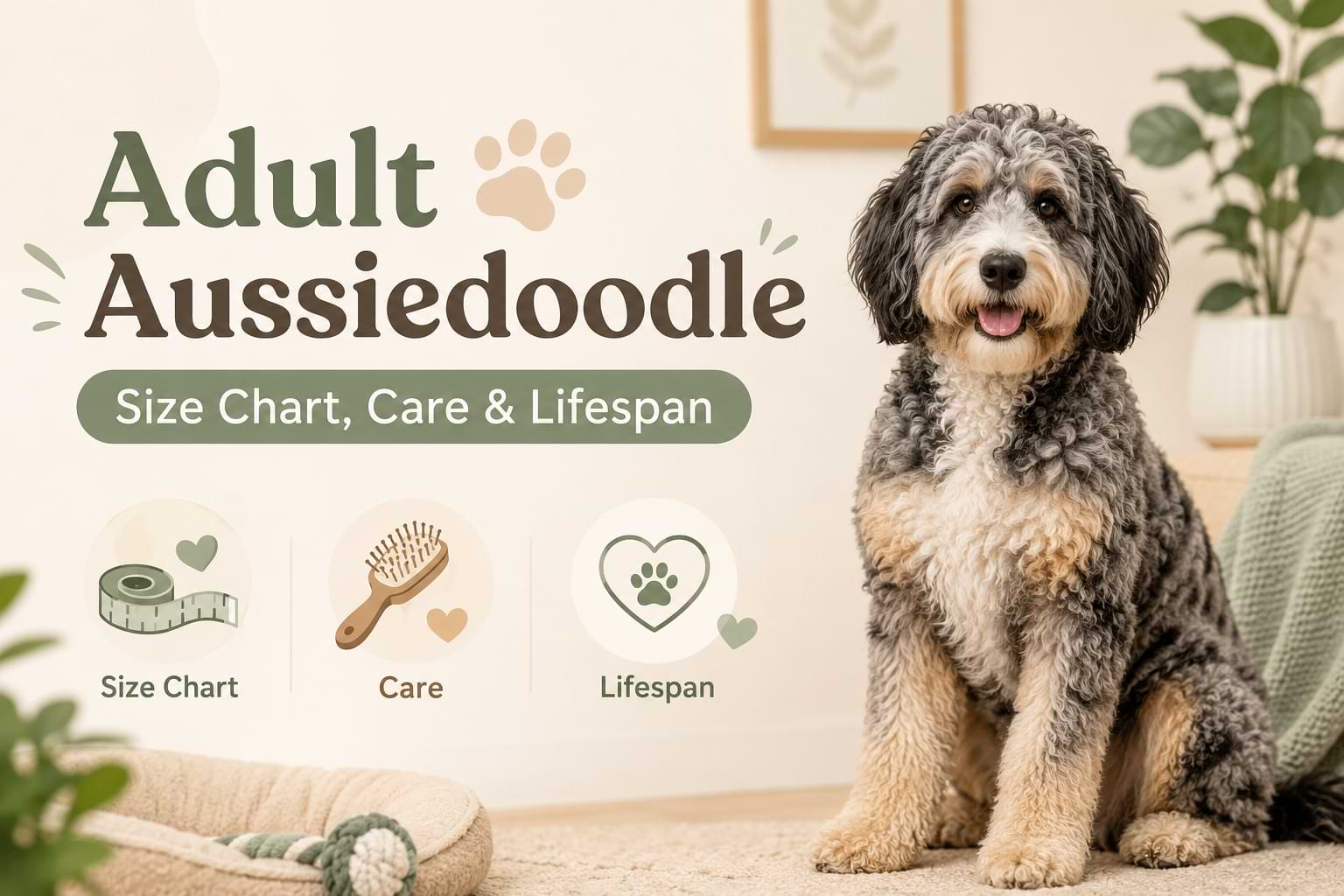
Shortest Key Takeaway
A fully grown adult Aussiedoodle weighs 25–70 pounds and stands 9–24 inches tall, depending on size type, reaches final height around 12 months, but doesn’t finish maturing behaviorally until 18–24 months.
Quick Summary
Adult Aussiedoodles come in three size categories — Toy, Miniature, and Standard — each with a different final weight and height. Most finish growing in height by their first birthday but keep filling out and maturing emotionally until age two.
Adults retain the athletic build and low-to-moderate shedding, wavy coat of the breed, require daily exercise, even after they “calm down,” and typically live 10–15 years. This guide breaks down exactly what to expect from an adult Aussiedoodle by size, coat, temperament, and care needs.
What Counts as “Adult”?
An Aussiedoodle is generally considered an adult once it has finished both physical growth and early-stage behavioral maturity — usually somewhere between 18 and 24 months old, though the timeline shifts by size and sex (more on that below).
Before that point, even a dog that looks fully grown may still act like a large puppy: chewing, testing boundaries, and needing more sleep and structure than a settled adult.
Adult Size by Type
| Size Type | Height (at shoulder) | Weight | Typical Poodle Parent |
|---|---|---|---|
| Toy Aussiedoodle | 9–12 in | 10–15 lbs | Toy Poodle |
| Miniature Aussiedoodle | 12–18 in | 15–35 lbs | Miniature Poodle |
| Standard Aussiedoodle | 19–24 in | 40–70 lbs | Standard Poodle |
Weight and height depend heavily on which size of Poodle was used in the cross, plus the size of the Australian Shepherd parent (standard or mini Aussie lines exist too).
Males tend to run larger than females across all three types. Most Aussiedoodles reach close to their adult height by 12 months, but standards in particular can keep adding muscle and chest depth until closer to 18–24 months.
What Does an Adult Aussiedoodle Look Like?
Adults keep a medium-boned, athletic build from the Australian Shepherd side and a wavy-to-curly, low-shedding coat from the Poodle side — texture ranges from a loose wave to a tighter curl depending on the individual dog.
Coat color and pattern vary widely: merle, tricolor, phantom, solid black or red, and parti markings are all common, and many adults keep the breed’s signature marbled or heterochromatic (odd-colored) eyes.
Ear carriage and exact proportions shift depending on generation (F1, F1B, multigen) and which parent’s traits show up more strongly, so littermates can end up looking noticeably different from each other as adults.
Temperament as an Adult
Adult Aussiedoodles are typically affectionate, people-oriented, and highly trainable — traits inherited from two working/companion parent breeds bred for intelligence and responsiveness. They tend to do well with kids and other pets when properly socialized, and many take naturally to having a “job,” whether that’s formal training, agility, or just structured daily routines.
They are not a low-energy breed as adults. The Australian Shepherd side’s drive doesn’t disappear with maturity — it becomes easier to manage, not eliminated. Adults still need meaningful daily exercise and mental stimulation; without it, boredom tends to surface as chewing, barking, or restlessness rather than genuine calm.
When Do Aussiedoodles Actually Calm Down?

Most Aussiedoodles start noticeably settling between 18 months and 2 years old. Females often mature a bit faster, both physically and behaviorally, than males. Smaller size types (Toy, Mini) tend to reach that settled adult stage sooner than Standards.
Even once “calm,” adults still need daily physical and mental outlets — a tired Aussiedoodle is a well-behaved one, but the underlying energy and intelligence stay part of the dog for life.
Adult Care Basics
- Exercise: 45–90+ minutes daily, split between physical activity (walks, fetch, off-leash time) and mental work (training, puzzle toys, scent games).
- Grooming: Brushing 2–3 times a week to prevent matting, with professional grooming roughly every 4–6 weeks depending on coat length and texture.
- Diet: A high-quality diet with real animal protein, sized to the dog’s actual size type and activity level rather than a one-size-fits-all portion.
- Health monitoring: Adults are generally healthy but can inherit conditions common to both parent breeds, including hip dysplasia, certain eye conditions, and skin/coat allergies — routine vet checkups matter even once a dog looks and acts fully settled.
- Lifespan: Most adult Aussiedoodles live 10–15 years, with smaller size types trending toward the longer end of that range.
FAQs
How big do Aussiedoodles get?
Adult Aussiedoodles typically weigh between 25 and 70 pounds and stand 12 to 24 inches tall, though the exact range depends heavily on which size category they fall into. Standard Aussiedoodles run largest, usually reaching 19–24 inches and 40–70 pounds;
Miniature Aussiedoodles land in the middle at 12–18 inches and 15–35 pounds; and Toy Aussiedoodles stay smallest, at 9–12 inches and roughly 10–15 pounds. Most reach close to full height by 12 months but can keep filling out in weight and chest depth until 18–24 months, with standards often taking the longest to finish maturing.
Is an Aussiedoodle a good house dog?
Yes, an Aussiedoodle can make an excellent house dog for owners who can meet its exercise and mental-stimulation needs, but it isn’t a low-maintenance, leave-it-alone breed. Bred from two working parent breeds, they’re affectionate, eager to please, and typically great with kids and other pets, which suits indoor family life well.
The catch is energy and intelligence: without daily exercise, training, and enrichment, that same working-dog drive tends to show up as boredom-driven chewing, barking, or anxiety indoors, so the breed suits active households more than sedentary ones.
What does an adult Aussiedoodle look like?
A fully grown adult Aussiedoodle has a medium-boned, athletic build inherited from the Australian Shepherd side, topped with a wavy-to-curly, low-shedding coat inherited from the Poodle side. Coat colors and patterns vary widely — merle, tricolor, phantom, solid black, red, and parti are all common — and many keep the Aussie’s signature marbled or heterochromatic eyes.
Ear carriage, coat texture, and exact build shift depending on generation (F1, F1B, multigen) and which parent’s traits dominate, so two adult littermates can end up looking noticeably different from each other.
At what age does an Aussiedoodle calm down?
Most Aussiedoodles start noticeably calming down between 18 months and 2 years old, once they finish both physical growth and emotional maturity. Females tend to settle a bit earlier than males on average, and smaller Aussiedoodles (Toy, Mini) often mature faster than Standards.
That said, “calm” is relative for this breed — even mature adults still need regular exercise and mental work to stay settled, since the energy and drive inherited from the Australian Shepherd side doesn’t fully disappear, it just becomes easier to manage.
Does an Aussiedoodle’s coat or temperament change a lot once it’s an adult?
Yes, somewhat — puppy coats often loosen or tighten in curl pattern and can shift shade slightly as the adult coat comes in fully, usually by 12–18 months. Temperament tends to settle rather than change: the same intelligence and people-focus are there from puppyhood, but adults are typically calmer, more predictable, and easier to read than the same dog was as a young puppy.