Introduction
Puppy care is the comprehensive process of meeting a young dog’s physical, behavioral, and social needs from 8 weeks through 12 months of age to ensure healthy development into a well-adjusted adult. After raising multiple Aussiedoodle puppies over the past eight years, I’ve learned that the first 16 weeks determine whether you’ll spend the next decade with a confident, trainable companion or struggle with preventable behavioral and health issues.
New puppy owners often underestimate three critical elements: the narrow socialization window between 8-16 weeks (identified by the American Animal Hospital Association as the most influential period for lifelong behavior), the precise timing of vaccinations and deworming, and the connection between consistent daily routines and faster housebreaking success.
This guide integrates veterinary health protocols with practical training strategies, giving you week-by-week action steps instead of generic advice. Whether you’re bringing home a Mini Aussiedoodle or another breed, you’ll learn exactly what to do in the first 48 hours, how to prevent the most common first-year mistakes, and when to seek professional help.
The goal isn’t perfection—it’s building the foundation for a healthy relationship with your dog while avoiding costly corrections later.
WHAT YOU’LL LEARN
- Week-by-week puppy care schedule from 8 weeks to 6 months with specific health, training, and socialization tasks
- Exact feeding schedules by age including portion sizes, meal frequency, and how to choose appropriate puppy food
- Complete vaccination and deworming timeline with veterinarian visit schedules and what to expect at each appointment
- Housebreaking framework that works using crate training, scheduling, and positive reinforcement to reduce accidents within 2-3 weeks
- Critical socialization checklist for the 8-16 week window, including what experiences to prioritize and which to avoid
- Common puppy behavioral issues (biting, chewing, crying) with specific solutions and realistic timelines for improvement
Before You Bring Your Puppy Home: Essential Preparation

Complete preparation reduces your puppy’s stress and prevents avoidable first-week chaos. The week before pickup, you need supplies, a veterinarian selected, and your home puppy-proofed.
Your puppy interprets the transition from breeder to your home as a significant stress event. Preparation minimizes compounding that stress with missing supplies, unsafe environments, or scrambling to find emergency veterinary care. According to the American Veterinary Medical Association (AVMA), puppies experience their peak stress during the first 72 hours in a new environment, making advance preparation essential for smooth adjustment.
Puppy Supply Checklist
Purchase these items one week before pickup:
- Crate: Size appropriate for adult breed weight (puppy should stand, turn, and lie down comfortably, but not so large they can eliminate in one corner and sleep in another)
- Food and water bowls: Stainless steel or ceramic (avoid plastic which harbors bacteria)
- Puppy food: Same brand the breeder used for first 2 weeks to prevent digestive upset
- Collar and ID tag: Adjustable, with your phone number even before first vet visit
- 6-foot leash: Standard length for training (avoid retractable leashes initially)
- Enzymatic cleaner: Specifically for pet accidents (regular cleaners don’t eliminate odor markers that encourage repeat elimination)
- Chew toys: 3-4 different textures (rubber, rope, soft plush) to identify preferences
- Treats: Small, soft training treats (pea-sized pieces)
Puppy-Proofing Your Home
Remove or secure these hazards before arrival:
- Electrical cords (puppies chew them; use cord concealers or bitter spray)
- Toxic plants (lilies, sago palms, azaleas—see ASPCA complete list)
- Small objects at ground level (coins, rubber bands, children’s toys)
- Household chemicals and medications in low cabinets
- Gaps under fences in the yard (puppies squeeze through surprisingly small openings)
I learned this the hard way: our first Aussiedoodle puppy found a dropped earring backing within 20 minutes of arriving home. The emergency vet visit cost $340 and could have been prevented with a thorough floor-level inspection.
Selecting a Veterinarian
Schedule your first vet appointment for 24-48 hours after bringing your puppy home. Choose a veterinarian before pickup by:
- Confirming they accept new puppy patients (some practices have waitlists)
- Asking about after-hours emergency protocols (do they have 24-hour care or refer to an emergency clinic?)
- Verifying they follow AVMA or AAHA guidelines for puppy vaccinations
- Requesting an estimate for first-year care (typically $800-$1,200 including vaccinations, exams, spay/neuter, and preventatives)
Your breeder should provide health records showing any vaccinations or deworming already completed. Bring these to your first appointment.
First 48 Hours With Your New Puppy
The first two days establish your puppy’s sense of safety and introduce them to your home’s routine. Limit excitement, stick to a schedule, and prioritize rest over socialization activities.
Puppies typically arrive at 8 weeks old after weaning. They’ve just separated from their littermates and mother, creating anxiety even in confident puppies. Your job is to become their new source of security through predictability and calm responses.
Hour 1: The Introduction
When you first arrive home:
- Take puppy directly to the designated potty area (before entering the house)
- Wait up to 10 minutes for elimination—if they go, offer calm praise and a small treat
- Show them their crate location with the door open and a treat inside
- Limit the accessible area to one or two rooms initially (use baby gates)
Avoid overwhelming your puppy with:
- Multiple visitors in the first 48 hours
- Children repeatedly picking them up
- Free access to the entire house
- Long play sessions (puppies need 18-20 hours of sleep daily at 8 weeks)
Common Mistake:
Many new owners invite friends and family over to “meet the puppy” during the first weekend. This overstimulation often causes increased crying at night, refusal to eat, and regression in house training. Wait until day 4-5 for visitor introductions.
First Night: Sleep and Crying
Expect crying the first 2-3 nights. Your puppy misses their littermates and doesn’t yet understand you’re their new family.
Setup for Success:
- Place the crate in your bedroom for the first 1-2 weeks (proximity reduces anxiety)
- Include a soft blanket or towel (ideally one that smells like their littermates from the breeder)
- No food or water in the crate overnight after 8 PM
- Set an alarm to take the puppy out once during the night (typically around 2-3 AM for 8-week-old puppies)
Responding to Crying:
If the puppy cries:
- Wait 30-60 seconds to see if they self-soothe
- If crying continues, take them directly to the potty area with no play or interaction
- After they eliminate (or after 5 minutes if they don’t), return them to the crate
- Ignore further crying unless it intensifies or changes tone (which might indicate distress or need)
Don’t remove a crying puppy from the crate to “comfort” them unless you’ve already taken them out for a potty break. This teaches crying = freedom from crate, creating a pattern you’ll fight for months.
First Meals and Monitoring
Feed the same food your breeder used, at the same times if possible. Typical 8-week-old puppies eat 3-4 times daily.
Monitor these signs in the first 48 hours:
- Normal: Soft stool for first 24-48 hours (stress-related)
- Concerning: Diarrhea lasting beyond 48 hours, bloody stool, or vomiting more than once
- Normal: Decreased appetite for first 2 meals
- Concerning: Refusal to eat for 12+ hours, or lethargy/unresponsiveness
When I brought home our Mini Aussiedoodle Luna, she refused food for the first 18 hours. We tried hand-feeding small amounts and adding warm water to soften the kibble. She began eating normally on day two once the stress decreased. However, we called our veterinarian at the 16-hour mark to confirm this was within normal range.
Puppy Feeding Schedule and Nutrition Guidelines
Puppies require frequent, portion-controlled meals with food formulated for growth. Age determines meal frequency, portion size, and when to transition to adult food.
Proper nutrition affects growth rate, immune system development, and long-term health. The World Small Animal Veterinary Association (WSAVA) recommends selecting puppy foods that meet AAFCO (Association of American Feed Control Officials) standards for growth, which ensures adequate protein, fat, calcium, and phosphorus levels.
Feeding Schedule by Age
| Age | Meals Per Day | Hours Between Meals | Total Daily Amount |
|---|---|---|---|
| 8-12 weeks | 4 meals | Every 4 hours | Follow food package guidelines by weight |
| 12-16 weeks | 3 meals | Every 5-6 hours | Increase portion as puppy grows |
| 4-6 months | 3 meals | Every 6-7 hours | Continue following package by weight |
| 6-12 months | 2 meals | Every 10-12 hours | Maintain steady portions |
| 12+ months | 2 meals | Every 10-12 hours | Transition to adult food |
Portion Size Calculation:
Puppy food packages provide feeding charts based on expected adult weight. For Aussiedoodles and other designer breeds, estimate adult weight by:
- Mini Aussiedoodle: 15-35 pounds
- Standard Aussiedoodle: 40-70 pounds
Divide total daily amount by number of meals. For example, a 10-pound, 10-week-old Mini Aussiedoodle might need 1.5 cups daily, split into four 0.375-cup meals.
Choosing Puppy Food
Select food based on these criteria:
- AAFCO statement on the label: “formulated to meet the nutritional levels established by the AAFCO Dog Food Nutrient Profiles for growth”
- Named protein source as first ingredient: Chicken, beef, lamb, or salmon (not “meat by-products”)
- Breed-size appropriate: Large-breed puppy formulas contain controlled calcium/phosphorus for breeds over 50 pounds at maturity to prevent developmental orthopedic disease
- Reputation and recall history: Check FDA pet food recall database for the brand
Avoid grain-free diets unless your veterinarian specifically recommends them. The FDA has investigated potential links between grain-free diets (particularly those heavy in legumes) and dilated cardiomyopathy (DCM) in dogs.
When to Transition Foods:
- From breeder’s food to your choice: Week 3-4 after bringing puppy home, using 7-day gradual transition (mix 25% new food for 2 days, 50% for 2 days, 75% for 2 days, then 100%)
- From puppy food to adult food: When the puppy reaches 90% of expected adult weight (10-12 months for most breeds, 12-18 months for large breeds)
Treats and Training Rewards
Treats should comprise no more than 10% of daily caloric intake. For an 8-week-old puppy eating 400 calories daily, limit treats to 40 calories.
Use treats strategically:
- Training sessions: Pea-sized pieces of soft treats, 10-15 pieces per 5-minute session
- Crate training: One small treat when puppy enters crate voluntarily
- Housebreaking: One treat immediately after outdoor elimination
We made the mistake of using large training treats with our first puppy, resulting in decreased meal appetite and loose stool. Switching to tiny pieces (literally the size of a pea) solved both issues while maintaining training effectiveness.
Vaccination and Deworming Timeline
Vaccinations protect puppies from potentially fatal infectious diseases during the critical period when maternal antibodies fade but their immune systems remain immature. Deworming eliminates common intestinal parasites nearly all puppies carry.
The American Animal Hospital Association (AAHA) publishes canine vaccination guidelines updated every three years. Core vaccines protect against distemper, parvovirus, adenovirus, and rabies—diseases with high mortality rates or public health significance. Non-core vaccines depend on geographic location and lifestyle.
Core Vaccination Schedule
| Puppy Age | Vaccine | What It Prevents | Schedule Notes |
|---|---|---|---|
| 6-8 weeks | DHPP #1 | Distemper, Hepatitis, Parainfluenza, Parvovirus | Usually given by breeder |
| 10-12 weeks | DHPP #2 | Same as above | First vet visit after bringing puppy home |
| 14-16 weeks | DHPP #3 + Rabies | DHPP diseases + rabies virus | Critical timing—don’t delay |
| 12-16 months | DHPP booster + Rabies | Establishes long-term immunity | Then every 1-3 years per state law |
Why Multiple DHPP Doses?
Puppies receive maternal antibodies through their mother’s first milk (colostrum). These antibodies protect them initially but also interfere with vaccine effectiveness. Maternal antibodies fade between 8-16 weeks, but the exact timing varies by puppy. Multiple doses ensure at least one dose is given after maternal antibodies decline but before the puppy becomes vulnerable to disease.
Your puppy is not fully protected until 7-10 days after the final DHPP dose (typically around 17 weeks of age). This affects socialization decisions, covered in the next section.
Non-Core Vaccines (Risk-Based)
Discuss these with your veterinarian:
- Bordetella (kennel cough): Recommended if attending puppy classes, grooming facilities, or daycare
- Leptospirosis: Recommended in areas with wildlife exposure or standing water
- Lyme disease: Recommended in tick-endemic areas (particularly Northeast and Upper Midwest United States)
- Canine influenza: Recommended for dogs frequently exposed to other dogs in boarding or daycare
Deworming Protocol
Most puppies have roundworms or hookworms, even from responsible breeders. These parasites pass from mother to puppy before birth or through nursing.
Standard Deworming Schedule:
- 2, 4, 6, and 8 weeks old (usually done by breeder)
- 12 and 16 weeks old (done by your veterinarian)
- Fecal examination at each vet visit to check for parasites
Zoonotic Risk: Roundworms can infect humans, particularly children, through contaminated soil or surfaces. Always wash hands after handling your puppy, and pick up feces immediately from the yard.
Flea, Tick, and Heartworm Prevention
Begin monthly preventatives at 8 weeks old:
- Heartworm prevention: Monthly chewable (e.g., Heartgard, Interceptor, Simparica Trio)
- Flea/tick prevention: Integrated with heartworm prevention or separate product based on regional risk
Your veterinarian will recommend specific products based on your location. In our area (Pacific Northwest), tick-borne diseases are less common, so we use a heartworm-only preventative. When we traveled to the Northeast, our vet prescribed a combination product for the duration of our stay.
Cost Reality Check:
First-year vaccinations and preventatives typically cost:
- DHPP series (3 doses): $60-$90
- Rabies vaccine: $15-$25
- Exam fees (3-4 visits): $150-$300
- Deworming: $20-$40
- Monthly preventatives: $120-$200
- Fecal tests: $60-$100
Total: $425-$755, not including spay/neuter ($200-$500).
Housebreaking: Crate Training and Potty Schedule

Housebreaking succeeds through management, scheduling, and positive reinforcement, typically achieving consistency within 3-6 weeks for puppies starting at 8 weeks old. Crate training prevents accidents when you can’t supervise and teaches bladder control.
Dogs instinctively avoid soiling their sleeping area. A properly sized crate leverages this instinct while you establish a predictable elimination schedule. Common housebreaking failures stem from inconsistent timing, crates too large, or punishment-based approaches that create fear.
Crate Training Foundation
Crate Selection:
Choose a crate where your puppy can stand up, turn around, and lie down comfortably but cannot eliminate in one end and sleep in the other. For growing breeds, purchase an adult-sized crate with a divider panel to adjust the space as the puppy grows.
Introducing the Crate (Week 1):
- Day 1-2: Place treats inside the crate with the door open; let puppy explore freely
- Day 3-4: Feed meals inside the crate with the door open
- Day 5-7: Close the door for 5 minutes while puppy eats, then open immediately
- Week 2: Gradually extend crate time to 15-30 minutes while you’re in the same room
- Week 3: Practice brief departures (5-10 minutes) with puppy crated
Common Mistake:
Rushing crate training by immediately crating the puppy for hours creates negative associations. Our first puppy screamed for 45 minutes the first night because we didn’t introduce the crate gradually during daytime hours first. With our second puppy, we spent three days building positive associations before closing the door, resulting in zero nighttime crying.
Housebreaking Schedule
Puppies need to eliminate:
- Immediately after waking up (including naps)
- 5-15 minutes after eating
- After play sessions
- Every 2-3 hours during the day (at 8-12 weeks old)
- Once during the night (until 12-14 weeks)
Sample Daily Schedule (8-12 Week Old Puppy):
| Time | Activity | Notes |
|---|---|---|
| 6:00 AM | Wake up → Outside immediately | Carry to prevent accidents |
| 6:15 AM | Breakfast | In crate or supervised area |
| 6:30 AM | Outside | Post-meal elimination |
| 6:45 AM | Supervised play | Watch for circling/sniffing |
| 8:00 AM | Outside | Before crating |
| 8:15 AM | Crate time (while you work/leave) | 2-3 hour maximum |
| 10:30 AM | Outside immediately | After crate time |
| 10:45 AM | Supervised play or training | |
| 12:00 PM | Lunch → Outside after | Second meal |
| 12:30 PM | Nap time in crate | |
| 2:30 PM | Outside immediately | After nap |
| 2:45 PM | Play and training | |
| 4:00 PM | Outside | Before evening routine |
| 5:00 PM | Dinner → Outside after | Third meal |
| 7:00 PM | Outside | Pre-bedtime routine |
| 8:00 PM | Remove water bowl | Prevents nighttime accidents |
| 9:30 PM | Final potty break | Before bedtime |
| 2:00 AM | Night potty break | Only if puppy wakes/whines |
As your puppy matures, extend the time between breaks. By 16 weeks, most puppies manage 4-hour intervals. By 6 months, they can hold elimination for 6-8 hours during sleep.
The Potty Break Protocol
Every single potty break follows this exact sequence:
- Take puppy to the same spot (scent markers encourage elimination)
- Use a verbal cue (“Go potty” or “Do your business”)
- Wait silently for 5-10 minutes (no play, no talking)
- When puppy eliminates, mark the behavior immediately (“Yes!” or click) and give one high-value treat
- Return inside or continue activity
If the puppy doesn’t eliminate within 10 minutes, return inside and try again in 15 minutes. Watch closely for signs (circling, sniffing, sudden stopping during play) and take them out immediately if these appear.
Handling Accidents
Accidents are inevitable during the first 4-6 weeks. Your response determines whether they become habitual.
If you catch the puppy mid-accident:
- Interrupt with a neutral sound (clap hands once)
- Immediately take outside to the potty spot
- Praise and treat if they finish outside
If you discover an accident after the fact:
- Clean it thoroughly with enzymatic cleaner (not ammonia-based products)
- Don’t punish the puppy (they cannot connect punishment to an event that happened minutes or hours ago)
- Increase supervision and decrease freedom temporarily
The classic “rubbing their nose in it” approach doesn’t work because dogs don’t understand retroactive punishment. It only teaches them to fear you, not to eliminate outside.
Progress Tracking:
Week 1: Expect 5-8 accidents
Week 2: Expect 3-5 accidents
Week 3: Expect 1-3 accidents
Week 4: Expect 0-2 accidents
Week 6: Consistently clean with rare accidents
If you’re not seeing improvement by week 4, evaluate these common issues:
- Crate too large (puppy can eliminate in one area and sleep in another)
- Inconsistent schedule (different family members following different timing)
- Missing subtle “I need to go” signals
- Possible urinary tract infection (if puppy eliminates in very small amounts frequently)
The Critical Socialization Window (8-16 Weeks)
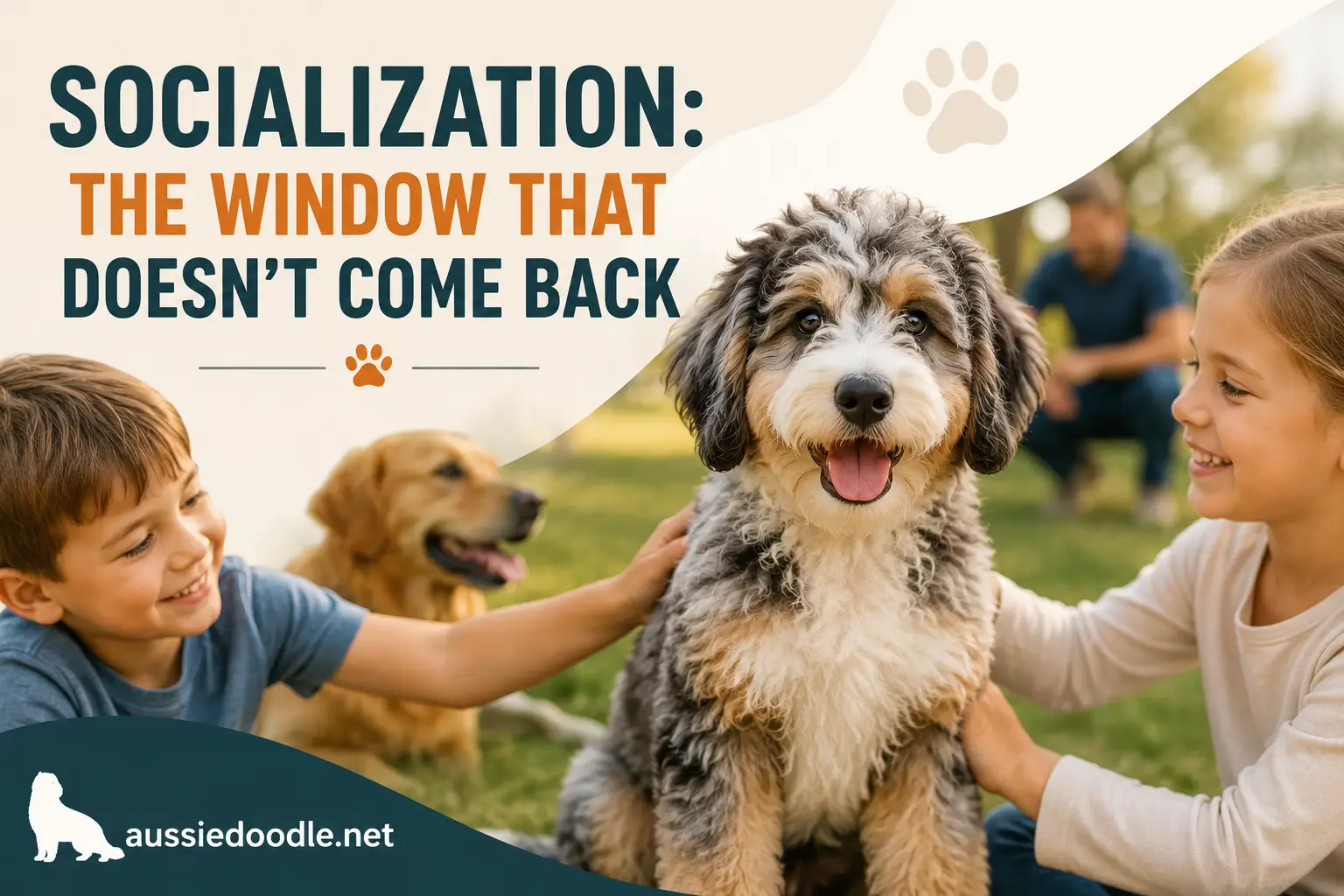
The period between 8-16 weeks is when puppies most easily form positive associations with new experiences, people, animals, and environments. Proper socialization during this window prevents lifelong fear, aggression, and anxiety issues.
According to the American Veterinary Society of Animal Behavior (AVSAB), behavioral issues are the leading cause of relinquishment to shelters. Most behavioral problems stem from inadequate socialization during the critical window. However, puppies aren’t fully vaccinated until 16-17 weeks, creating a challenge: you must socialize during the vaccination series while managing disease risk.
Balancing Socialization and Disease Risk
Safe Socialization Activities Before Final Vaccines:
✓ Invite healthy, fully vaccinated dogs to your home
✓ Puppy socialization classes that require proof of vaccines and clean facilities
✓ Carry your puppy in public places (pet stores, downtown areas) without allowing floor contact
✓ Car rides to various locations
✓ Exposure to household sounds (vacuum, doorbell, TV, kitchen appliances)
✓ Meeting various people (different ages, genders, wearing hats/sunglasses, using mobility aids)
Avoid Until Fully Vaccinated:
✗ Dog parks
✗ Pet store floors
✗ Areas where unvaccinated dogs congregate
✗ Walking in high-traffic dog areas
✗ Contact with dogs of unknown vaccination status
The AVSAB position statement emphasizes: “Behavioral issues, not infectious diseases, are the number one cause of death for dogs under three years of age.” Responsible socialization during the vaccine series is less risky than no socialization.
Socialization Checklist (Complete Before 16 Weeks)
Print this checklist and aim to expose your puppy to each item 2-3 times minimum:
People (20+ different individuals):
- Men, women, children (various ages)
- People wearing hats, sunglasses, uniforms
- People with beards, different ethnicities
- People using canes, wheelchairs, walkers
- People carrying umbrellas, bags, boxes
Surfaces:
- Carpet, tile, hardwood, concrete
- Grass, gravel, sand, metal grates
- Stairs (up and down)
- Slippery floors
Sounds:
- Vacuum cleaner, hair dryer, blender
- Doorbell, knocking
- Children playing/screaming
- Trucks, motorcycles, sirens
- Thunderstorm recordings (gradual volume increase)
Environments:
- Veterinary clinic (happy visits with just treats, no procedures)
- Friend’s homes
- Car rides to various destinations
- Outdoor cafes (puppy in your lap)
- Different neighborhoods
Objects and Experiences:
- Umbrellas opening
- Bicycles, skateboards, strollers
- Plastic bags blowing
- Grooming tools (brush, nail clippers)
- Handling exercises (touching paws, ears, mouth)
Other Animals:
- Other puppies in controlled settings
- Calm adult dogs (vaccinated)
- Cats (if possible)
- Livestock if relevant to your lifestyle
Socialization Protocol
Exposure alone isn’t enough—the experience must be positive. Follow this protocol for each new experience:
- Start at a comfortable distance or intensity: If introducing a vacuum cleaner, begin with it off and far away
- Pair the new stimulus with high-value treats: Vacuum appears = puppy gets chicken
- Watch puppy’s body language: Relaxed, curious, play bow = good signs; cowering, tail tucked, trying to escape = too intense
- Gradually increase intensity only if puppy remains comfortable: Move vacuum closer, then turn it on briefly, then operate normally
- End each exposure on a positive note: Before the puppy shows stress
What Not to Do:
- Force interactions (“Just pet the dog, they’re friendly!”)
- Punish fear responses (“Don’t be scared!”)
- Overwhelm with too many new things at once
- Continue exposure after puppy shows fear
I witnessed the consequence of forced socialization at a puppy playgroup. An owner repeatedly pushed their cowering puppy toward other puppies “to help them get over it.” That puppy developed dog reactivity that required months of professional behavioral modification. The owner later told me they wished they’d recognized the puppy’s stress signals and slowed down.
Puppy Socialization Classes
Enroll in a puppy socialization or puppy kindergarten class starting around 10-12 weeks. Choose classes that:
- Require proof of age-appropriate vaccinations
- Clean and disinfect the training area between classes
- Use positive reinforcement training methods exclusively
- Include both structured training and supervised play
- Limit class size to 6-8 puppies with similar ages/sizes
- Have trainers certified by organizations like CPDT (Certified Professional Dog Trainer) or KPA (Karen Pryor Academy)
Our Mini Aussiedoodle attended six weeks of puppy kindergarten starting at 11 weeks. The class provided controlled exposure to 6 other puppies, various people, and novel objects like tunnels and wobble boards. More importantly, it taught us how to read her body language and adjust our expectations—skills that proved valuable long after the class ended.
Puppy Training Basics: Bite Inhibition, Chewing, and Basic Commands
Early training establishes communication, prevents unwanted behaviors from becoming habits, and strengthens your bond. Positive reinforcement methods teach puppies what to do, not just what not to do.
Puppies learn fastest during their socialization window. Training isn’t about perfect obedience at 12 weeks—it’s about building a foundation where your puppy understands that listening to you results in good things. Research published in the Journal of Veterinary Behavior shows that puppies trained with positive reinforcement (rewards for correct behavior) demonstrate better long-term retention and fewer behavioral issues than puppies trained with corrections or punishment.
Positive Reinforcement Fundamentals
How It Works:
When a puppy performs a behavior you want, you immediately reward them, increasing the likelihood they’ll repeat that behavior. Rewards include:
- Food treats (most powerful for young puppies)
- Play with a favorite toy
- Verbal praise in an excited tone
- Physical affection (if your puppy enjoys it)
Timing is Critical:
The reward must occur within 1-2 seconds of the desired behavior. This is why many trainers use a marker system:
- Puppy performs correct behavior
- You immediately mark it with a word (“Yes!”) or clicker sound
- You deliver the treat within 3-5 seconds
The marker tells the puppy exactly which behavior earned the reward, even if treat delivery is slightly delayed.
Bite Inhibition (Stopping Puppy Biting)
Puppy mouthing and biting is normal exploratory behavior—puppies use their mouths like hands. However, they must learn to control bite pressure before adulthood.
Why Puppies Bite:
- Play behavior (how they interacted with littermates)
- Teething discomfort (3-6 months)
- Overstimulation or overtiredness
- Attention-seeking
Teaching Bite Inhibition:
Phase 1: Reduce Bite Pressure (Weeks 8-12)
When your puppy bites during play:
- Let out a high-pitched “Ouch!” (mimicking puppy yelp)
- Immediately stop all interaction and turn away for 10-15 seconds
- Resume play
- If biting continues, repeat; if it happens a third time, end play session entirely and leave the room for 1-2 minutes
This teaches that hard bites end fun. Initially, your puppy may bite harder after your yelp (excitement), so progression isn’t always linear.
Phase 2: Reduce Bite Frequency (Weeks 12-16)
Once your puppy consistently uses soft mouth pressure, work on eliminating biting altogether:
- Any teeth-on-skin contact = immediate “Ouch!” and end of interaction
- Simultaneously teach “drop it” and “leave it” commands
- Redirect to appropriate chew toys
Common Mistakes:
- Playing rough games that encourage mouthing (wrestling with hands)
- Inconsistent responses (sometimes ignoring bites, sometimes reacting)
- Physical punishment (tapping nose, holding mouth shut) which can increase aggression
- Not providing enough appropriate chew alternatives
Our Aussiedoodle went through a “land shark” phase at 10-12 weeks where she bit constantly. We realized we were inadvertently rewarding her by giving attention (even negative reactions are attention). Once we became completely consistent—every bite = instant end of interaction—improvement occurred within 5 days.
Managing Destructive Chewing
Puppies must chew, especially during teething (3-6 months). You cannot eliminate chewing; you can only redirect it.
Chew Toy Strategy:
Provide 5-7 different chew options with varying textures:
- Hard rubber (Kong, West Paw Toppl)
- Rope toys
- Soft plush (for gentle chewers; supervise to prevent swallowing stuffing)
- Edible chews (bully sticks, yak chews—supervise to prevent choking)
- Cold/frozen items for teething (frozen washcloth, frozen Kong with food)
Preventing Inappropriate Chewing:
- Management: If you cannot supervise, confine puppy to a safe area (crate, playpen)
- Exercise: A tired puppy chews less (mental exercise counts too—training sessions, puzzle toys)
- Rotation: Keep only 2-3 toys accessible at once; rotate weekly to maintain novelty
- Redirection: When you catch puppy chewing something forbidden, calmly interrupt, redirect to appropriate toy, and praise when they engage with it
What to Do When They Grab Forbidden Items:
Teach “drop it” and “trade”:
- Offer something of equal or higher value (treat or favorite toy)
- When puppy releases forbidden item, say “drop it,” give reward
- Practice this in low-stakes situations first (trading a boring toy)
Never chase a puppy who grabs something forbidden—this becomes a fun game. Instead, walk away or offer something better.
Basic Commands (8-16 Weeks)
Focus on these five foundation behaviors:
1. Name Recognition
Your puppy’s name should mean “look at me.”
Training:
- Say puppy’s name once
- When they look at you, mark (“Yes!”) and treat
- Practice 5-10 times daily
- Only use their name for positive things, never for corrections
2. Sit
How to teach:
- Hold treat at puppy’s nose
- Slowly move treat up and back over their head
- As their bottom touches the ground, say “Sit,” mark, and treat
- After 10-15 successful repetitions, begin saying “Sit” before the lure motion
- Gradually fade the lure, eventually using only the verbal cue and hand signal
3. Come When Called (Recall)
Start indoors with zero distractions.
Training:
- Have treats ready
- Say puppy’s name to get attention, then “Come!” in excited voice
- When they move toward you, encourage enthusiastically
- Reward heavily when they arrive (3-5 treats, not just one)
- Practice 5-10 times daily in different rooms
- Gradually add distractions (practice in yard, then on long leash in park)
Critical Rule:
Never call your puppy for something unpleasant (bath, nail trim, crate time when they don’t want to). Always go get them instead. Recall must always = good things.
4. Stay
Don’t expect duration at this age; focus on the concept.
Training:
- Ask puppy to sit
- Say “Stay” with palm facing them
- Wait 2-3 seconds
- Mark and treat while they’re still sitting
- Gradually increase duration to 10-15 seconds
- Add distance only after duration is solid
5. Leave It
This prevents your puppy from picking up dangerous items.
Training:
- Hold treat in closed fist
- Puppy will sniff, lick, paw at your hand
- Wait for them to back away even slightly
- Mark that moment, give treat from other hand
- Repeat until puppy immediately backs away from closed fist
- Progress to treat on open palm, then on floor, then more tempting items
Training Session Structure
Keep sessions short and positive:
- Duration: 3-5 minutes per session
- Frequency: 3-5 sessions daily
- End on success: Always finish with something your puppy does well
- Avoid frustration: If puppy seems confused, go back to an easier step
We made the mistake of practicing “down” for 15 minutes straight with our first puppy. She became frustrated and started avoiding training sessions. With our second puppy, we limited sessions to 5 minutes, ending when she was still eager. Her enthusiasm for training remained high throughout her first year.
Daily Routine and Sleep Requirements
Puppies thrive on predictable schedules that align their biological needs with your daily structure. Consistency in timing for meals, potty breaks, play, training, and sleep accelerates learning and reduces anxiety.
Young puppies require 18-20 hours of sleep per day. Sleep deprivation in puppies manifests as hyperactivity, increased biting, difficulty focusing, and more frequent accidents. Many behavior problems I’ve observed in young puppies resolved simply by enforcing more structured nap times.
Sample Daily Schedule (8-12 Weeks)
This schedule assumes someone is home most of the day. Adjust timing to fit your work schedule, but maintain consistent intervals.
6:00 AM – Wake and Potty
Take puppy directly outside (carry if possible to prevent accidents). Wait for elimination, reward, bring inside.
6:15 AM – Breakfast
Feed in crate or designated area. Remove food after 15 minutes.
6:30 AM – Potty Break
Take outside again (post-meal elimination).
6:45 AM – Play and Training
15-20 minutes of gentle play and one short training session (3-5 minutes).
7:15 AM – Morning Nap
Puppy in crate for 2-3 hour nap. This is when you get ready for work, do chores, or attend virtual meetings.
10:00 AM – Potty and Play
Repeat cycle: potty, short play/training session.
11:00 AM – Crate Nap
Another 1-2 hour rest period.
12:00 PM – Lunch
Second meal, potty, brief play.
12:30 PM – Afternoon Nap
Longer nap (2-3 hours).
3:00 PM – Wake, Potty, Play
Slightly longer play session (20-30 minutes) with training incorporated.
4:00 PM – Supervised Quiet Time
Puppy in same room with you while you work/relax. Provide chew toy. This is calm co-existence time, not active play.
5:00 PM – Dinner
Third meal (or fourth for very young puppies), followed by potty.
5:30 PM – Family Time
This is when you can involve children in supervised play, practice handling exercises, or work on socialization.
7:00 PM – Evening Potty and Wind-Down
Begin calmer activities. Remove water bowl by 8 PM.
8:00 PM – Final Training and Enrichment
Last training session of the day, or puzzle toy for mental stimulation.
9:00 PM – Final Potty Break
Last trip outside before bed.
9:30 PM – Bedtime
Puppy in crate near your bedroom. Lights out, quiet environment.
2:00 AM – Night Potty (if needed)
Only if puppy wakes and whines. Quiet, no-interaction potty break, then back to crate.
Sleep Environment
Create a sleep-promoting environment:
- Crate location: In your bedroom for first 2-4 weeks, then gradually move if desired
- Darkness: Use blackout curtains or cover crate with breathable blanket
- White noise: Can mask household sounds that wake puppy
- Temperature: 68-72°F; puppies cannot regulate temperature as efficiently as adults
- Crate comfort: Washable blanket or mat (remove if puppy eliminates in crate)
Enforcing Naps
Puppies don’t voluntarily nap enough, especially in stimulating environments. If your puppy shows these signs, they need a nap:
- Increased biting or mouthing
- Hyperactive “zoomies” that seem frantic rather than playful
- Inability to focus on training
- Excessive whining or barking
- Clumsiness or stumbling
Place puppy in crate with a chew toy or frozen Kong. They may protest for 5-10 minutes before settling. This is normal and necessary—think of it as naptime for an overtired toddler.
Exercise Needs by Age
8-12 weeks: Three 10-15 minute play sessions daily
3-4 months: Three 15-20 minute sessions
4-6 months: Two 20-30 minute sessions plus one longer walk (20 minutes)
6-12 months: Gradually increase to 30-45 minute walks twice daily
Important:
The general guideline is 5 minutes of exercise per month of age, twice daily. A 3-month-old puppy = 15 minutes, twice daily. Over-exercising young puppies, especially large breeds, can damage developing joints and growth plates.
Mental exercise counts significantly. A 10-minute training session tires a puppy as much as a 20-minute walk.
Adjusting for Working Owners
If you work outside the home:
Option 1: Midday Help
- Hire dog walker or pet sitter for midday visit
- Ask trusted neighbor or friend
- Use dog daycare (only after final vaccines and careful facility selection)
Option 2: Confined Area Instead of Crate
- Use exercise pen or puppy-proofed bathroom
- Include crate with door open (sleeping area)
- Separate potty area with pee pad (last resort; delays outdoor housebreaking)
- Water available
- Chew toys and enrichment
Option 3: Adjust Your Schedule
- Come home at lunch
- Start with puppy on a Friday, giving you weekend to establish routine
- Work from home initially if possible
Realistic expectation: An 8-12 week old puppy cannot hold elimination for a full 8-hour workday. If you cannot provide midday relief, consider waiting until the puppy is 4-5 months old, adopting a slightly older puppy (4-6 months), or adjusting your work situation temporarily.
When I worked full-time during our first puppy’s early months, I came home every lunch break for the first 8 weeks. It was exhausting, but the investment in consistent house training paid off. By 14 weeks, she could manage the full workday with a pet sitter visit at hour 5.
Common Puppy Health Issues and Warning Signs
Most puppies experience minor health issues during their first year. Knowing what’s normal, what requires monitoring, and what demands immediate veterinary attention prevents both unnecessary panic and dangerous delays.
The first year involves establishing baseline health patterns with your veterinarian. Schedule wellness exams every 3-4 weeks during the vaccine series, then every 6-12 months after. These visits allow your vet to track growth, catch problems early, and build a health history.
Normal vs. Concerning: Common Situations
Soft Stool or Diarrhea
Normal:
- Soft stool for 24-48 hours after coming home (stress-related)
- Slightly soft stool after diet change
- Single episode of diarrhea with normal energy
Concerning – Call Vet:
- Diarrhea lasting more than 24 hours
- Bloody stool (bright red or black/tarry)
- Diarrhea with lethargy, vomiting, or appetite loss
- Diarrhea in puppies under 12 weeks (dehydration risk higher)
Vomiting
Normal:
- Single vomit episode after eating too fast
- Regurgitation of undigested food within 30 minutes of eating (then eating it again—gross but common)
Concerning – Call Vet:
- Vomiting more than twice in 24 hours
- Vomiting with diarrhea
- Vomiting with abdominal pain (hunched posture, whining when touched)
- Projectile vomiting
- Vomit containing blood or foreign material
Coughing
Normal:
- Occasional single cough
- Brief coughing after drinking water too fast
Concerning – Call Vet:
- Persistent coughing lasting more than 24 hours
- Honking cough (can indicate kennel cough or tracheal issue)
- Coughing with nasal discharge, lethargy, or decreased appetite
- Coughing that worsens over time
Scratching and Itching
Normal:
- Occasional scratching (all dogs itch sometimes)
- Brief scratching after play in grass
Concerning – Call Vet:
- Constant scratching that disrupts sleep or play
- Red, inflamed skin
- Hair loss or scabs
- Ear odor or discharge
- Scooting bottom on floor repeatedly (anal gland or parasite issue)
Emergency Warning Signs
Seek immediate veterinary care if your puppy shows:
- Difficulty breathing: Open-mouth breathing at rest, blue/pale gums, gasping
- Seizures: Any seizure activity in a puppy
- Collapse or inability to stand: Sudden weakness or unresponsiveness
- Severe pain: Screaming when touched, rigid body, inability to get comfortable
- Bloated, hard abdomen: Especially with unproductive retching (emergency in large breeds—potential gastric dilatation-volvulus)
- Toxin ingestion: If you know or suspect puppy ate something toxic (chocolate, xylitol, rat poison, medications, toxic plants)
- Trauma: Hit by car, attacked by another animal, fall from height
- Inability to urinate or defecate: Straining with no output for more than 6 hours
- Extreme lethargy: Unresponsive or only minimally responsive to stimulation
- Temperature extremes: Rectal temperature below 99°F or above 103°F (normal puppy temperature: 101-102.5°F)
When our Mini Aussiedoodle was 14 weeks old, she became suddenly lethargic and refused her evening meal. Within 2 hours, she developed diarrhea. We called our emergency vet, who advised bringing her immediately given her age. She was diagnosed with giardia (a parasitic infection), received subcutaneous fluids for dehydration, and was prescribed medication. The vet told us we made the right call—puppies dehydrate rapidly, and what seems like “maybe wait until morning” can become critical overnight.
Common First-Year Health Issues
Intestinal Parasites
Despite regular deworming, puppies can acquire:
- Roundworms
- Hookworms
- Giardia (protozoal, not a worm)
- Coccidia (protozoal)
Signs: Diarrhea, vomiting, pot-bellied appearance, visible worms in stool or vomit, poor growth
Prevention: Regular fecal testing at vet visits, monthly preventatives, immediate cleanup of feces
Kennel Cough (Infectious Tracheobronchitis)
A highly contagious respiratory infection causing a dry, honking cough.
Signs: Persistent cough (sounds like goose honk), sometimes with gagging or retching, usually normal energy and appetite
Treatment: Usually self-limiting in 1-2 weeks; vet may prescribe cough suppressant; isolate from other dogs
Ear Infections
More common in breeds with floppy ears (including Aussiedoodles).
Signs: Head shaking, ear scratching, odor, redness, discharge
Prevention: Dry ears after baths/swimming; check ears weekly; clean only outer ear with vet-approved cleaner
Skin Issues
Puppies can develop hot spots, allergies, or irritation.
Signs: Redness, hair loss, constant licking/scratching, scabs
Common causes: Flea allergy, food sensitivity, contact irritation, bacterial/yeast infection
Building Your Puppy Health Record
Keep a file (digital or physical) with:
- Vaccine dates and type
- Deworming dates
- Fecal test results
- Weight at each vet visit (track growth)
- Any illnesses and treatments
- Microchip number
- Breeder health records
- Pet insurance information
This record helps if you change vets, travel with your puppy, or face an emergency with an unfamiliar veterinarian.
Pet Insurance Decision
Consider purchasing pet insurance before your first vet visit (pre-existing conditions aren’t covered).
When It Makes Sense:
- You could not afford a $3,000-$5,000 emergency
- Your breed is prone to specific conditions (hip dysplasia, bloat)
- You want comprehensive coverage including wellness
When to Skip:
- You have $5,000+ emergency fund dedicated to pet care
- You prefer to self-insure
Popular providers include Healthy Paws, Trupanion, Embrace, and ASPCA Pet Insurance. Compare coverage limits, deductibles, reimbursement percentages, and hereditary condition coverage.
We opted for insurance with a $250 deductible and 90% reimbursement. In our Aussiedoodle’s first year, we filed claims for the giardia treatment ($340), a minor laceration requiring glue ($180), and her spay surgery ($520). After the deductible, we were reimbursed $774 of the $1,040 total. Our premium was $420 for the year, resulting in net savings of $354—plus peace of mind for potential major emergencies.
First-Year Costs and Time Commitment
Raising a puppy requires both financial investment and daily time commitment. Understanding realistic costs and time requirements prevents surprises and helps you prepare adequately.
The ASPCA estimates first-year costs for a medium dog at $1,000-$2,000+, but this varies significantly based on region, breed, and choices (premium food vs. budget, pet insurance, training classes, daycare).
First-Year Financial Breakdown
One-Time Initial Costs:
| Item | Cost Range |
|---|---|
| Puppy purchase (breeder) | $800-$3,000+ |
| Puppy purchase (adoption) | $50-$500 |
| Crate | $40-$120 |
| Bed/blankets | $20-$60 |
| Bowls | $10-$30 |
| Collar, leash, ID tag | $20-$50 |
| Initial toy/chew supply | $30-$60 |
| Baby gates/exercise pen | $40-$100 |
| Grooming supplies | $30-$80 |
| Total Initial | $1,040-$4,000 |
Recurring Annual Costs:
| Category | Cost Range |
|---|---|
| Food (quality puppy food) | $300-$800 |
| Treats | $100-$200 |
| Veterinary care (vaccines, exams, fecal tests) | $400-$700 |
| Flea/tick/heartworm prevention | $150-$250 |
| Spay/neuter | $200-$600 |
| Pet insurance (optional) | $300-$800 |
| Training classes | $100-$400 |
| Toys (replacements) | $50-$150 |
| Grooming (professional, if needed) | $0-$600 |
| Miscellaneous (enzyme cleaner, replacement items) | $100-$200 |
| Total First Year Recurring | $1,700-$4,700 |
Total First Year: $2,740-$8,700
This range reflects budget-conscious to premium choices. Most first-time owners fall in the $3,500-$5,000 range.
Hidden/Unexpected Costs:
- Damaged items: Chewed furniture, ruined shoes, replacement phone chargers ($100-$500)
- Emergency vet visits: Even minor issues cost $200-$500
- Professional training for behavioral issues: $300-$1,500
- Boarding/pet sitting when you travel: $30-$75 per day
- Home repairs: Scratched doors, stained carpet ($0-$1,000+)
Time Commitment Breakdown
Weeks 8-12 (Most Intensive):
Daily time investment: 4-6 hours
- Potty breaks: 8-10 trips daily at 10-15 minutes each = 2-2.5 hours
- Feeding/meal cleanup: 3-4 meals at 15 minutes = 45-60 minutes
- Training sessions: 3-5 sessions at 5 minutes = 15-25 minutes
- Play/exercise: 3 sessions at 15 minutes = 45 minutes
- Crate training/settling: 30-60 minutes of active management
- Socialization activities: 20-30 minutes daily
- Grooming/handling practice: 10 minutes
- Cleanup (accidents, general): 15-30 minutes
Weeks 12-24:
Daily time investment: 3-4 hours
- Potty breaks reduce to 6-7 daily
- Meals reduce to 2-3 daily
- Longer play sessions but fewer total hours of supervision
6-12 Months:
Daily time investment: 2-3 hours
- Morning and evening walks: 30-45 minutes each
- Training: 10-15 minutes
- Play: 20-30 minutes
- Feeding and care: 30 minutes
This time investment is why many trainers and veterinarians recommend taking at least 3-5 days off work when bringing home a new puppy. The first week demands constant attention.
Realistic Lifestyle Adjustments
For Working Professionals:
You’ll need to:
- Arrange midday potty breaks for first 3-4 months
- Sacrifice lunch breaks for first 8-12 weeks
- Reduce after-work social activities
- Wake up 60-90 minutes earlier to manage morning routine
- Budget $300-$600/month for dog walker or daycare
For Families:
- Distribute responsibilities (create a schedule assigning feeding, potty breaks, training to specific family members)
- Supervise all child-puppy interactions
- Expect initial chaos and decreased household cleanliness
- Plan for interrupted sleep for first 2-4 weeks
For Everyone:
- Limited travel for first 6 months (or significant pet sitting costs)
- Reduced spontaneity (can’t stay out for 8+ hours)
- Home must accommodate puppy needs (secure yard or frequent outdoor access)
- Commitment for 12-15+ years
I underestimated the lifestyle impact with our first puppy. The first month, I declined every social invitation, missed a friend’s birthday party, and felt resentful of the time demands. With our second puppy, I prepared mentally by treating it like a temporary intensive project (similar to a newborn phase) and scheduled the adoption during a work slow period. Adjusting expectations made the experience far more positive.
FAQs
How often should I feed my puppy?
Feed puppies 8-12 weeks old four times daily, puppies 12-16 weeks old three times daily, and puppies 4-6 months old three times daily. After 6 months, transition to two meals daily. Divide the total daily amount recommended on the food package by the number of meals.
When can my puppy go to the dog park?
Wait until your puppy completes their vaccination series (typically 16-17 weeks) and demonstrates solid recall and socialization skills. Many behaviorists recommend waiting until 6-9 months when your puppy is mature enough to handle unpredictable dog interactions. Dog parks pose both disease risk and potential for traumatic experiences with poorly supervised dogs.
How do I know if my puppy is sick or just tired?
Tired puppies sleep heavily but wake up energetic, eat normally, and engage enthusiastically during play. Sick puppies show lethargy even after rest, decreased appetite, physical symptoms (vomiting, diarrhea, coughing), or behavior changes (hiding, whimpering). When in doubt, call your veterinarian—they can help you determine if an exam is needed.
Is it normal for my puppy to sleep 18-20 hours a day?
Yes. Puppies 8-16 weeks old need 18-20 hours of sleep for proper growth and development. Sleep supports brain development, memory consolidation from training, and physical growth. If your puppy seems hyperactive or mouthy, they likely need more enforced nap time, not more activity.
When will my puppy stop biting me?
Most puppies show significant improvement in bite inhibition by 16-18 weeks with consistent training. Teething increases biting between 3-6 months, but the behavior should be manageable with proper redirection. If hard, aggressive biting continues past 6 months, consult a professional dog trainer or veterinary behaviorist.
How long can my puppy hold their bladder?
The general rule is one hour per month of age, plus one. An 8-week-old puppy (2 months) can hold elimination for approximately 3 hours maximum. A 12-week-old puppy can manage about 4 hours. Overnight, puppies often hold slightly longer (add 1-2 hours) because they’re inactive. By 6 months, most puppies can manage 6-8 hours overnight but still need breaks every 4-6 hours during active daytime hours.
Should I use puppy pads or go straight to outdoor training?
Outdoor training only is more effective for most situations because it avoids teaching your puppy that indoor elimination is acceptable. Puppy pads can extend the housebreaking timeline because you must later retrain the puppy that indoor elimination is no longer allowed. However, pads may be necessary for apartment dwellers without easy outdoor access or for very young puppies (under 8 weeks) in breeding programs.
What should I do if my puppy cries all night?
For the first 2-3 nights, some crying is normal. Place the crate in your bedroom for proximity comfort, ensure the puppy eliminated before bed, and provide a safe chew item in the crate. If crying persists beyond 60 seconds, take the puppy out for a brief, boring potty break with zero interaction. If crying continues beyond the first week or intensifies, evaluate: Is the crate too large? Does the puppy need a midnight potty break? Is the puppy getting enough daytime exercise and stimulation? Are you accidentally rewarding crying by removing them from the crate?
How do I choose a good puppy food?
Look for food with an AAFCO statement confirming it meets nutritional standards for growth, a named protein source (chicken, beef, lamb) as the first ingredient, and appropriate formulation for your breed size (large-breed puppies need controlled calcium/phosphorus). Avoid grain-free diets unless your veterinarian specifically recommends them due to the potential link with dilated cardiomyopathy. Consult your veterinarian for recommendations based on your puppy’s specific needs.
When should I start training my puppy?
Begin training the day you bring your puppy home. Eight-week-old puppies can learn name recognition, basic sit, and recall. Keep sessions short (3-5 minutes), use high-value treats, and focus on positive reinforcement. Enroll in a puppy socialization or kindergarten class around 10-12 weeks for structured learning and supervised socialization opportunities.
Do I need pet insurance?
Pet insurance makes sense if you cannot comfortably afford an unexpected $3,000-$5,000 veterinary bill. Purchase insurance before your first vet visit since pre-existing conditions aren’t covered. Compare policies for coverage limits, deductibles, reimbursement percentages, wellness coverage options, and hereditary condition inclusion. Alternatively, establish a dedicated pet emergency fund with automatic monthly deposits.
How much exercise does my puppy need?
Follow the guideline of 5 minutes of exercise per month of age, twice daily. A 3-month-old puppy needs about 15 minutes of exercise twice daily. Over-exercising young puppies, particularly large breeds, can damage developing joints and growth plates. Mental exercise through training and puzzle toys tires puppies as effectively as physical exercise. Balance short play sessions with adequate rest.
When can my puppy meet other dogs?
Your puppy can meet healthy, fully vaccinated dogs in controlled environments (your home, puppy socialization classes) starting immediately at 8 weeks. Avoid dog parks, pet store floors, and high-traffic dog areas until 2 weeks after the final vaccination (around 18 weeks). The American Veterinary Society of Animal Behavior emphasizes that the socialization benefits during the critical 8-16 week window outweigh disease risks when you use appropriate precautions.
Conclusion
Successful puppy care combines veterinary health protocols, consistent training, strategic socialization during the critical 8-16 week window, and realistic expectations about time and financial investment. The decisions you make during your puppy’s first four months determine whether you’ll spend the next decade with a confident, well-adjusted companion or manage preventable behavioral and health issues.
Focus your energy on these high-impact priorities: establishing a predictable daily routine that supports housebreaking within 3-6 weeks, completing the vaccination series on schedule while simultaneously exposing your puppy to diverse people and experiences, and building positive associations with crate training, handling, and basic commands using reward-based methods. After raising multiple Aussiedoodles, the single most valuable lesson I can share is this: problems that seem overwhelming at 10 weeks—constant crying, frequent accidents, relentless biting—improve dramatically with consistent application of the strategies in this guide, but only if you implement them during the narrow developmental windows when puppies learn most readily.
Your next step is to create your personalized week-by-week puppy care schedule by adapting the timelines in this guide to your specific situation, selecting a veterinarian who follows AAHA or AVMA protocols, and committing to at least one puppy socialization class starting at 10-12 weeks. Visit our complete puppy training guide for detailed step-by-step protocols on teaching essential commands, browse our puppy feeding recommendations by breed to fine-tune your nutrition approach, and join our community of Aussiedoodle owners sharing real-time solutions to the challenges you’ll face in your first year together.