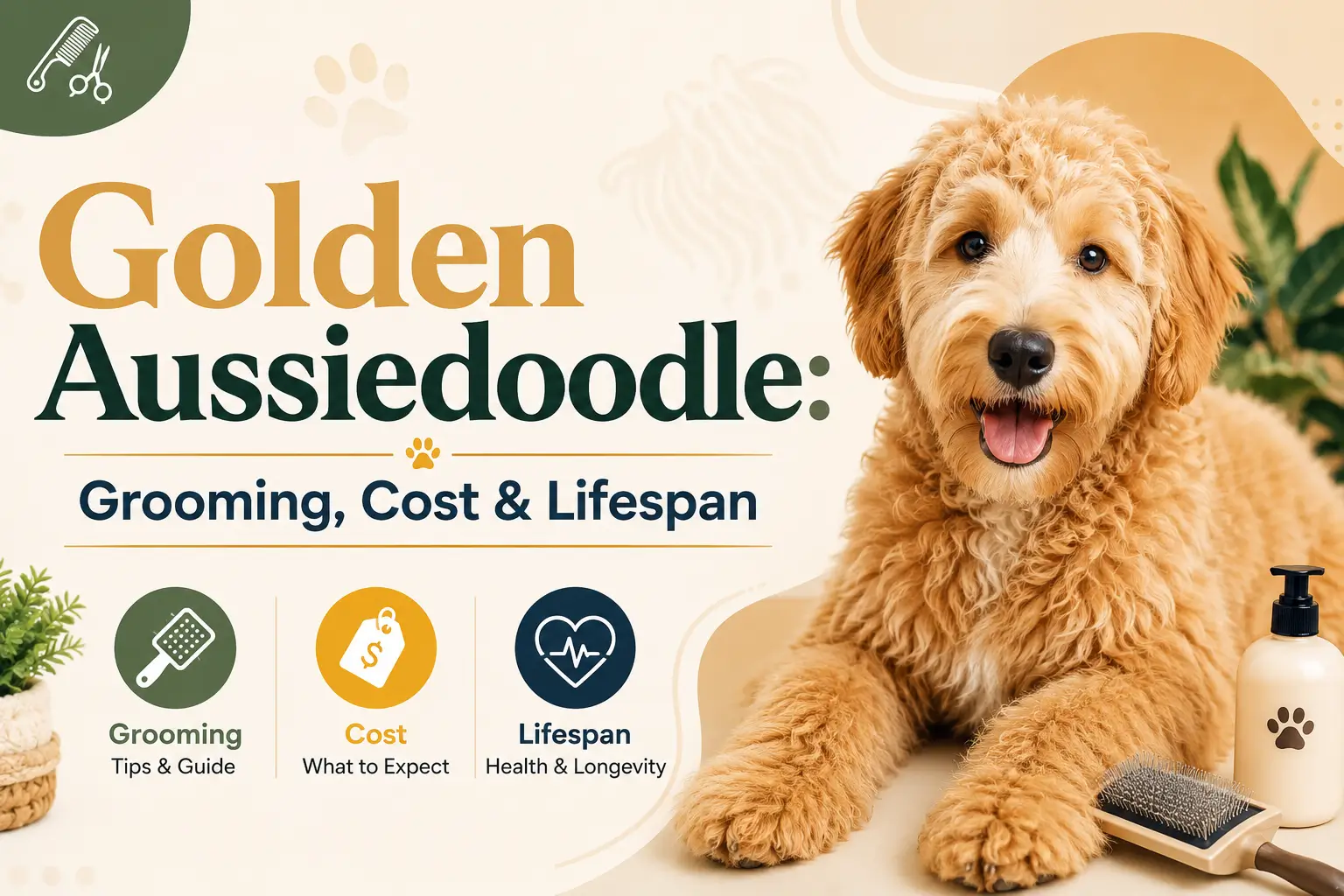
Golden Ozzy Doodle: Grooming, Cost & Lifespan

Introduction

A Golden Ozzy Doodle is a triple-cross hybrid: one Golden Retriever parent bred with one Aussiedoodle parent (itself a cross of Australian Shepherd and Poodle). The result is a dog that pulls coat, temperament, and health traits from three distinct breeds, which makes it more variable and more interesting than most single-cross Doodles.

If you want to know what that variability means for your grooming budget, your wallet, and your dog’s health over a 12-to-15-year life, this guide covers all three with real numbers and no marketing spin.

What Is a Golden Ozzy Doodle?

A Golden Ozzy Doodle is the offspring of a Golden Retriever and an Aussiedoodle. The Aussiedoodle parent is itself a cross between an Australian Shepherd and a Poodle — making the Golden Ozzy Doodle a three-breed combination in a single dog.

This matters more than it sounds. Unlike a standard F1 Aussiedoodle, where you’re blending two breeds, a Golden Ozzy Doodle introduces a third genetic pool.

That increases variability in size, coat type, shedding level, and even personality — sometimes dramatically, even within a single litter.

Parent Breeds at a Glance

Golden Retriever:

According to the American Kennel Club, Golden Retrievers typically weigh 55–75 pounds and live 10–12 years. They’re known for a dense, water-repellent double coat, high trainability, and a famously patient temperament.

Aussiedoodle:

An Aussiedoodle combines the Australian Shepherd (medium-sized, high-drive, herding intelligence) with the Poodle (low-shedding, highly trainable, comes in three sizes).

The resulting dog inherits traits from both sides — and the Poodle’s size (Toy, Miniature, or Standard) largely determines how big the Aussiedoodle, and therefore the Golden Ozzy Doodle, will grow.

How the Triple Cross Affects Size, Coat, and Temperament

Size in a Golden Ozzy Doodle is determined primarily by which Poodle size was used in the Aussiedoodle parent. A Mini Aussiedoodle bred with a Golden Retriever will produce a medium dog, roughly 30–50 pounds. A Standard Aussiedoodle cross can yield a dog in the 55–75 pound range, close to a full-sized Golden Retriever.

Coat and temperament are less predictable. The Golden Retriever adds a straight-to-wavy, higher-shedding coat tendency. The Australian Shepherd side may add merle coloring or the characteristic Aussie intensity.

The Poodle side pulls toward curl and lower shedding. Which traits dominate in any individual puppy is a function of which genes express — and that cannot be guaranteed at birth.

Golden Ozzy Doodle Coat Types and Grooming Schedule

Golden Ozzy Doodle Coat Types and Grooming Schedule

This is where the Golden Ozzy Doodle gets genuinely complicated — and where most breed guides fail you by oversimplifying.

The Three Coat Types This Cross Produces

The Golden Retriever’s influence pushes the coat toward straighter, denser, and higher-shedding. The Poodle’s influence pushes toward tighter curl and lower shed.

The Australian Shepherd side adds the possibility of a silky, medium-length flat coat. Depending on which genes express, a Golden Ozzy Doodle puppy can end up with one of three coat outcomes:

Wavy coat:

The most common outcome. Loose waves that sit between straight and curly. Moderate shedding. Requires brushing 3–4 times per week to prevent matting at the ears, armpits, and groin — the friction points.

Curly coat:

Tighter curls inherited from stronger Poodle expression. Lower shedding, closer to what allergy-sensitive owners are hoping for. Requires brushing every other day and professional grooming every 6–8 weeks, because curly hair traps debris and mats faster than it sheds.

Straight coat:

The least common, but it happens when the Golden Retriever coat genes dominate. Higher shedding than either wavy or curly. Easier to brush — a pin brush works fine — but this coat type is not allergy-friendly and requires more frequent vacuuming in your home.

Muhammad Rehan Iqbal, co-founder of Aussiedoodle.net and an owner who has raised Aussiedoodles across multiple life cycles, notes something that most breed guides won’t tell you: coat type within a single litter is not uniform.

Two littermates from the same Golden Ozzy Doodle parents can produce one wavy-coated puppy and one with a tighter curl — and their grooming needs over a lifetime will be meaningfully different. If you’re buying this dog partly for allergy reasons, selecting the puppy with the curliest coat in the litter gives you the best odds, but it is not a guarantee.

Ask the breeder to show you the coats of dogs they’ve produced in previous litters, not just the current one.

Weekly Grooming Routine — Tools and Steps

A slicker brush, a stainless steel greyhound comb, and a dematting comb are the three tools every Golden Ozzy Doodle owner needs. Here’s a reliable weekly routine for a wavy or curly coat:

  1. Start with the dematting comb on any friction zones — behind the ears, under the front legs, around the collar.
  2. Work through the entire body with the slicker brush in the direction of coat growth. Use short strokes, not long sweeping ones.
  3. Follow with the steel greyhound comb to catch anything the slicker brush missed. If the comb snags, there’s still a mat forming — go back to the dematting comb.
  4. Check paw pads for debris and trim hair between the pads every 2–3 weeks.
  5. Check ears weekly. Doodle-mix ears trap moisture and are prone to infection. Wipe with a vet-approved ear cleaner — ask your veterinarian to recommend a specific product at your first visit.
  6. Brush teeth at minimum twice weekly. Dental disease is one of the most preventable chronic conditions in dogs.
  7. Trim nails every 3–4 weeks or when you hear clicking on hard floors.

Professional Grooming: Frequency and Cost

A Golden Ozzy Doodle with a wavy or curly coat needs professional grooming every 6–8 weeks to prevent the coat from matting beyond what home brushing can manage. Straight-coated dogs can stretch to every 10–12 weeks with consistent brushing.

Professional grooming for a medium-to-large Doodle-type dog typically runs $65–$120 per session, depending on coat condition, region, and whether the dog is well-brushed when it arrives. A matted dog takes longer and costs more — some groomers charge a dematting fee on top of the standard rate.

At 6–8 sessions per year, that’s $390–$960 annually in professional grooming alone. This is a real ownership cost that almost no breed marketing page discloses. Budget for it before you buy.

How Much Does a Golden Ozzy Doodle Cost?

Puppy Purchase Price — What Drives the Range

Golden Ozzy Doodle puppies from reputable breeders who health-test their parent dogs typically sell for $1,500–$3,500. Several factors move the price within that range:

  • Poodle size used: Mini crosses command a premium because they’re harder to produce and smaller dogs are in higher demand in urban markets.
  • Coat color: Merle-patterned puppies, which can appear when the Australian Shepherd side expresses strongly, often carry a price premium of $200–$500 over non-merle littermates.
  • Generation: F1B puppies (where the Aussiedoodle parent is bred back to a Poodle) tend to cost more because the F1B generation more reliably produces the low-shedding curl that buyers want.
  • Health testing: Breeders who run OFA hip and elbow screenings, eye clearances, and MDR1 gene testing on parents charge more — and should. You’re paying for reduced risk, not just a document.

Prices above $3,500 are not automatically a sign of higher quality. Prices below $1,000 for a “health-tested” Golden Ozzy Doodle should prompt serious questions about what testing was actually done.

First-Year Ownership Costs — Broken Down

The purchase price is the beginning, not the total cost. A realistic first-year budget for a Golden Ozzy Doodle:

Cost Category Estimated Range
Puppy purchase price $1,500–$3,500
Spay/neuter (if not included) $200–$500
First-year veterinary visits (vaccines, parasite prevention, wellness) $300–$700
Food (high-quality dry kibble, medium-large dog) $400–$700/year
Professional grooming (6–8 sessions) $390–$960/year
Grooming tools (one-time startup) $60–$120
Crate, bed, leash, collar, bowls $150–$300
Training classes (strongly recommended for this breed) $150–$300
First-year total $3,150–$7,080

Annual Recurring Costs After Year One

After the one-time startup costs, expect to spend $1,500–$3,000 per year on a healthy Golden Ozzy Doodle. That includes food, grooming, routine vet care, and parasite prevention. Pet insurance is worth considering — monthly premiums for a medium-large Doodle-type dog typically run $40–$80, and a single orthopedic surgery (which Golden Retrievers are predisposed to) can run $3,000–$6,000 out of pocket.

Golden Ozzy Doodle Lifespan and Health Considerations

Expected Lifespan — What the Parent Breed Data Tells Us

There is no breed-specific longevity study on the Golden Ozzy Doodle yet — the hybrid is too new and too small in population. What we can do is look at the three parent breeds and reason from there:

  • Golden Retriever: 10–12 years (AKC)
  • Australian Shepherd: 12–15 years (AKC)
  • Poodle: 10–18 years depending on size — Toy Poodles live significantly longer than Standards (AKC)

A reasonable working estimate for a Golden Ozzy Doodle is 12–14 years, weighted toward the middle of these ranges. Hybrid vigor — the tendency of crossbred dogs to outlive purebred parents — may push this slightly higher, but hybrid vigor is not a guarantee and is not evenly distributed across all genetic combinations.

Health Conditions to Know Before You Buy

The Golden Retriever parent brings elevated risk for:

  • Hip and elbow dysplasia — Golden Retrievers have among the highest rates of hip dysplasia of any breed, per OFA data. Responsible breeders screen parent dogs.
  • Cancer — Golden Retrievers have an unusually high cancer rate. A 2015 Morris Animal Foundation study found that approximately 60% of Golden Retrievers die from cancer. This risk is diluted in a triple cross but not eliminated.
  • Heart disease (subvalvular aortic stenosis) — A congenital condition more common in Golden Retrievers than in most breeds.

The Australian Shepherd parent brings risk for:

  • Eye conditions — Collie Eye Anomaly (CEA) and Progressive Retinal Atrophy (PRA) are heritable conditions in Australian Shepherds. CAER (Companion Animal Eye Registry, administered by OFA) certification on parent dogs is the minimum standard.
  • Epilepsy — Australian Shepherds have an elevated incidence of hereditary epilepsy.
  • MDR1 gene mutation — detailed in the next section.

The MDR1 Gene Mutation — What Every Owner of a Herding-Mix Dog Must Know

The MDR1 mutation (technically a variant in the ABCB1 gene) is present in a significant percentage of Australian Shepherd-lineage dogs. Dogs carrying this mutation have increased sensitivity to certain common medications — including ivermectin (found in some heartworm preventatives), loperamide (Imodium), and several chemotherapy drugs.

In affected dogs, these drugs can cross the blood-brain barrier and cause neurological toxicity, including seizures and death.

The Washington State University Veterinary Clinical Pharmacology Lab (vcpl.wsu.edu) maintains the definitive list of affected drugs and the genetic test for MDR1 status. Testing costs approximately $70 and can be done with a cheek swab at home.

Before your Golden Ozzy Doodle receives any medication, your veterinarian should know the dog’s MDR1 status. If the breeder has not tested the parents, test your dog before its first heartworm preventative.

Ask your breeder directly: “Have both parents been MDR1 tested?” A breeder who cannot answer that question is not health-testing comprehensively.

Golden Ozzy Doodle vs. Aussiedoodle — What’s the Difference?

If you’re already on Aussiedoodle.net, there’s a good chance you’re deciding between these two. Here’s a direct comparison:

Trait Aussiedoodle Golden Ozzy Doodle
Parent breeds Australian Shepherd + Poodle Golden Retriever + Aussiedoodle
Typical size (standard) 40–70 lbs 45–75 lbs
Coat shedding Low to moderate (varies by generation) Moderate (Golden Retriever influence increases shed risk)
Temperament High-drive, loyal, can be intense Slightly softer temperament due to Golden Retriever influence
Trainability Very high Very high
Grooming burden Moderate to high Moderate to high — similar, with slightly more shed to manage
Health risks MDR1, eye conditions, hip dysplasia All Aussiedoodle risks + elevated cancer risk from Golden Retriever side
Typical price $1,200–$3,000 $1,500–$3,500

The core difference:

The Golden Retriever’s contribution softens the Australian Shepherd’s intensity and adds a warmer, more easy-going quality to the temperament — but it also adds a denser, higher-shedding coat and an elevated cancer risk. Neither dog is better or worse. They’re different. If you want a slightly less intense dog and you’re comfortable with the grooming reality of a Golden-influenced coat, the Golden Ozzy Doodle makes sense. If you prefer a slightly lighter coat burden and don’t mind the Aussie’s edge, a standard Aussiedoodle is the cleaner choice.

Is a Golden Ozzy Doodle Hypoallergenic?

Is a Golden Ozzy Doodle Hypoallergenic?

No dog is truly hypoallergenic — this is a settled scientific point, not a debate. The allergen that triggers reactions in most dog-allergic people is Can f 1, a protein found in dog saliva, urine, and dander. It is present in all dogs. What varies is how much each dog produces and how much of it ends up airborne in your home.

Low-shedding dogs like Poodles and Poodle-heavy crosses deposit less dander-coated hair into the environment, which often reduces allergic reactions — but they do not eliminate them. Some allergy-sensitive people do well with a curly-coated Doodle. Others react regardless of coat type.

The honest answer for a Golden Ozzy Doodle:

The Poodle genetics in the Aussiedoodle parent pull toward lower shedding. The Golden Retriever parent pulls in the opposite direction. A curly F1B Golden Ozzy Doodle (where the Aussiedoodle parent was F1B) is the best-odds option for someone with mild dog allergies.

A straight-coated or wavy-coated individual from this cross is not a good fit for anyone with significant dog allergies.

Original opinion:

The Doodle industry has oversold hypoallergenicity to the point of causing real harm — people buy a $2,500 dog based on this promise, develop reactions, and the dog ends up in rescue.

If you have serious dog allergies, spend $30 on an allergy test before spending thousands on a puppy. That’s not a negative statement about this breed — it’s a responsible one.

Temperament and Daily Life With a Golden Ozzy Doodle

Energy Level and Exercise Needs

A Golden Ozzy Doodle is not a low-maintenance dog in terms of time. Australian Shepherds were bred to work all day. Poodles are high-energy sporting dogs. Golden Retrievers are active, athletic dogs. All three parent lines are working or sporting breeds. The result is a dog that needs real exercise — not a walk around the block.

Plan for 60–90 minutes of active exercise daily. That includes off-leash running, fetch, swimming, or structured play — not just walking. Mental stimulation matters as much as physical exercise for this cross. A bored Golden Ozzy Doodle will find its own entertainment, and it will not be the entertainment you’d have chosen.

Separation Anxiety — An Honest Assessment

This is the part of the temperament picture that enthusiast breed pages tend to skip. Golden Retrievers are deeply social and bond intensely to their families. Australian Shepherds were bred to work alongside a handler constantly. Both traits combine to produce a dog with a high potential for separation anxiety when left alone for long periods.

Golden Ozzy Doodles are not ideal for households where both adults work full days in an office and the dog would be alone for 8–10 hours. If that’s your situation, a dog walker, daycare, or a second dog are worth budgeting for — and should be part of your cost calculation before you buy.

This dog is a strong fit for: active households, families with someone home regularly, homes with large outdoor space, owners who work from home, or people who can commit to the exercise and social contact the dog needs.

This dog is a harder fit for: apartment dwellers without yard access, people new to high-drive dogs, households with very long daily absences, or anyone who underestimates grooming time and cost.

FAQs

How big does a Golden Ozzy Doodle get?

Size depends primarily on the Poodle used in the Aussiedoodle parent. A Miniature Poodle cross produces a medium-sized dog of roughly 30–50 pounds. A Standard Poodle cross yields 55–75 pounds, close to a full-sized Golden Retriever. There is no “Mini Golden Ozzy Doodle” standardization — always ask the breeder which Poodle size was used and what their adult dogs from previous litters actually weigh.

Do Golden Ozzy Doodles shed?

Yes, to varying degrees depending on coat type. Curly-coated individuals shed the least. Wavy-coated dogs shed moderately. Straight-coated dogs shed more heavily — comparable to a Golden Retriever. No Golden Ozzy Doodle is zero-shed. If shedding is a dealbreaker, ask to see the coat type on both the Aussiedoodle parent and the puppy’s littermates before committing.

Are Golden Ozzy Doodles good with kids?

Generally yes. The Golden Retriever’s patient, gentle temperament and the Poodle’s trainability both work in favor of family compatibility. The Australian Shepherd side occasionally introduces a herding instinct — some individuals will attempt to herd small children by nipping at heels. Consistent socialization and training from puppyhood manages this effectively. As with any breed, no dog should be left unsupervised with young children.

What health tests should a Golden Ozzy Doodle breeder perform?

At minimum, a responsible breeder should provide: OFA hip and elbow evaluation on both parent dogs, CAER eye certification (for the Australian Shepherd line), MDR1/ABCB1 gene testing on both parents, and cardiac clearance on the Golden Retriever parent (due to subvalvular aortic stenosis risk). Ask for documentation, not verbal assurance. The OFA public database (ofa.org) allows you to verify most clearances by registered name.

Leave a Comment